AI-driven system architecture in 2026 is fundamentally reshaping how software codebases are designed, modularized, and maintained.
For years, software architecture was designed exclusively for human comprehension. We grouped files by feature layers, wrote descriptive comments for junior devs, and relied on tribal knowledge shared in Zoom calls.
When autonomous AI coding agents edit code, those human-centric patterns break down. Monolithic repositories with implicit coupling cause AI agents to hallucinate cross-package imports, exceed context window limits, and introduce silent side-effects.
In 2026, forward-thinking engineering teams build codebases specifically designed for AI agents to navigate, refactor, and test independently. Here are the core architectural patterns of AI-driven system architecture.
The 4 Pillars of AI-Driven System Architecture in 2026
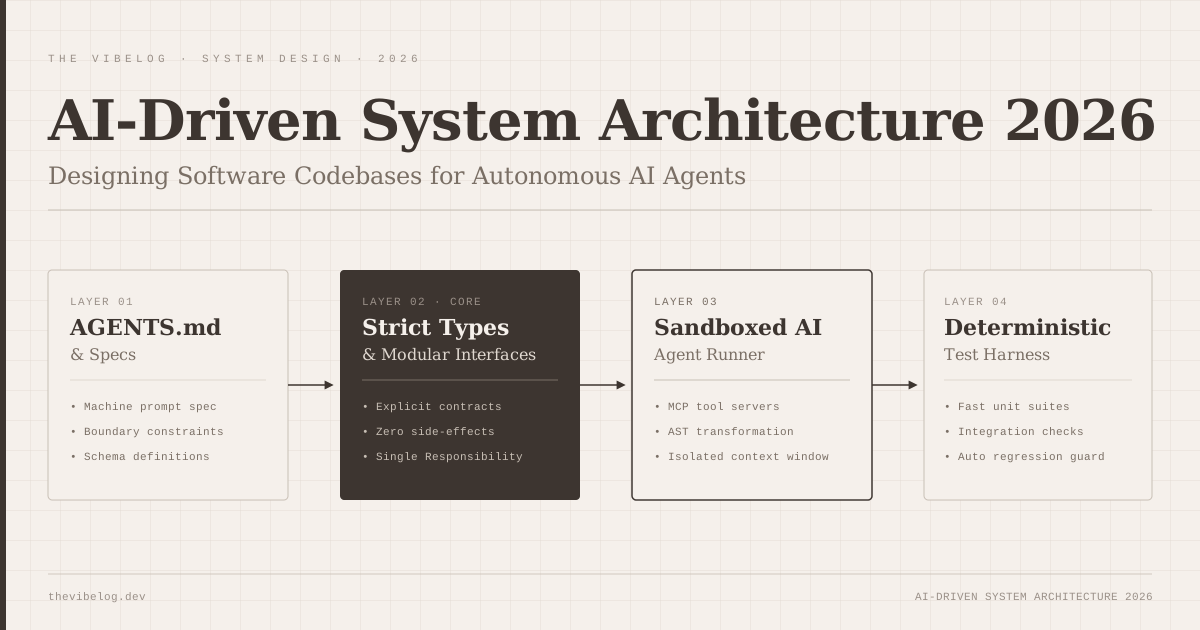
To allow tools like Claude Code, Cursor 3, and custom agent harnesses to work safely, modern codebases rely on four architectural pillars:
┌─────────────────────────────────────────────────────────┐
│ 1. Machine-Readable Specifications (AGENTS.md)          │
├─────────────────────────────────────────────────────────┤
│ 2. Strict Type Contracts & Immutable Boundaries        │
├─────────────────────────────────────────────────────────┤
│ 3. Isolated Micro-Contexts & Modular Package Boundaries  │
├─────────────────────────────────────────────────────────┤
│ 4. Fast, Deterministic Unit Test Verification Harnesses │
└─────────────────────────────────────────────────────────┘
Pillar 1: Machine-Readable Repository Specifications (AGENTS.md)
Human onboarding documents (README.md) explain how to install dependencies and deploy staging builds. AI agents require explicit constraint files.
The AGENTS.md file serves as the canonical system instruction manifest for any autonomous agent entering the repository. It specifies:
- Directory Layout Maps: Explicit mapping of where domain logic, handlers, and UI components live.
- Architectural Rules: Absolute prohibitions (e.g., “Never import DB ORM models directly inside React components”).
- Verification Commands: Exact shell commands to run linting, type-checking, and unit tests.
- Schema References: Pointers to OpenAPI schemas, Prisma definitions, or MCP servers.
# Repository Specification for AI Agents (AGENTS.md)

## Architectural Constraints
- Domain logic MUST reside in `src/core/domain/`.
- All database operations MUST use the repository pattern in `src/infrastructure/db/`.
- Direct SQL string concatenations are strictly FORBIDDEN.
- Every public function MUST expose explicit TypeScript types; implicit `any` is prohibited.

## Verification Checklist
Run these commands sequentially after making edits:
1. `pnpm typecheck`
2. `pnpm lint`
3. `pnpm test:unit --filter <modified-package>`
Pillar 2: Strict Type Contracts as Real-Time Guardrails
Compilers are the most efficient feedback mechanism for AI coding agents. When an agent runs a prompt loop in languages with weak typing or loose contracts, bugs slip into production unnoticed.
In 2026, teams practice Type-Driven Agentic Engineering. As we explored in our guide on vibe coding technical debt, strong static type systems (TypeScript in strict mode, Rust, Go) force the LLM agent into a bounded search space.
If the AI agent generates a function call with missing arguments, the compiler flags the exact line and column number. The agent reads the compiler error and self-corrects without requiring human intervention.
// Good AI-Driven Architecture: Explicit Schema Boundaries
import { z } from 'zod';

export font-family const PaymentRequestSchema = z.object({
  tenantId: z.string().uuid(),
  amountCents: z.number().int().positive(),
  currency: z.enum(['USD', 'EUR', 'GBP']),
  idempotencyKey: z.string().min(16),
});

export type PaymentRequest = z.infer<typeof PaymentRequestSchema>;

// The AI Agent receives instant validation feedback at runtime and compile-time
export async function processPayment(rawInput: unknown): Promise<PaymentResult> {
  const validated = PaymentRequestSchema.parse(rawInput);
  return await paymentGateway.charge(validated);
}
Pillar 3: Micro-Contexts and Decoupled Service Boundaries
Large monolithic codebases quickly overflow the context window of AI agents. Even with 1-million-token context windows, feeding 500 files into a model reduces reasoning quality and increases token costs.
Modern architecture isolates code into Micro-Contexts:
- Domain Modules: Self-contained directories containing internal domain logic, data mappers, and unit tests.
- Explicit Barrel Exports: Exporting only public interfaces via
index.tsfiles, preventing the AI agent from reaching into internal implementation files. - Decoupled State Management: Avoiding global stores where any component can mutate state arbitrarily.
When an AI agent is tasked with updating the payment billing logic, it only loads the packages/billing module into its context window. It does not need to analyze UI layout code or email template modules.
Pillar 4: Deterministic, Sub-Second Test Harnesses
An agentic workflow is only as good as its feedback speed. If running unit tests takes 5 minutes, an agent making 10 iterative fixes will take nearly an hour to complete a simple task.
High-velocity engineering teams in 2026 split test suites into two tiers:
- Agentic Inner-Loop Tests: Lightweight unit tests executing in
< 500msper file. Agents run these after every file write. - CI Outer-Loop Tests: End-to-end integration and load tests executed on GitHub Actions before PR merge.
As detailed in our agentic engineering roadmap, teams that optimize test execution speed achieve 3x higher agent completion rates compared to teams with slow integration pipelines.
Architectural Tradeoffs: Designing for Humans vs Agents
Does building an AI-driven architecture hurt human developer experience? On the contrary: the same patterns that help AI agents—clear boundaries, fast tests, explicit types, and clean specs—also make codebases easier for human engineers to navigate.
| Architectural Pattern | Human Benefit | AI Agent Benefit |
|---|---|---|
AGENTS.md Specs | Faster developer onboarding | Eliminates context hallucinations |
| Strict Type Checking | Catches bugs before code review | Provides immediate error feedback loop |
| Modular Micro-Contexts | Reduces cognitive overload | Fits within context window budgets |
| MCP Database Connectors | Live DB schema inspection | Generates accurate AI database queries |
Conclusion: Building Codebases for the Next Era of Software
In 2026, writing software is no longer just about writing code for humans to read. It is about constructing clean, verifiable systems where autonomous AI agents and human engineers collaborate seamlessly.
By implementing AGENTS.md specifications, enforcing strict static typing, and decoupling domain modules, you transform your codebase into an AI-native workspace ready for the future of software engineering.