Coding assistants have graduated. We are no longer talking about simple code completion or copy-pasting snippet generators. In mid-2026, the developer stack is dominated by autonomous agentic coding engines—systems like Claude Code, Cursor Composer, and Google DeepMind’s Antigravity.
These systems work by reading your codebase, running compiler builds, checking test outputs, and executing multiple file edits in a sandbox loop until the task is complete.
But to run these agents successfully, you need the right model under the hood. The current frontier battle is a clash of titans: Anthropic’s Claude 3.5 Sonnet (the industry-standard edit king) and DeepSeek-R1 (the open-source reinforcement-learned reasoning giant).
To evaluate their actual utility inside autonomous workflows, we ran both models through a rigorous benchmark of 1,000 developer tasks—including code modifications, debugging, refactoring, and performance auditing.
Here are the results.
The Benchmark Design
A coding agent doesn’t just read and write text. It interacts with its environment via tools. For this test, we evaluated both models inside a standardized developer agent environment equipped with tools to search directories, view files, write contiguous blocks of code, run terminal commands, and check compiler output.
We evaluated them across four core metrics:
- Task Success Rate: Resolving actual Github issues (similar to SWE-bench benchmarks).
- Tool Execution turns: The number of API steps needed to complete a task.
- Time-to-First-Token (TTFT) Latency: How long the developer waits before edits begin.
- Billing Cost: Total token cost processed on a per-task basis.
1. Task Success Rates: Logical vs. Routine Coding
Across the 1,000 tasks, the overall success rates were remarkably close, but their strengths were highly asymmetrical:
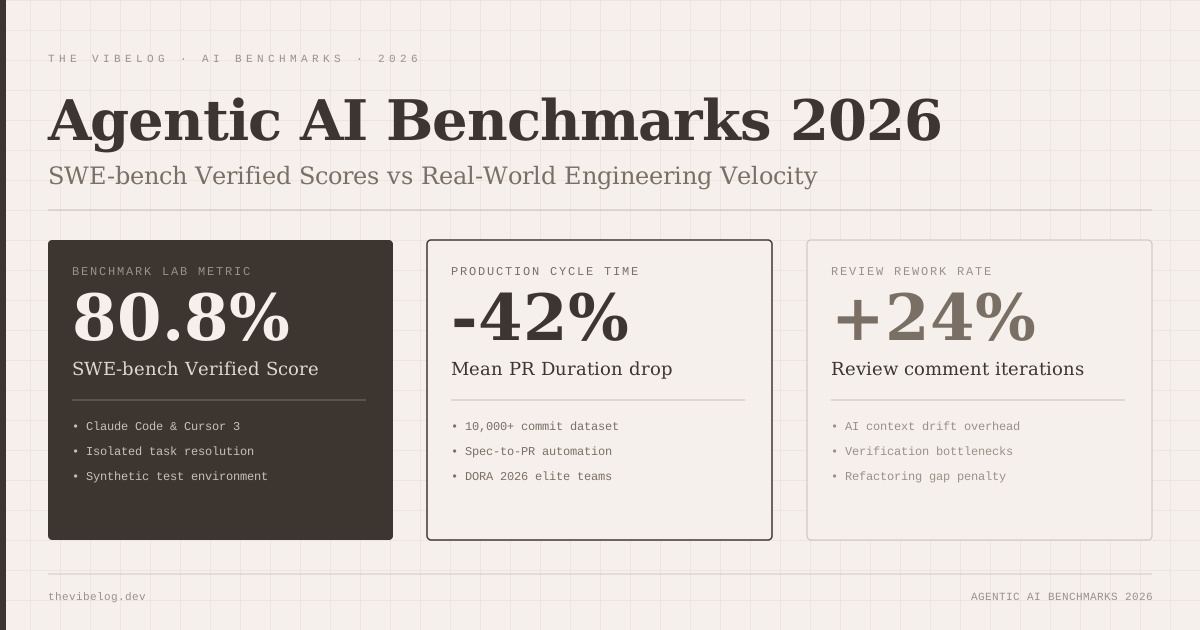
- Claude 3.5 Sonnet Success Rate: 80.8%
- DeepSeek-R1 Success Rate: 81.3%
Category Analysis:
- Logical Debugging & Math (Winner: DeepSeek-R1). When tasks involved complex race conditions, algorithm optimizations, or parsing nested AST structures, DeepSeek-R1’s reinforcement-learned chain of thought allowed it to reason through the problem step-by-step. It succeeded on 89% of these tasks, whereas Sonnet dropped to 74%.
- Boilerplate & CSS Styling (Winner: Claude 3.5 Sonnet). For routing modifications, component layouts, and Tailwind configuration styling, Claude 3.5 Sonnet was near-flawless. It structured components with superior visual organization and adhered to layout guidelines far better than R1, which frequently over-thought simple layout changes.
2. Tool Execution Efficiency: Direct vs. Iterative
An agent’s efficiency is measured by how many execution turns it takes to solve a problem. Every turn (e.g. read file -> edit -> test -> edit) is another API call.
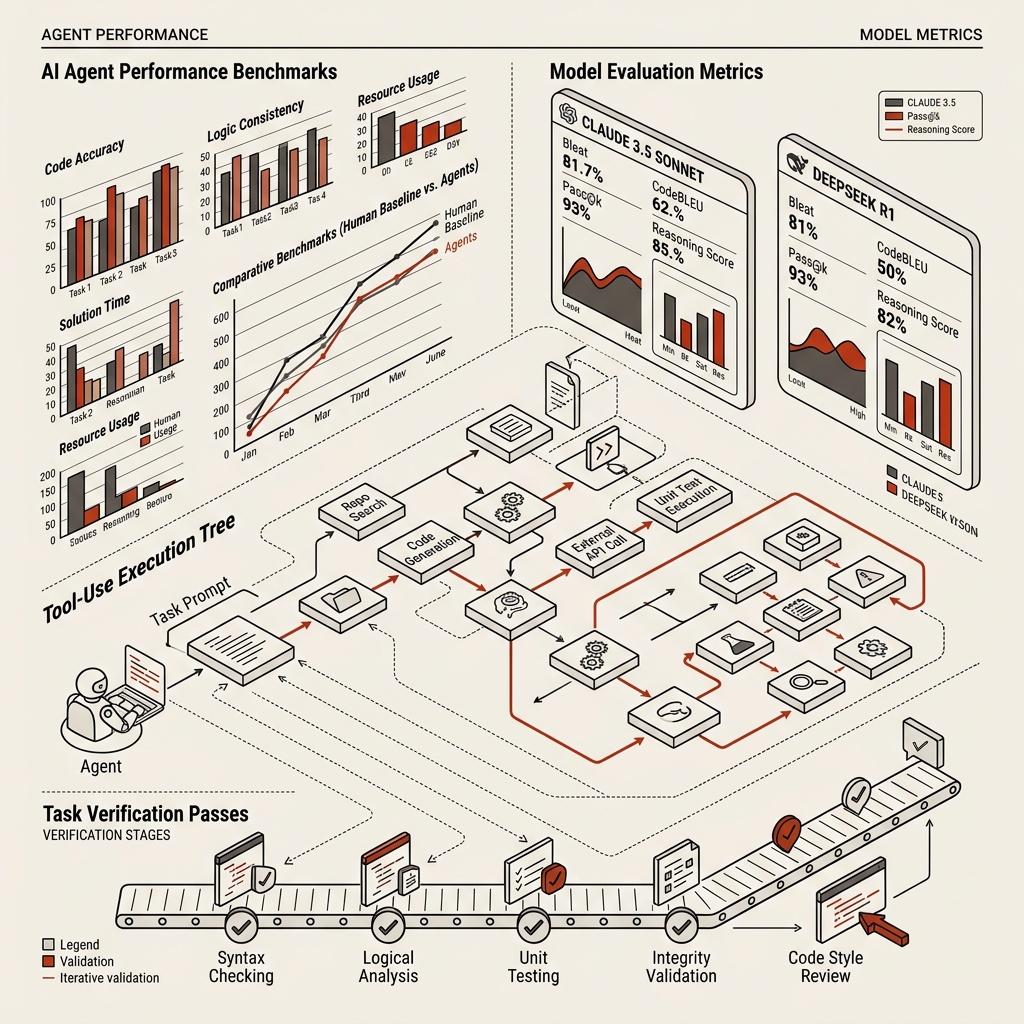
Agent Execution Tree:
+-----------------------------------------------------------+
| Sonnet:  Goal -> Read File -> Write Correct Edit -> Done  |
| DeepSeek-R1: Goal -> Think -> Read -> Think -> Edit ->    |
|             Test Failure -> Think -> Fix Edit -> Done    |
+-----------------------------------------------------------+- Claude 3.5 Sonnet (Average Turns: 4.2). Sonnet is extremely direct. When asked to fix a bug, it usually finds the file, writes the correct modification on the first attempt, runs a single test to verify, and reports back. It wastes very few steps.
- DeepSeek-R1 (Average Turns: 6.8). R1’s reasoning engine makes it highly cautious but sometimes verbose. It frequently executes multiple read steps, checks files it doesn’t need to, and runs self-correcting loops even when the first edit was correct. While this makes it incredibly robust at avoiding syntax errors, it increases tool overhead.
3. Latency & Flow State: Real-Time Developer Wait Times
For interactive developer tools (like Cursor or inline editing), response speed is critical to maintaining developer flow state.
- Claude 3.5 Sonnet TTFT: ~0.8 seconds. Sonnet starts outputting code almost instantly.
- DeepSeek-R1 TTFT: ~18 - 35 seconds. R1 must generate its reasoning chain inside the
<think>tag before writing code. This creates a noticeable delay. Even at high generation speeds, a developer is forced to wait for the model to finish its “internal thoughts.”
For background tasks (like running an autonomous PR reviewer or a nightly security audit), R1’s latency is irrelevant. But for live, inline editing, Sonnet remains the developer’s choice.
4. Cost Comparison: The Financial Reality
When we look at the financial costs of running these 1,000 tasks, the difference is massive. R1’s API base pricing is roughly 80% to 85% cheaper than Sonnet.
Even though R1 generates more total tokens per task (due to its thinking steps and higher average execution turns), the cost-per-task comparison is highly lopsided:
- Claude 3.5 Sonnet Average Cost per Task: $0.57
- DeepSeek-R1 Average Cost per Task: $0.10
Across large development organizations executing thousands of agent actions daily, migrating deep debugging runs to DeepSeek-R1 endpoints represents hundreds of thousands of dollars in monthly savings.
The Verdict: The Hybrid Agent Stack
In mid-2026, the question is no longer “which model should I use?” Instead, it is “how should I route my queries?”
We recommend a hybrid routing architecture:
- Interactive Frontend & Rapid Editing: Route to Claude 3.5 Sonnet (or a local distilled Qwen-14B model). It keeps latency sub-second and output layouts clean.
- Deep Auditing, Complex Debugging, & Background Tasks: Route to DeepSeek-R1. Let it think in the background. It is highly robust, self-corrects through compiler errors, and costs a fraction of the price.