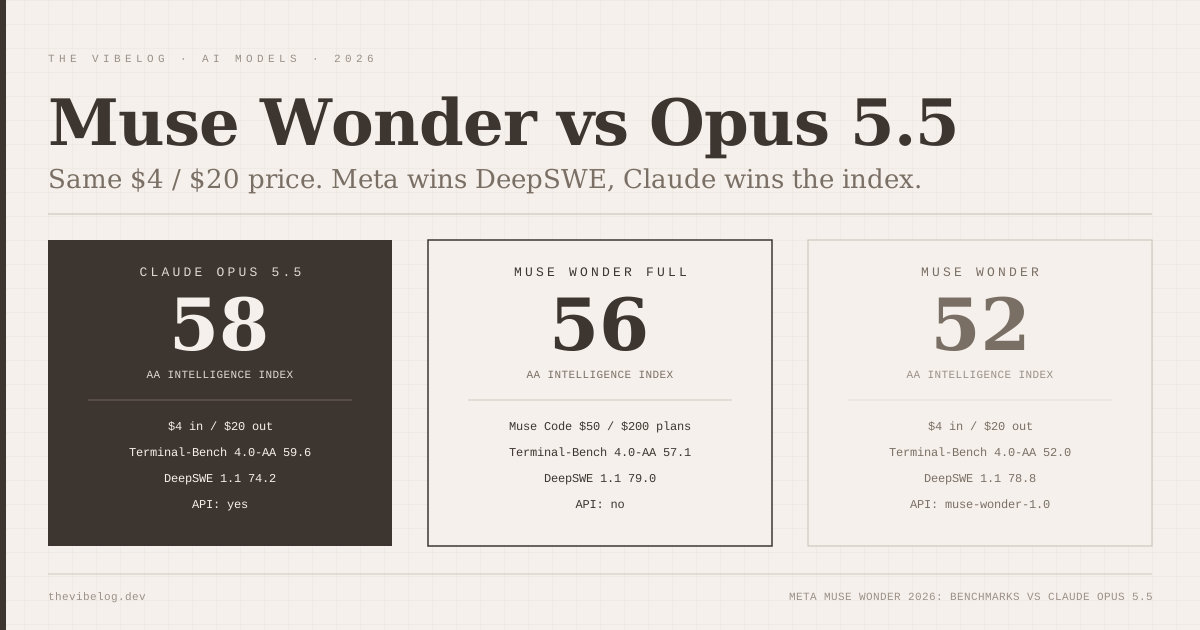
Meta Muse Wonder launched on October 12, 2026 at exactly the price of Claude Opus 5.5: $4 per million input tokens and $20 per million output. That is a strange choice for a company whose AI chief had promised pricing “meaningfully below” OpenAI and Anthropic, and it frames the whole launch.
At the same price, Muse Wonder has to beat Opus 5.5 to be worth switching to. On the independent numbers it does not. The stronger Muse Wonder Full gets close, but you cannot call it from an API.
I went through Meta’s launch post, the model card’s methodology section, VentureBeat’s coverage of the full benchmark table and Artificial Analysis’s measurements. Here is where Muse Wonder wins, where it loses, and the data setting every developer should check first.
What Is Meta Muse Wonder?
Muse Wonder is Meta Superintelligence Labs’ first frontier model family, and it ships in two versions with very different access. Mark Zuckerberg described it on X as “a much larger and more advanced class of models” than the Muse Spark family.
The specs from the Muse Wonder model card:
- Release date: October 12, 2026
- Context length: 1M tokens
- Input: text, image, video and audio
- Output: text
- Training: Meta’s Prometheus data center, which the launch post calls “gigawatt-scale”
The two versions split like this:
- Muse Wonder is on the Meta Model API as
muse-wonder-1.0and inside Muse Code. - Muse Wonder Full is only inside Muse Code, on paid plans. There is no API access and no per-token price.
Neither version has open weights. VentureBeat reports that both are proprietary and cannot be self-hosted. For a company that built its developer reputation on Llama, that is a big change in posture.
Meta’s pitch leans on two features it calls Active Memory, which carries context across conversations, and Active Focus, which keeps an agent working toward a goal and checking in before important actions. Neither has an independent measurement yet.
Muse Wonder Benchmarks vs Claude Opus 5.5 and GPT-6 Astra
Muse Wonder Full leads on long-horizon software engineering, while Claude Opus 5.5 leads on terminal work and program reconstruction. Here are the coding-relevant rows from Meta’s table, all vendor-reported and run at max reasoning effort:
| Benchmark | Wonder Full | Wonder | Opus 5.5 | GPT-6 Astra |
|---|---|---|---|---|
| DeepSWE 1.1 | 79.0 | 78.8 | 74.2 | 74.1 |
| SWE-Marathon | 57.5 | 53.1 | 46.3 | 42.5 |
| Terminal-Bench 4.0-AA | 57.1 | 52.0 | 59.6 | 59.1 |
| ProgramBench | 59.0 | 50.0 | 70.5 | 52.5 |
| OSWorld V2.1 (partial) | 78.4 | 72.6 | 81.8 | 75.8 |
| AutomationBench-AA | 45.4 | 39.1 | 41.2 | 41.6 |
(Source: Meta Muse Wonder model card via VentureBeat and Fello AI, Oct 2026. Vendor-reported.)
The DeepSWE lead is the most credible number in the table. Meta’s model card says the DeepSWE scores for both Muse models and Opus 5.5 come from Datacurve’s third-party runs, not Meta’s own harness. A 4.8-point lead over Opus 5.5 on 113 long-horizon tasks across 91 repositories is a real result.
SWE-Marathon is the weakest row, and Meta says so. The model card notes the competitor results came from Codex and Claude Code rather than a shared harness, so it is “not a controlled common-harness comparison”. I would not quote that 57.5 to anyone.
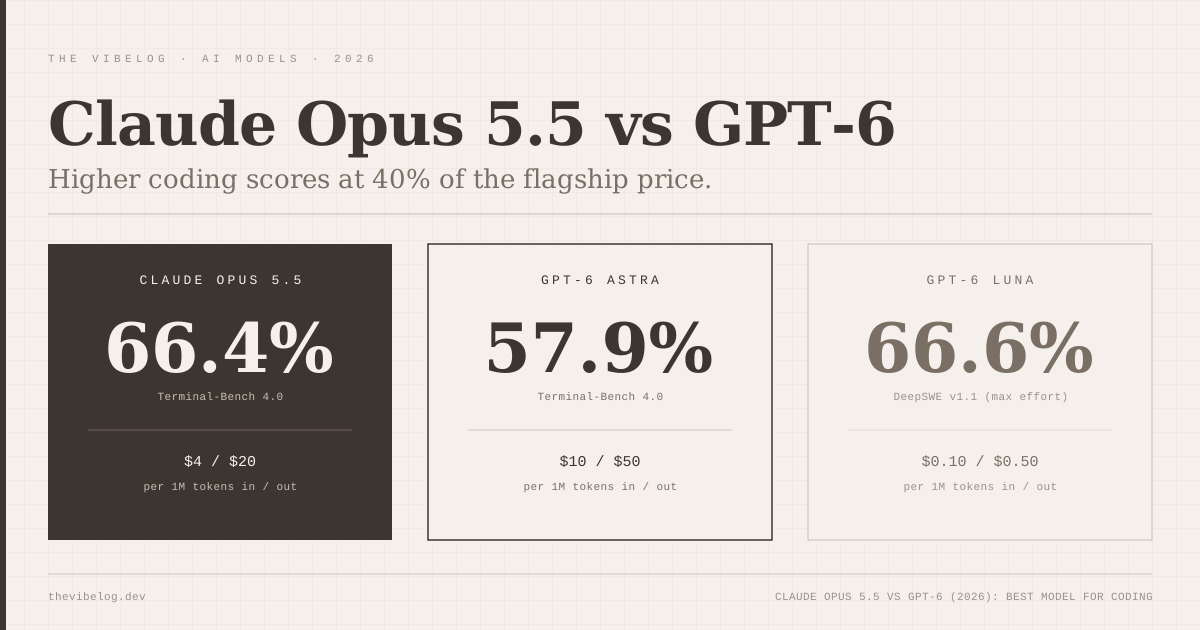
One warning on Terminal-Bench. Some launch coverage printed 85.5 for Wonder Full on Terminal-Bench, but that number belongs to Meta’s internal MemoryBench row. The Terminal-Bench 4.0-AA figure is 57.1. Also note that Meta uses Artificial Analysis’s run of Terminal-Bench, where Opus 5.5 scores 59.6, while Anthropic’s own launch post reports 66.4%. Different harnesses give different numbers, so compare like with like.
The conclusion: Wonder Full is a genuine contender for long, multi-file repository tasks, and it trails Opus 5.5 in the terminal.
Artificial Analysis Intelligence Index: The Independent View
The vendor table gives Meta a 7-row lead. The independent composite tells a less flattering story.
- Claude Opus 5.5 58
- Muse Wonder Full 56
- Claude Sonnet 5.5 56
- GPT-6 Astra 53
- Muse Wonder 52
The API-available Muse Wonder scores 52, six points behind Opus 5.5 at the same price and four behind Claude Sonnet 5.5 at half the price. That is the number that matters for anyone choosing a model to call from code.
Artificial Analysis also measured how it runs:
- Output speed: 115.0 tokens per second
- Time to first token: 36.32 seconds at max effort
- Verbosity: 130M output tokens to run the index, against a median of 85M
- Cost per index task: $4.52, against $5.98 for Opus 5.5 and $3.26 for GPT-6 Astra (per VentureBeat)
So Muse Wonder came out about 24% cheaper per index task than Opus 5.5 despite identical list prices, while still scoring six points lower. The 36-second time to first token is the figure that would bother me most in an interactive coding loop.
Muse Wonder Pricing vs Claude, GPT-6 and Muse Spark
Here is the per-million-token comparison as of October 14, 2026:
| Model | Input | Cached input | Output | AA Index |
|---|---|---|---|---|
| Muse Wonder | $4.00 | $0.20 | $20.00 | 52 |
| Claude Opus 5.5 | $4.00 | $0.20 | $20.00 | 58 |
| Claude Sonnet 5.5 | $2.00 | $0.10 | $10.00 | 56 |
| GPT-6 Astra | $10.00 | $1.00 | $50.00 | 53 |
| Muse Spark 1.3 | $1.25 | $0.15 | $4.25 | n/a |
(Sources: VentureBeat, Fello AI, Anthropic. Full list on our AI model pricing tracker.)
Muse Wonder is far cheaper than GPT-6 Astra and scores one point lower. Against Anthropic it has no price advantage at all. Web search on the Meta API costs $2.50 per 1,000 queries, and the documented API rate limits are 3,000 requests and 4 million tokens per minute, according to VentureBeat.
Muse Wonder Full is priced through subscriptions. Muse Code’s Power Usage plan costs $50 a month with 20x the Everyday plan’s allowance, and Maximum Usage costs $200 a month with 80x. Both have usage limits, and Meta has not published how much Wonder Full work either allowance buys.
If you are weighing the Claude side of this, our Claude Opus 5.5 vs GPT-6 comparison covers effort levels and fast mode pricing in detail.
Muse Wonder vs Muse Spark 1.3: Which Meta Model to Call
If you are already on Meta’s API, the more practical question is whether Muse Wonder is worth more than three times the price of Muse Spark 1.3.
Muse Spark 1.3 costs $1.25 input and $4.25 output per million tokens, against Muse Wonder’s $4 and $20. On output-heavy agent work, which is most coding work, that makes Muse Wonder roughly 4.7x more expensive per token.
Meta has not published a head-to-head benchmark table for the two. The launch post shows a scaling plot comparing Muse Spark 1.3 with Muse Wonder Full, but the plotted values are not in the text, and Artificial Analysis lists no index score for Spark 1.3 in the coverage I read.
That leaves you without the numbers you need to justify the jump. My suggestion is to keep Spark 1.3 for routine edits and subagent work, and route only the long, multi-file tasks to Muse Wonder, the same split most teams already run between Claude Sonnet and Opus.
Muse Code and the Contributor Mode Catch
Muse Code subscriptions default to Contributor mode, which lets Meta use your prompts, code, files and outputs to train future models. This is the detail I would want every developer to read before trying Wonder Full.
Engadget’s coverage of the Muse Code launch on August 5, 2026 described it as a terminal coding agent aimed squarely at Claude Code and Codex, able to plan changes, write code and delegate to sub-agents. At launch it ran Muse Spark 1.2 and offered a Contributor tier at $0.10 input and $0.20 output per million tokens, in exchange for helping improve the model.
Per VentureBeat, the rules now look like this:
- Pay-as-you-go Muse Wonder API: Standard mode only. Meta says submitted content is not used for training.
- Muse Code subscriptions: Contributor mode by default. You can turn it off, but only for future submissions, and Meta prohibits confidential or personal data in Contributor mode.
- Zero data retention: available to approved Model API organisations, without server-side conversation state, file uploads or built-in web search.
So the only route to Meta’s best model is the route where training on your code is the default. For hobby projects that may be a fair trade. For a company codebase, turn Contributor mode off before the first prompt, or stay on the API with plain Muse Wonder.
Muse Wonder Safety Findings Worth Knowing
The model card is more candid than most. Meta says it cannot rule out that Muse Wonder Full, without mitigations, reaches its high-risk threshold in the chemical and biological domain. It applies safety post-training and system-level classifiers, and rates residual risk “moderate or lower” across all domains after mitigations.
On cyber evaluations, Wonder Full scored 88.4% on CyberGym and 58.9% on ExploitBench. The full safety report is promised “soon”, so outside review is still limited.
For coding agents, the practical point is the same one we made about Anthropic’s decision to cut agent evals off the internet: a model this capable needs sandboxing and approval gates, whoever made it.
Should You Switch to Muse Wonder?
For most developers, not yet.
Choose Claude Opus 5.5 if you want the strongest overall model at this price. It leads the independent index, Terminal-Bench 4.0-AA and ProgramBench.
Choose Claude Sonnet 5.5 if cost matters. It matches Wonder Full on the Intelligence Index at half Muse Wonder’s API price.
Try Muse Wonder Full in Muse Code if your work is long-horizon repository changes, where its third-party DeepSWE 1.1 score of 79.0 is the best in the table. Switch off Contributor mode first.
Skip the Muse Wonder API unless you are already on Meta’s stack. At Opus 5.5’s price with a six-point lower index score, there is no clear reason to move.
Meta is back at the frontier, which is good news for prices over the next year. This first release just did not use that position to undercut anyone. Today’s other post looks at a different side of the agent era: how Anthropic’s merge volume forced it to replace Git with Scion.