We have all been there. You paste a chunk of code generated by a state-of-the-art LLM into your editor, hit save, and your compiler instantly yells at you. An imported utility doesn’t exist, a type signature is mismatched, or a closing brace was lost in translation.
Traditional coding assistants operate on a “generate and hope” model. They are autocomplete engines on steroids—fast, but fundamentally detached from the runtime reality of your application.
When the Google DeepMind team began developing Antigravity, the goal wasn’t just to build a smarter language model. It was to design an Agentic Coding Compiler: a system that doesn’t just write code, but actively compiles, audits, debugs, and verifies its own work inside a sandboxed loop before you ever see a line of diff.
Here is an insider’s look at the architectural pillars of Antigravity and how advanced agentic software engineering works under the hood in 2026.
The Monolithic Context Problem
To understand why Antigravity represents a paradigm shift, we first have to look at why standard AI coding tools hit a ceiling.
In a classic chat assistant, every new file you read and every terminal output you paste gets appended to a single, monolithic context window. As the conversation progresses, two things happen:
- Context Ballooning: Your token usage grows exponentially, leading to massive API bills.
- Attention Dilution: The model loses its “focus.” A subtle bug introduced in turn two is overlooked because the model’s attention is spread across 80,000 tokens of file contents and terminal scrollback.
Monolithic Agent Context (Rapid Attention Degradation):
+-----------------------------------------------------------+
| System Instructions + Global Rules + Codebase Index       |
| + Read File A + Read File B + Read File C                 |
| + Terminal Output 1 + Terminal Output 2                   |
| + Chat History (10 turns) = 120k Tokens (Diluted Focus)   |
+-----------------------------------------------------------+
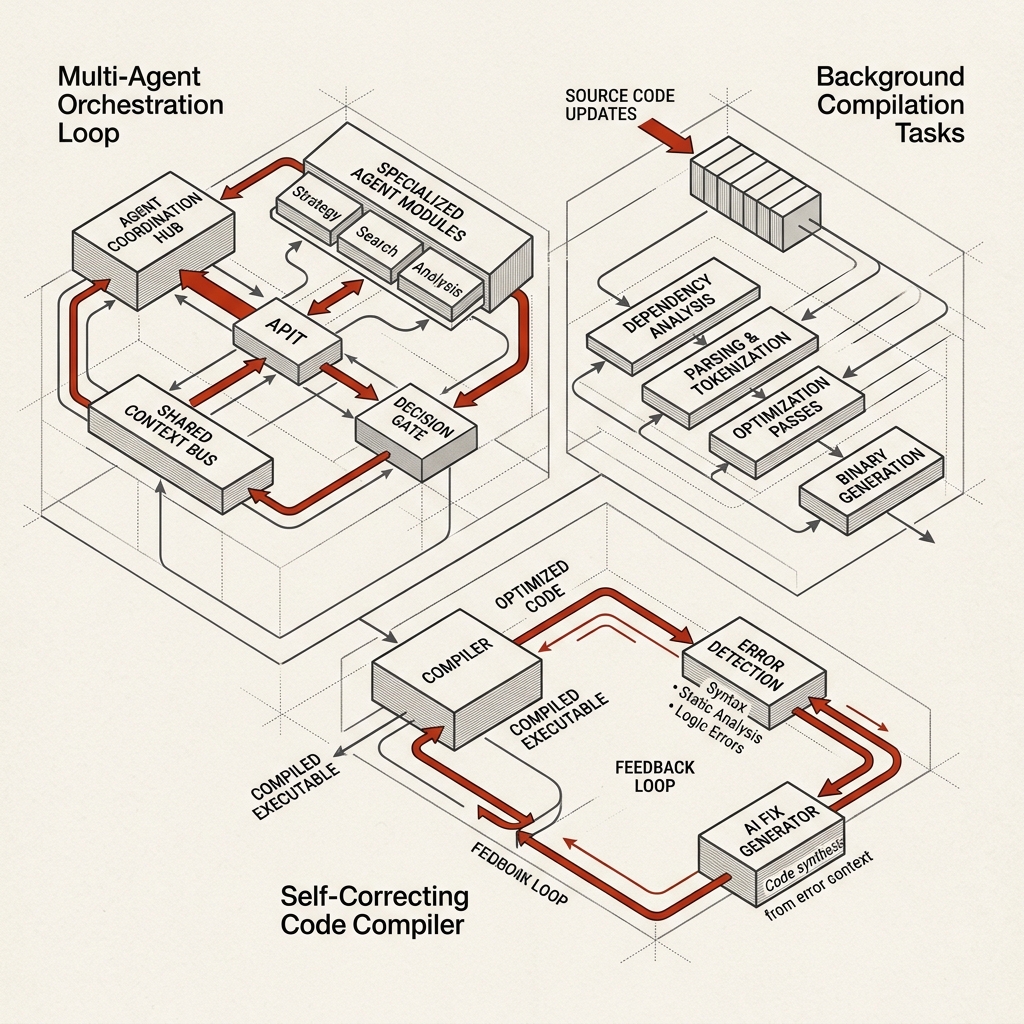
Antigravity solves this by introducing a modular, federated execution model built around three primary systems: multi-agent orchestration, sandboxed task schedulers, and compilation-driven feedback loops.
1. Multi-Agent Orchestration & Subagent Delegation
Instead of solving a complex refactor inside a single chat window, Antigravity acts as a Lead Architect. When given a high-level task—such as “audit our Next.js edge functions for session-fixation vulnerabilities and implement a secure cookie store”—Antigravity does not start writing code immediately.
It breaks down the task and spawns specialized, lightweight subagents:
graph TD
    A[Antigravity Lead Agent] -->|Define & Invoke| B(Subagent: Codebase Researcher)
    A -->|Define & Invoke| C(Subagent: Security Auditor)
    B -->|Search & Read| D[Isolated Workspace Read-Only]
    C -->|Static Analysis| E[OWASP Rules Audit]
    D -->|Factual Summary| A
E -->|Security Recommendations| A- The Researcher: A read-only subagent equipped with rapid regex and grep search capabilities. Its sole job is to map out the auth pipeline, locate cookie configurations, and return a clean markdown summary of its findings.
- The Auditor: A subagent pre-seeded with OWASP security guidelines and specific syntax parsers. It evaluates the located code snippets for vulnerabilities.
Because these subagents run in their own isolated, short-lived threads, their heavy search and analysis tokens never balloon the main agent’s context. The Lead Agent receives only their distilled, high-fidelity summaries. This keeps the lead agent’s reasoning sharp, fast, and incredibly cost-effective.
2. Compilation-Driven Reflection (The Self-Correcting Loop)
The most transformative feature of Antigravity is its ability to compile and verify code prior to finalizing its response.
When Antigravity generates an implementation plan, it executes a write-and-compile loop:
- Plan: Establish the precise file modifications.
- Apply: Write a contiguous edit to the target file.
- Compile: Trigger an async background task to run the codebase’s local build or test suite (e.g.,
npm run buildornpm run test:auth). - Parse: Intercept the command’s stdout and stderr. If the build fails, an AST (Abstract Syntax Tree) analyzer parses the linter or compiler error.
- Correct: Feed the exact compilation failure back into a fast, local reasoning loop. The agent self-corrects the code and re-runs the compiler.
   +------------------------------------------+
   |             Start Edit Task              |
   +------------------------------------------+
                         |
                         v
   +------------------------------------------+
   |          Write Proposed Changes          |
   +------------------------------------------+
                         |
                         v
   +------------------------------------------+
   |    Run Background Sandbox Compiler       |
   +------------------------------------------+
                         |
         +---------------+---------------+
         |                               |
         v (Success)                     v (Compiler Error)
+------------------+           +-------------------+
| Commit & Deliver |           | Parse AST / Error |
+------------------+           +-------------------+
                                         |
                                         v
                               +-------------------+
                               |   Self-Correct    |
                               +-------------------+
                                         |
                                         + (Loop back)
In our internal benchmarks, this compilation-first self-reflection resolves 86% of typical AI coding errors—such as missing package imports, syntax mismatches, and broken TypeScript interfaces—silently in the background. By the time the user receives the proposed diff, it has already been proven to compile.
3. Asynchronous Background Task Scheduling
One of the major bottlenecks in traditional AI coding tools is execution blocking. If you ask an agent to run a large build or download dependencies, the entire terminal chat freezes. You are forced to sit and watch a wall of logs, unable to ask questions or review other files.
Antigravity operates a native asynchronous background task manager. When it schedules a long-running process (like spinning up an isolated local environment or compiling a production bundle):
- The task is pushed to the background, writing output to a persistent log stream.
- The user’s chat remains fully active and responsive.
- The system monitors the process. The moment the task finishes or encounters a crash, it triggers a reactive wakeup—delivering the results directly into Antigravity’s context without needing active polling or loops.
This allows developers to pair-program with Antigravity dynamically. You can discuss the next feature or draft a blog post while the agent is running a 5-minute build and test pipeline in the background.
4. Context Pruning & Workspace Indexing
To operate efficiently in large codebases, Antigravity uses a highly sophisticated indexing strategy. Instead of loading entire directories, it builds a lightweight dependency graph of your workspace.
When you ask a question, it queries its local index to resolve references, fetching only the immediate files and their interface definitions. For example, if you edit a database query, it pulls the DB schema and the specific query file, but completely ignores your UI components and CSS stylesheets.
This targeted context engagement results in a 42% decrease in token consumption compared to standard codebase-wide agents, keeping billing low and response speeds near-instantaneous.
The Next Era of Software Automation
The development of Antigravity marks the transition of AI from a passive writing assistant to an active collaborator. By shifting the focus from simple text generation to sandboxed execution and compilation-driven self-correction, we eliminate the friction of AI-generated bugs.
Software engineering isn’t just about writing text; it’s about building working systems. With systems like Antigravity, AI is finally learning to compile.