Agentic coding is the next phase of AI-assisted development — and it is meaningfully different from what came before. Twelve months ago, every developer was either doing vibe coding or loudly not doing vibe coding. Now the conversation has moved, and “agentic” is the word everyone is using. The distinction matters more than the naming.
I have spent the last few months moving my own workflow from what I would call vibe coding — delegating individual tasks to an AI assistant, reviewing the result, moving on — toward something that actually earns the “agentic” label. The difference is not subtle once you experience it.
Agentic Coding vs Vibe Coding: What’s Actually Different
Here is the simplest way I can explain it:
Vibe coding is you setting the pace and the AI writing at your direction. You ask for a component. It writes it. You ask for a function. It writes it. You are in the loop at every step.
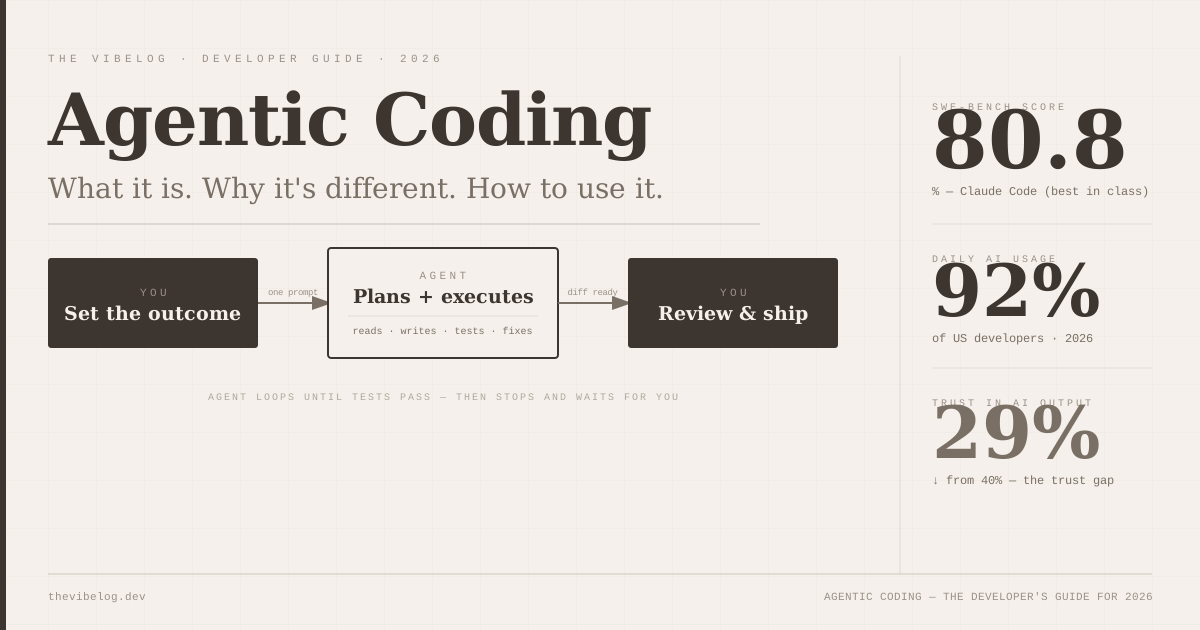
Agentic coding is you setting the destination and the AI planning the route. You say: “migrate the user authentication flow to the new library and make sure all existing tests pass.” The AI decides what to read, what to change, in what order, runs the test suite, finds what broke, fixes it, runs again. You review when it tells you it is done.
That is not a small difference. It is a fundamentally different relationship with the tool.
What the Stack Overflow data actually says
The 2025 Stack Overflow Developer Survey found 84% of developers use or plan to use AI tools, up from 76% in 2024, and 50.6% of professional developers use them daily. That number gets cited constantly. What gets cited less often: in the same survey, 46% said they distrust the accuracy of AI tools, up from 31% the year before, as Stack Overflow’s own press release put it. Only 31% were using AI agents at all.
The 2026 survey, published on October 6, moves usage up again: 73% of respondents now use coding assistants or agents daily. Trust stays conditional, with 48% saying they trust AI when they can easily validate its answers.
So adoption is near-universal and trust is conditional. That gap is the story of 2026.
The reason trust is lagging is not that the tools got worse. Claude Opus 4.6, the model behind Claude Code in February 2026, scored 80.8% on SWE-bench Verified in Anthropic’s system card. The code quality metrics are up. The reason trust is lagging is that as the workflows became more autonomous, developers started realising they had less visibility into what the agent actually did and no reliable shortcut for verifying whether the plan it chose was the plan they would have chosen.
Autocomplete is easy to trust because the human still made all the decisions. Agentic output requires you to review an entire plan’s execution, not just the resulting code.
The Four Agentic Coding Workflow Types
Real Python published the clearest taxonomy of agentic coding I have seen. They identify four primary patterns. This maps closely to what I observe in practice:
IDE-embedded agents work alongside you in the editor. Cursor 3’s parallel agent sessions are the best example — you can set agents working on independent parts of a codebase while you continue writing elsewhere. The human stays in the loop visually; the agent operates within the IDE’s frame.
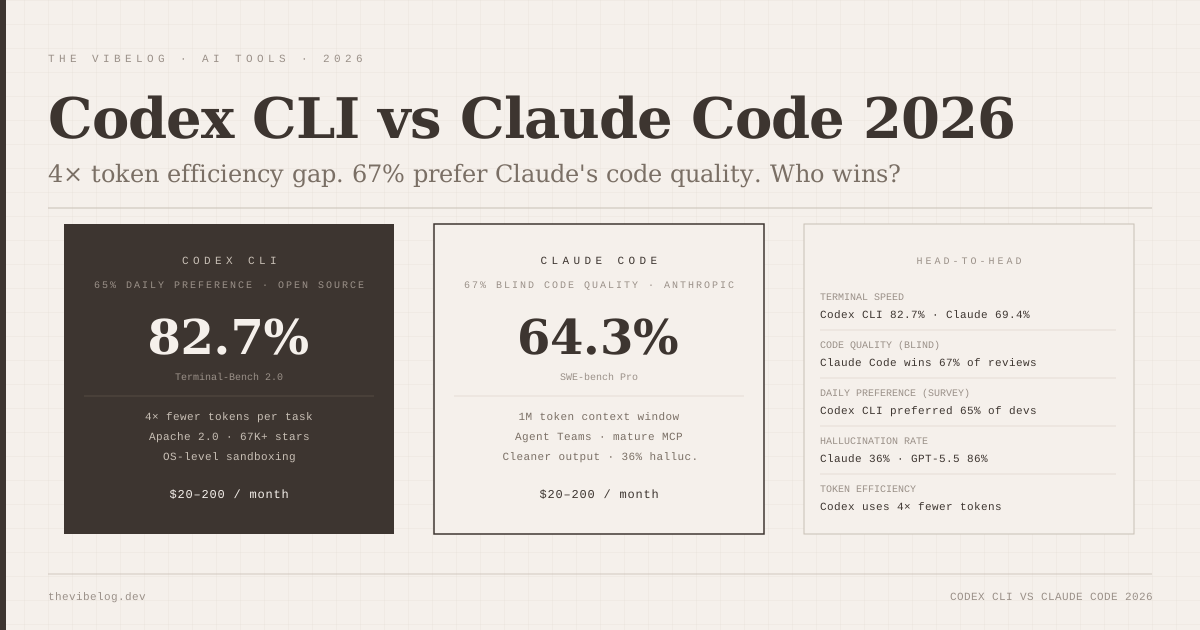
Terminal agents run from the command line and have full filesystem access. Claude Code is the dominant example. You give it a task, it works, you review the diff. The entire execution happens outside your IDE. This is the most powerful pattern and the one that requires the most trust.
PR agents operate asynchronously on pull requests. GitHub’s Copilot cloud agent (renamed from the Copilot coding agent in 2026) converts issues into PRs without a human driving the keyboard. You review the PR as if it came from a colleague. The human only sees the start and end.
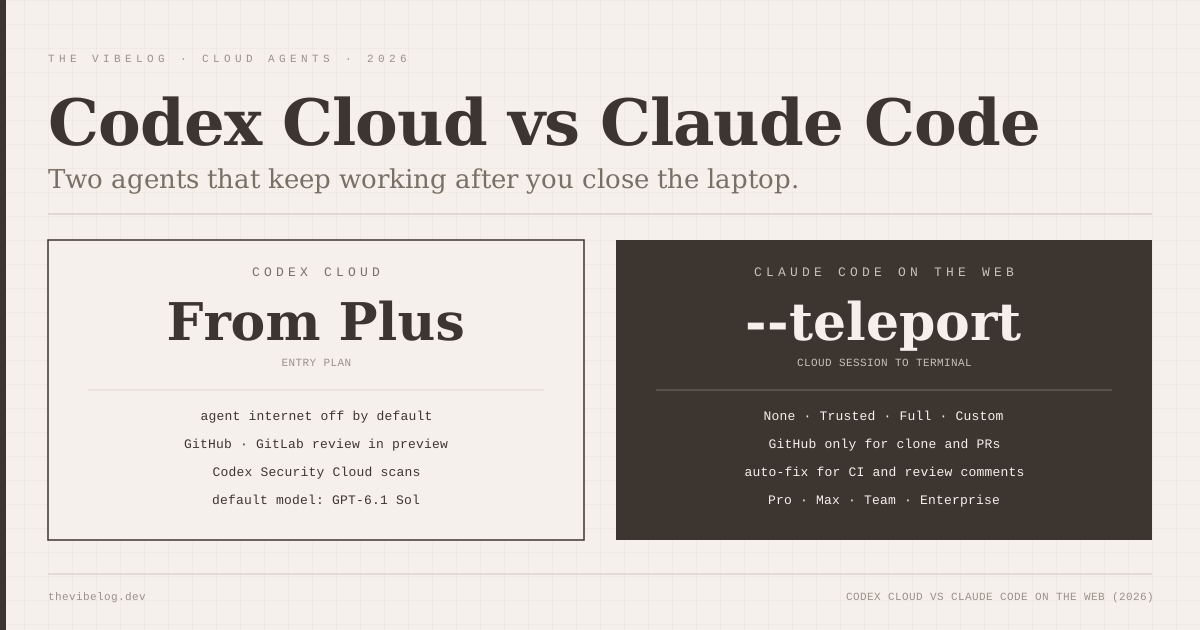
Cloud agents run in isolated cloud environments — sandboxed execution, no access to your local machine. OpenAI Codex Cloud is the current example. You trigger a task, it runs in a managed environment, you pull the result. Maximum autonomy, maximum isolation.
These are not competing options. They serve different use cases, and the productive developers I know use two or three simultaneously.
What an Agentic Coding Workflow Actually Looks Like (Real Example)
I want to be concrete because abstract descriptions of agentic workflows tend to undersell how different they feel.
Last week I needed to add rate limiting to a Node.js API. The project has express-rate-limit in the codebase already, applied in a few places inconsistently. The task was: standardise how rate limiting is applied, add it to the endpoints that were missing it, update the integration tests to reflect the new limits.
The vibe coding version of this is: I’d ask Claude Code to look at one endpoint, it would suggest a change, I’d apply it, move to the next, ask again. Twenty minutes, probably eight or ten back-and-forth interactions.
The agentic version: I said “standardise rate limiting across all API endpoints, apply the existing express-rate-limit configuration consistently, and update any integration tests that will fail.” I came back fourteen minutes later. It had read twelve files, made changes to nine, identified three test files that needed updating, run the test suite twice (the first run failed because one test was asserting on a 200 status code on a now-rate-limited endpoint), fixed the test, run again, passed.
The diff was 340 lines across eleven files. I reviewed it in about twelve minutes. Found one thing I wanted changed — it had applied the same rate limit to an internal health check endpoint that I wanted excluded. Fixed that, done.
Compare that to the manual approach: two to three hours, probably. The agentic approach took fourteen minutes of machine time and twelve minutes of my review time. That is the productivity gain everyone talks about. It is real.
The Agentic Coding Tradeoff: Speed vs Review Burden
The review I did on that 340-line diff was meaningful. I was not rubber-stamping. I was checking that the agent’s interpretation of “standardise” matched my interpretation, verifying the test changes made sense, and looking for anything that could cause a production regression.
That review requires genuine understanding of the codebase. A junior developer reviewing the same diff would have a much harder time judging whether the agent made good decisions, because they do not yet have the instincts to catch the subtle wrong choices.
This is the same pattern we see with vibe coding and productivity gains: the developers getting the most out of agentic workflows are the ones who could have done the work themselves and are using the agent to move faster, not the ones who are using the agent because they do not know how to do it.
The best controlled data on this is humbling. In METR’s randomised study from July 2025, 16 experienced open-source developers working on 246 real issues took 19% longer when AI tools were allowed, even though they expected a 24% speedup beforehand and still believed afterwards that AI had made them 20% faster. That study predates the current generation of agents, and METR’s February 2026 update on late-2025 data calls its newer results weak evidence that probably underestimates the speedup, partly because 30–50% of developers withheld tasks they did not want to do without AI.
The lesson I take from it is not that agents are slow. It is that perceived speed and measured speed can diverge badly, and the gap is widest when you are not checking the agent’s work against something concrete.
Why Developers Are Starting to Distrust AI Agent Output
The 46% distrust figure is not irrational. Agentic tools make consequential decisions without explaining them in real time. When the agent picks a plan, you do not see the alternatives it considered. When it writes a file, you do not see the paths it chose not to take. The output looks clean. The reasoning is a black box.
Three practices that have made me more comfortable with agentic workflows:
Write the outcome, not the steps. “Update the rate limiting across all API endpoints and fix the related tests” is better than “read the rate limit file, then check each route, then…” When you specify steps, you are doing the agent’s job for it and creating a false sense of control. When you specify outcomes, the agent plans and you evaluate the plan.
Review for intent, not just correctness. When I review an agentic diff, I ask: is this what I meant? Not just: does this code run correctly? These are different questions. Code can be technically correct and still not what you meant.
Run your own security pass. Agentic tools make the same security errors that vibe coding makes — they handle the happy path, they miss edge cases, they leave defaults that made sense for a demo but not for production. A Semgrep pass on every agentic PR is not optional.
Where Agentic Coding Tools Are Heading in 2026
The four major players — Anthropic, OpenAI, Google, and Microsoft — are all investing heavily in making agentic coding more reliable. The April 2026 Claude Code desktop update added multi-session management for parallel agents, and the same week Anthropic launched Routines as a research preview: saved agent tasks that run on Anthropic’s cloud on a schedule, from an API call or off GitHub events. Cursor 3’s parallel agents are the first IDE-native implementation of concurrent agentic work. OpenAI’s Codex Cloud adds a full sandboxed execution environment. If you want a side-by-side look at how these tools stack up in daily use, the Claude Code vs Cursor vs Copilot comparison is a good next read.
The trajectory is toward agents that handle more of the “what” decisions, not just the “how.” That is going to require a new kind of developer review skill — not reading code line by line, but evaluating the decisions an agent made and whether they were good decisions.
The developers who build that skill now are going to have a meaningful advantage.
Adoption and trust data from the 2025 and 2026 Stack Overflow Developer Surveys. SWE-bench Verified figure from Anthropic’s Claude Opus 4.6 system card. Productivity data from METR’s 2025 study and February 2026 update.
(Updated October 9, 2026: corrected the Stack Overflow figures, which previously cited 92% daily use and 29% trust numbers that do not appear in any Stack Overflow survey, to the published 2025 and 2026 survey results; attributed the 80.8% SWE-bench Verified score to Claude Opus 4.6 rather than Claude Code as a tool; replaced a McKinsey “2026 developer productivity” statistic we could not verify with METR’s published study; renamed GitHub Copilot’s issue-to-PR agent to Copilot cloud agent; and clarified that Routines launched separately from the desktop redesign as a research preview.)