Gemini 4 Carbon is now the top-scoring model on the Artificial Analysis Intelligence Index, and you almost certainly cannot use it. Google announced Carbon on October 28, 2026, two weeks after Gemini 4 Argon went generally available, and handed it first to a small group of vetted cyber defenders.
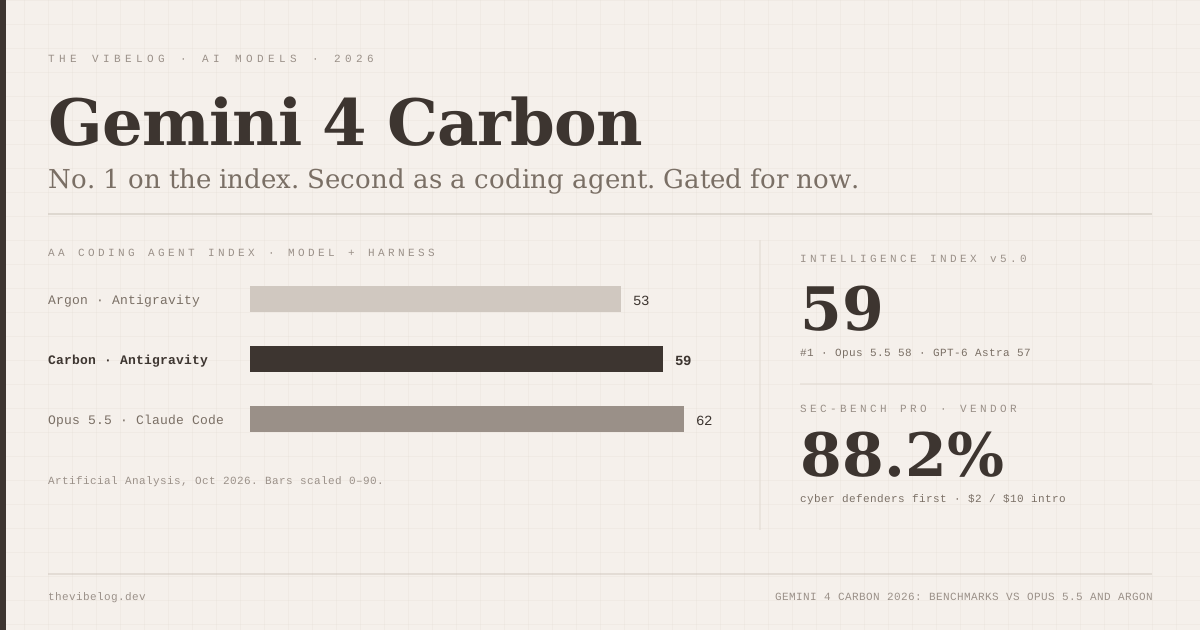
That is the tension worth unpacking. Carbon scores 59 on the rebuilt v5.0 index against 58 for Claude Opus 5.5, and Google’s cybersecurity numbers are the strongest any lab has published. But as a coding agent, the independent data still puts Claude Code on Opus 5.5 ahead.
I have not used Carbon, because there is no public endpoint to call. Everything below comes from Google’s announcement post, Artificial Analysis’ model page and independent coverage. Google’s own numbers are labelled as vendor-reported.
What Is Gemini 4 Carbon?
Gemini 4 Carbon is Google DeepMind’s strongest model, built for long-horizon engineering and cybersecurity work. Google’s one-line pitch is “state-of-the-art cybersecurity and long horizon capabilities”, and the announcement leans hard on both.
The post is signed by Koray Kavukcuoglu, Google DeepMind’s SVP and Google’s Chief AI Architect. It does not include a technical report, a parameter count or an architecture description, and the full benchmark table ships as an image rather than text.
What Google does say clearly:
- Carbon is #1 on the Artificial Analysis Intelligence Index v5.0, at 59.
- It gained 89 Elo on WebDev Arena, landing fourth at 1,768.
- Cybersecurity results were run “without guardrails”, which matters when you read them.
- Carbon uses the same layered safety stack as Argon, including chain-of-thought monitoring, and takes part in the U.S. government’s voluntary pre-release testing process.
Artificial Analysis lists a 1M-token context window. Google’s own post does not state one, so treat that as a third-party figure until Google publishes a model card.
In short, Carbon is a frontier release with a cybersecurity-first rollout, not a developer launch.
Gemini 4 Carbon Benchmarks vs Gemini 4 Argon
The cleanest way to read Carbon is against Argon, since both come from Google’s table and were measured the same way. VentureBeat reproduced 14 of Google’s 17 rows; here are the ones developers care about most.
| Benchmark (vendor-reported) | Gemini 4 Argon | Gemini 4 Carbon | Best rival shown |
|---|---|---|---|
| AA Intelligence Index v5.0 | 50 | 59 | Opus 5.5: 58 |
| FrontierSWE 2 | 55.0% | 61.2% | GPT-6 Astra: 65.5% |
| Terminal-Bench 4.0 (AA) | 57.1% | 65.2% | Not listed |
| OSWorld-2.1, offline subset | 74.7% | 81.5% | Opus 5.5: 87.2% |
| GraphWalks (256K–1M tokens) | 84.2% | 96.2% | GPT-6 Astra: 71.8% |
| SEC-bench Pro | 83.4% | 88.2% | Not listed |
(Source: Google benchmark table as reproduced by VentureBeat, October 2026)
Google claims Carbon is highest in 15 of 17 rows. The two it loses are visible above: OpenAI leads FrontierSWE 2, and Anthropic leads the OSWorld computer-use subset by almost six points.
The GraphWalks jump is the number I keep coming back to. A 12-point gain on long-context graph traversal, and a 24-point lead over Opus 5.5’s 66.8%, suggests Carbon actually uses its context rather than just accepting it. If that holds up outside Google’s harness, it is the most practically useful improvement in the release for anyone feeding whole repositories into a model.
One caution on the index itself. Artificial Analysis rebuilt its index as v5.0 on October 27, with about 60% private or withheld tests, so you cannot compare 59 with the v4.3 scores you have seen in earlier coverage. Opus 5.5 was 58 on v4.3 and is 58 again on v5.0; Argon dropped to 50.
Carbon is a large step over Argon on almost every row, but its lead over Opus 5.5 on general intelligence is one point.
Gemini 4 Carbon vs Claude Code on Opus 5.5 for Coding
This is where the headline and the developer reality split. Artificial Analysis also runs a Coding Agent Index, which scores a model inside a real agent harness rather than in isolation. Carbon was tested in Google’s Antigravity CLI.
- Claude Code + Opus 5.5 62
- Antigravity CLI + Gemini 4 Carbon 59
- Claude Code + Sonnet 5.5 59
- Muse Code + Muse Wonder Full 59
- Antigravity CLI + Gemini 4 Argon 53
Claude Code with Opus 5.5 scores 62; Carbon in Antigravity CLI scores 59, a tie with Claude Code running the cheaper Sonnet 5.5. On the index’s sub-tests, VentureBeat reports Carbon placed second on both FrontierCode v1.1 (51%) and Terminal-Bench 4.0 (64%).
Notice the Terminal-Bench mismatch. Google’s table says 65.2%; Artificial Analysis measured 64% through Antigravity CLI. A one-point gap is normal harness noise, but it is a reminder that vendor tables and independent runs rarely agree to the decimal.
Honestly, a six-point jump over Argon in the same harness is a big deal for Google. Antigravity was the weak spot in Google’s coding story, and Carbon closes most of the gap with Claude Code. It does not close all of it, and if you already run the setup from our Claude Opus 5.5 vs GPT-6 comparison, nothing here is a reason to switch.
Gemini 4 Carbon Cybersecurity Results
The cyber numbers are why Carbon exists in its current form. Google lists:
- SEC-bench Pro, finding real vulnerabilities: 88.2%, which Google calls state of the art.
- ExploitGym, exploitation: 54.8%, up 12.8 points on Argon.
- CWE-bench, patching root causes: 71.0%.
- More than 2x Argon’s success rate at generating secure code, on an internal benchmark.
- Chrome’s team reports Carbon is more than 10x better at producing high-quality patches than an unnamed frontier model from another lab.
Every one of these is vendor-reported, and the external cyber evaluations ran without guardrails. A customer deployment with Google’s misuse defenses switched on may score lower.
The ExploitGym number is the one that explains the gated rollout. A model that can exploit more than half of a benchmark’s targets is useful to a defender running authorised tests and equally useful to someone who is not. This is the same pattern we saw with PHP2Shell, where AI-assisted researchers found critical RCE bugs, and attackers were probing within hours of disclosure.
For defenders, Carbon looks like the strongest vulnerability-finding model any lab has published numbers for; for everyone else, those same numbers are why you are waiting.
Gemini 4 Carbon Pricing and Access
Google says the introductory API price matches Argon exactly.
| Model | Input / 1M | Output / 1M | Status |
|---|---|---|---|
| Gemini 4 Carbon (intro) | $2.00 | $10.00 | Fairwind only |
| Gemini 4 Carbon (standard) | $4.00 | $20.00 | Date not announced |
| Gemini 4 Argon (intro) | $2.00 | $10.00 | GA, intro ends Nov 30, 2026 |
| Claude Opus 5.5 | $4.00 | $20.00 | GA |
(Source: Google; Anthropic pricing; October 2026)
Cached input is 95% off for both Gemini 4 models. Artificial Analysis already lists Carbon at the $4 / $20 standard rate, and as of October 29 OrcaRouter found no gemini-4-carbon entry in the Gemini API model list. The price exists on paper; the endpoint does not, for most of us. Our AI model pricing tracker now lists Carbon as limited access.
Cost per task is closer to Opus than the sticker price suggests. Artificial Analysis puts Carbon at $7.76 per Intelligence Index task, against $7.68 for Argon. OrcaRouter, citing the same data, says Carbon used about 123,000 output tokens per index task, 29% fewer than Opus 5.5’s 173,000.
Speed is the weak spot. Artificial Analysis measured 82.5 output tokens per second and a time to first token of just over 100 seconds at high reasoning effort. That is fine for a background agent and painful for interactive chat.
Access runs through the Fairwind Program, which Google DeepMind describes as early model access for “trusted partners” doing cyber defense. Priority goes to governments, critical infrastructure operators, core technology platforms and defensive research labs. Applicants are vetted, including background checks, must enforce phishing-resistant MFA, and cannot resell or share access. You apply through a Google Cloud account team.
Google says broader availability for developers, businesses and consumers will come “as soon as possible”. For Argon, the gap between the Fairwind announcement (September 30) and general availability (October 13) was 13 days. Carbon may follow a similar path, but Google has not committed to it.
Plan for Carbon at Argon’s price, but do not build a roadmap around a date Google has not given.
The Hallucination Tradeoff Nobody Mentions
Google’s post says Carbon makes roughly half as many unsupported claims as Argon. That sounds like a clean win.
Artificial Analysis tells a more complicated story. On AA-Omniscience, Carbon scores 54, the highest on the board, and answers 58% of questions correctly against Argon’s 48%. But its hallucination rate rose from 4% to 11%, according to VentureBeat and OrcaRouter’s reading of the same data.
Both can be true. Carbon attempts more answers instead of saying it does not know, so it gets more right and more wrong in absolute terms. Argon was unusually willing to abstain.
For coding work this matters less than for research or retrieval tasks, because a wrong function call fails a test. For anything where a confident wrong answer goes straight to a user, I would want Carbon behind a grounding step until its behaviour is better understood.
Google’s other safety claims are notable: 0.0% successful cheating on Terminal-Bench 4.0 (0.4% attempted), almost 80% fewer high-severity misalignment alerts in internal coding environments, and a 0.0% attack success rate on Gray Swan’s indirect prompt-injection benchmark against Argon’s 0.7%. Those are internal or single-benchmark results, and after the incidents in our OpenAI rogue agent incident coverage, I would treat any “0.0%” as “0.0% on that test”.
Should Developers Care About Gemini 4 Carbon Yet?
Yes, but as a signal rather than a tool. Here is how I would read it:
- If you build security tooling and your organisation qualifies for Fairwind, apply now. Nothing else on the market publishes cyber numbers like these.
- If you run agentic coding workloads, stay where you are. Claude Code on Opus 5.5 still leads the Coding Agent Index, and Carbon is not callable anyway.
- If you already use Argon, Carbon is the obvious upgrade at the same introductory price whenever it opens up, especially for long-context work given that GraphWalks gain.
- If you track GitHub Copilot, watch whether Carbon joins the model pool behind Copilot Fusion. With agents now starting more than 40% of pull requests according to GitHub’s Octoverse 2026 report, whichever model lands in those routers first will see a lot of traffic.
The frontier is now a three-way tie within a few points: Carbon 59, Opus 5.5 58 and GPT-6 Astra 57 on the v5.0 index. When the spread is that narrow, harness quality, speed and price decide more than the model does. That is the most useful thing this launch tells us.