GPT-6.1 Terra is OpenAI’s new mid-priced model, and the headline is simple: $1 per million input tokens and $5 per million output, with a 74.2% OSWorld 2.1 score that OpenAI says is near the frontier for computer use. It shipped on October 26, 2026, and it replaces GPT-5.6 Terra at less than half the price.
That makes it the most interesting cheap model for agents that drive desktops and browsers. It does not make it the best one.
OpenAI’s own launch chart shows Claude Sonnet 5.5 nine points ahead on the same benchmark. I went through OpenAI’s model page and pricing docs, the InfoWorld coverage of the launch charts, and Artificial Analysis’ independent runs. I have not run Terra on my own workloads yet, so every number below is sourced, and vendor-reported figures are labelled.
What GPT-6.1 Terra Is
GPT-6.1 Terra is a reasoning model that sits between GPT-6 Luna and GPT-6.1 Sol in OpenAI’s lineup, tuned for high-volume agent work and computer use. InfoWorld describes it as a step up from GPT-5.6 Terra at 50% lower price, with OpenAI pitching “near-frontier performance” on visual reasoning, professional tasks and computer-use benchmarks.
The specs, from OpenAI’s GPT-6.1 Terra model page:
- Model ID:
gpt-6.1-terra(the only snapshot listed) - Context window: 1,050,000 tokens, with 922,000 max input and 128,000 max output
- Knowledge cutoff: June 1, 2026
- Modalities: text and image in, text out (no audio or video)
- Reasoning effort:
none,low,medium(default),high,xhigh,max - Tools in the Responses API:
computer_use,hosted_shell,apply_patch, web search, file search, code interpreter, MCP, skills and tool search
The none effort level is the detail I would not skip. Neither GPT-6.1 Sol nor GPT-6 Astra offers it, and for click-heavy automation where the model mostly reads a screen and picks the next action, paying for reasoning on every step is waste.
One constraint catches people: tool calling requires the Responses API. Chat Completions works for plain text, but a computer-use agent has to be on Responses.
GPT-6.1 Terra is OpenAI’s workhorse tier for agents, and it is the first model in that tier that treats computer use as a primary job.
GPT-6.1 Terra Pricing
The price cut is the reason this launch matters. These are the standard-tier rates from OpenAI’s API pricing page, per million tokens, for prompts up to 272K input tokens:
| Model | Input | Cached input | Output |
|---|---|---|---|
| GPT-6.1 Terra | $1.00 | $0.05 | $5.00 |
| GPT-5.6 Terra | $2.00 | $0.20 | $12.00 |
| GPT-6.1 Sol | $2.00 | $0.10 | $10.00 |
| GPT-6 Astra | $10.00 | $1.00 | $50.00 |
| GPT-6 Luna | $0.10 | $0.01 | $0.50 |
(Source: OpenAI API pricing page, October 2026.)
Cached input dropped from $0.20 to $0.05, which is a 75% cut. Agent loops re-send the same system prompt, tool schemas and screenshots on every turn, so cache reads are most of the input bill. That cut matters more than the headline rate.
The fine print, from the model page:
- Long context: above 272K input tokens, the whole request is billed at 2x input and cache rates and 1.5x output
- Cache writes: $1.25 per million for 30-minute retention, $2.50 for 12-hour retention
- Batch and Flex: 50% below standard
- Fast mode: 2x standard, and there is no Ultrafast tier for Terra
- Regional processing: a 10% premium
The 272K cliff is worth planning around. A computer-use session that accumulates hundreds of screenshots can cross it without anyone noticing, and from that point every turn costs 2x on input. Compacting history or trimming old screenshots is the fix. If you compare model prices often, the AI model pricing tracker now includes Terra next to Sol, Luna and the Claude 5.5 models.
At $1 and $5, Terra costs half of GPT-6.1 Sol and a fifth of Claude Opus 5.5, before you count its cheaper cache reads.
GPT-6.1 Terra Benchmarks (Vendor-Reported)
OpenAI’s launch charts compare Terra mostly to its own models, with a few Claude rows. These are max-effort figures as reported by InfoWorld’s launch coverage and Kingy AI’s transcription of the charts:
| Benchmark | GPT-6.1 Terra | GPT-5.6 Terra | GPT-6.1 Sol | Best Claude |
|---|---|---|---|---|
| OSWorld 2.1 | 74.2% | 57.1% | 78.0% | 83.9% (Sonnet 5.5) |
| Terminal-Bench 4.0 | 50.3% | 21.5% | 55.9% | 70.6% (Sonnet 5.5) |
| Agents’ Last Exam | 60.0% | 50.7% | 58.6% | 63.2% (Opus 5.5) |
| MMMU-Pro | 85.5% | 81.7% | 86.3% | not shown |
(Source: OpenAI launch charts via InfoWorld and Kingy AI, October 2026. All figures vendor-reported, max effort.)
The jump over GPT-5.6 Terra is large. Terminal-Bench 4.0 more than doubled, from 21.5% to 50.3%, and OSWorld 2.1 climbed 17 points. On Agents’ Last Exam, a test of professional tasks, Terra even edges GPT-6.1 Sol and GPT-6 Astra’s 59.3%.
The error-rate numbers are the other big claim. On OpenAI’s internal set of error-inducing prompts, Terra’s error rate at low effort fell from 53.6% to 16.7%, and at max effort to 4.3%. OpenAI itself cautions against reading those as production error rates, and I would too.
Then look at the right-hand column. Claude wins every row OpenAI chose to show Claude in. OpenAI put Sonnet 5.5 and Opus 5.5 in its own charts, which I respect, and the gap on Terminal-Bench 4.0 is 20 points.
GPT-6.1 Terra vs Claude Sonnet 5.5 for Computer Use
This is the comparison most teams building desktop agents will care about, and it splits cleanly on accuracy versus cost.
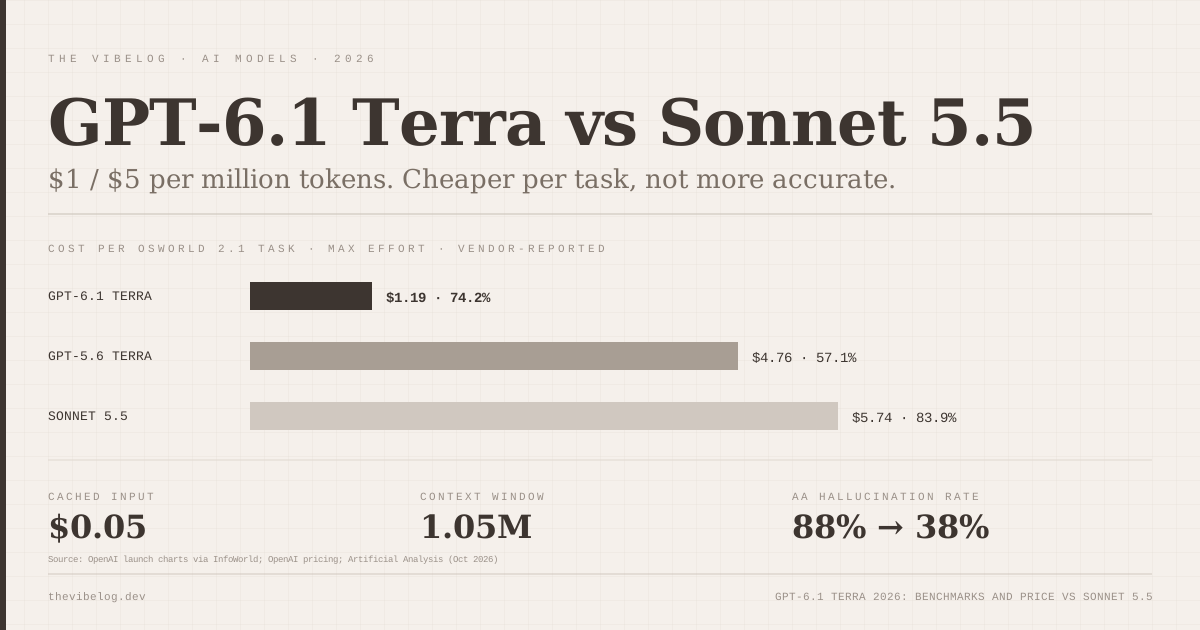
- Claude Sonnet 5.5 83.9% $5.74
- GPT-5.6 Terra 57.1% $4.76
- GPT-6.1 Terra 74.2% $1.19
In OpenAI’s chart, Sonnet 5.5 scores 83.9% at $5.74 per task, and Terra scores 74.2% at $1.19. Sonnet is about 13% more accurate and about 4.8x more expensive per attempt.
Which one wins depends on what a failure costs you.
If the task is retryable and checkable, such as filling a form, exporting a report or clicking through a test flow where a script can verify the end state, Terra’s economics are hard to argue with. Two Terra attempts still cost well under half of one Sonnet attempt.
If a failure means a wrong action in a real system, such as a submitted payment form, a sent email or a deleted record, the accuracy gap matters more than the price. I would pay for Sonnet there, and I would still gate the irreversible steps behind a human approval.
The comparison I find more interesting is at the bottom of the price range. Anthropic reports Claude Haiku 5.5 at 72.4% on OSWorld 2.1 offline at $0.10 / $0.50 per million tokens, which I covered in the Claude Haiku 5.5 breakdown. That is within two points of Terra’s score at a tenth of Terra’s list price. Both are vendor-reported, and OpenAI’s run setup may not match Anthropic’s, so do not read the two-point gap as precise. It still tells you Terra’s real competition on cheap computer use is Haiku, not Sonnet.
For desktop agents, Sonnet 5.5 is the accuracy pick, Terra is the volume pick, and Haiku 5.5 is the one to benchmark against Terra before you commit.
What Artificial Analysis Measured
Independent numbers matter here because OpenAI’s per-task costs come from its own harness. Artificial Analysis’ Terra write-up mostly backs up the direction of OpenAI’s claims:
- Intelligence Index: 6 points above GPT-5.6 Terra at max effort, 4 points below GPT-6.1 Sol, 10 points above GPT-6 Luna
- Cost per index task at max effort: $0.40, against $1.40 for GPT-5.6 Terra
- Hallucination rate (AA-Omniscience): 38%, down from 88% for GPT-5.6 Terra
- Coding Agent Index v2.0: Terra 48, GPT-6.1 Sol 54, GPT-6 Luna 31
- Terminal-Bench 4.0: about 20 points better than GPT-5.6 Terra, close to GPT-6.1 Sol at max effort
The hallucination drop is the result I did not expect. Going from 88% to 38% on AA-Omniscience moves Terra from a model you could not trust with factual lookups to one that is better than GPT-6.1 Sol on that test.
The speed numbers are less flattering. The Artificial Analysis model page lists Terra at max effort at 90.9 output tokens per second, but with a time to first token of 77.96 seconds, against a class median of 3.69 seconds. It also used 99 million output tokens to run the index, well above the 63 million median.
That is the price of max effort. Artificial Analysis says low and medium effort are the Pareto-optimal settings for cost, and for an interactive agent waiting 78 seconds before the first token is not workable anyway.
Run Terra at low or medium effort. Max effort buys a few index points at a large cost in latency and tokens.
Where You Can Use GPT-6.1 Terra
Terra launched across OpenAI’s surfaces on day one:
- API:
gpt-6.1-terraon the Responses, Chat Completions and Batch endpoints - Codex and ChatGPT Work: Plus, Pro, Enterprise and Edu users
- GitHub Copilot: Pro, Pro+, Max, Business and Enterprise, per GitHub’s changelog, in VS Code, Visual Studio, the Copilot CLI, the cloud agent, JetBrains IDEs, Xcode and Eclipse
The Copilot detail matters for cost. GitHub bills Terra “at provider list pricing under usage-based billing,” so on Copilot’s AI Credits it should draw down roughly half as fast as GPT-6.1 Sol. The rollout is gradual, and Business and Enterprise admins can block it through the model policy. New models are on by default unless an admin has turned that off. The GitHub Copilot pricing guide covers how the credit system works.
There is also a safety note in the launch. InfoWorld reports that Terra meets the “Critical” cybersecurity threshold under OpenAI’s Preparedness Framework and keeps the safeguards built for GPT-6 Astra. That is a capability rating, not a warning about Terra specifically, but it explains why some security-research prompts will get refused.
Should You Switch to GPT-6.1 Terra?
If you are on GPT-5.6 Terra, yes, and today. It is cheaper on every line of the price sheet and better on every benchmark OpenAI and Artificial Analysis report. There is no tradeoff to weigh.
If you are on GPT-6.1 Sol for agent work, test Terra on your real tasks. On Agents’ Last Exam it matches Sol at half the price. On coding it trails, 48 to 54 on Artificial Analysis’ Coding Agent Index and 50.3% to 55.9% on OpenAI’s Terminal-Bench 4.0 run, so I would keep Sol (or Sonnet 5.5) for hard code changes. The GPT-6.1 Sol vs Claude Sonnet 5.5 comparison covers that tier.
If you are building a computer-use agent, the honest answer is to run three models on twenty of your own tasks: Terra, Haiku 5.5 and Sonnet 5.5. Measure completed tasks per dollar, not tokens per dollar. Greyhound Research’s Sanchit Vir Gogia made the same point to InfoWorld: “Token processing is fuel with a higher operating cost.” A cheap model that needs a human to fix one run in five is not cheap.
For the agent tooling around these models, the Cursor Agent SDK vs Claude Agent SDK comparison I published today covers how to build and evaluate agents like this as code.
GPT-6.1 Terra is the best-value OpenAI model for agents right now. It is not the most accurate computer-use model, and OpenAI’s own chart says so.