On June 1, 2026, GitHub Copilot stops being a flat subscription and becomes a token metering system. For the majority of developers — those using it primarily for autocomplete and occasional chat — the practical difference is close to nothing. Code completions stay unlimited. Next edit suggestions stay unlimited. The day-to-day experience does not change.
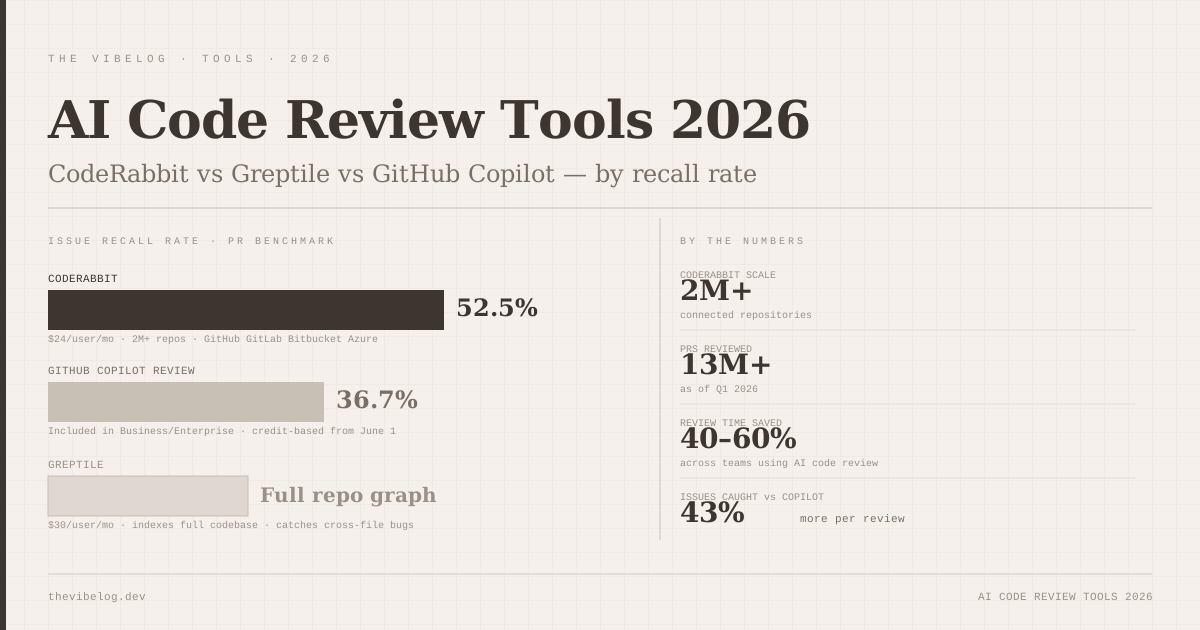
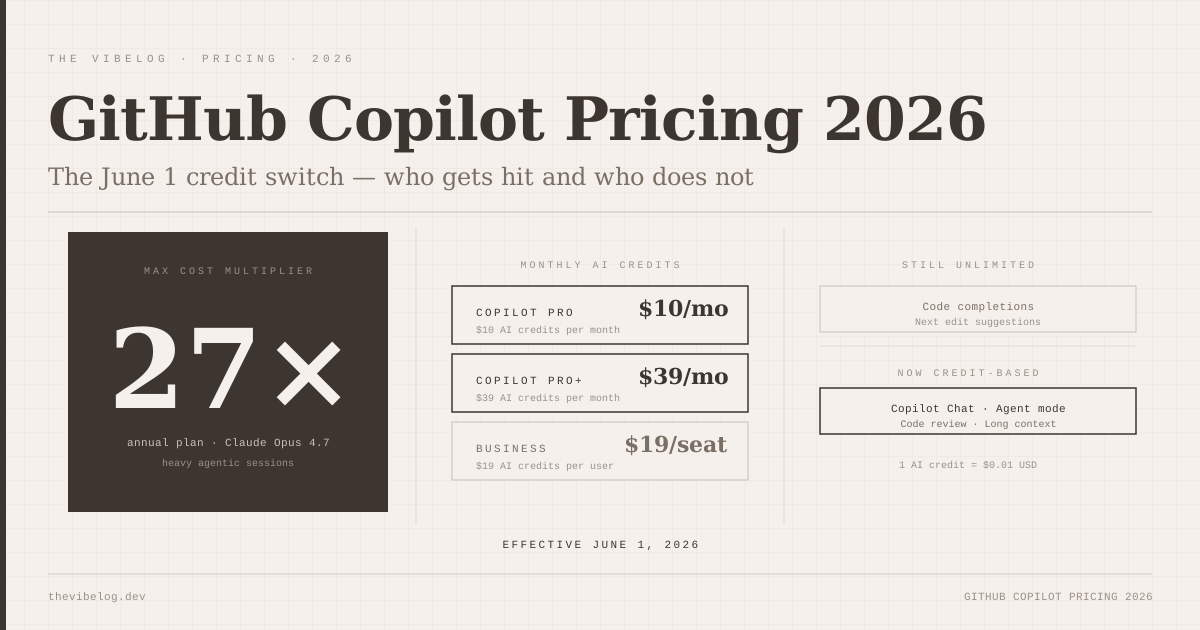
For a specific group — annual plan holders who have been running extended Claude Opus 4.7 sessions through Copilot Chat, or teams using Copilot’s agent mode heavily — the math is genuinely alarming. Tara Prasad Routray’s analysis on Level Up Coding documented annual subscribers facing up to a 27x cost multiplier on those interactions. Not 27% more. 27 times more effective cost per exchange.
Both of those statements are true at the same time.
How the new credit system actually works
Starting June 1, every GitHub Copilot plan switches to AI credits. One AI credit equals $0.01 USD. Every interaction that uses a premium model — a chat message, an agent session, a code review request — consumes credits based on the token count and the model used.
Copilot Pro: $10 per month = $10 in monthly AI credits
Copilot Pro+: $39 per month = $39 in monthly AI credits
Copilot Business: $19 per user per month = $19 in monthly AI credits
The plans are converting existing tiers to credit equivalents. The list prices on those plans are not changing. What is changing is what you get for that price when you move beyond the unlimited tier.
GitHub has published a preview billing tool in early May so developers can model their actual consumption before the June 1 switch. If you are currently on Pro, you can go check your projected credit usage now, before the billing model changes.
What stays unlimited — and what does not
This distinction is where most of the noise about the pricing change gets muddled.
Unlimited, regardless of credits:
Code completions (the primary autocomplete feature) and next edit suggestions remain unlimited on all paid plans. If you are using Copilot mainly for inline code suggestions — the thing most developers spend most of their time on — your bill does not change.
Credit-consuming:
Copilot Chat interactions, agent mode sessions, code review requests, and multi-turn conversations all consume credits at per-token rates based on the model selected. The longer the session, the larger the context you are providing, and the more capable the model — the more credits it costs.
This is the distinction that matters. A developer who uses autocomplete for eight hours a day and sends two short chat messages is paying roughly the same as before. A developer running three-hour Claude Opus 4.7 agent sessions through Copilot is about to see a very different bill.
The 27x multiplier explained — who it actually hits
The multiplier figure comes from annual plan mechanics. Annual Copilot Pro subscribers were locked into a pricing assumption that included a certain number of premium requests at a fixed amortised cost. When those interactions now get repriced at per-token rates using Claude Opus 4.7 — the most expensive model available at $25 per million output tokens — the effective cost per interaction can be substantially higher than what annual subscribers had implicitly been paying.
The people this hits hardest share a specific profile: they are on annual plans (so they committed to pricing based on old assumptions), they use Copilot Chat with premium models regularly, and they run long context sessions — code review of large PRs, agentic feature implementation, extended debugging sessions. Each of those interactions is token-heavy, and token-heavy + Claude Opus 4.7 is the most expensive combination available.
If you are a monthly subscriber and you use Copilot mainly for autocomplete, the 27x figure has nothing to do with your bill.
GitHub Copilot is multi-model now — and the model choice is a cost decision
This is the aspect of the 2026 Copilot that deserves more developer attention: it is no longer a single-model product. As of 2026, Copilot Chat and agent mode support:
- Claude Opus 4.7, Claude Sonnet 4.6, Claude Haiku 4.5 — Claude Opus 4.7 is the most capable and the most expensive
- GPT-5.4, GPT-5.5 — GPT-5.5’s token efficiency (roughly 72% fewer output tokens than equivalent older models on the same tasks) can offset its slightly higher per-token cost
- Gemini 3 Pro, Gemini 3 Flash — Gemini 3 Flash is the cheapest option for large context windows with no long-context surcharge
Under usage-based billing, your model selection is a direct cost lever. Running the same coding task through Claude Opus 4.7 versus Gemini 3 Flash produces meaningfully different credit consumption. If you are doing work where frontier coding performance matters — the kind of complex multi-file refactoring where Claude’s architectural reasoning is the differentiator — Opus 4.7 is the right call. If you are doing chat-based code explanation on a large file where any frontier model is good enough, Flash is a legitimate alternative that costs significantly less per session.
GitHub has published a model comparison page in their docs showing capability levels alongside credit costs. It is worth reading before June 1.
Copilot vs Cursor vs Claude Code — the 2026 cost map
The pricing change shifts where Copilot sits in the competitive landscape in ways that are non-obvious.
Copilot Pro at $10/month becomes the clearest value in the market for developers who primarily use autocomplete. Half the price of Cursor ($20/month), works in every editor, unlimited completions. If your main use case is inline suggestions and you do not run heavy agent sessions, this is still an excellent deal.
Copilot Pro+ at $39/month is now in a strange position. It is nearly double Cursor Pro and nearly double Claude Code’s monthly access fee, and its $39 credit allocation gets consumed by agent sessions faster than the equivalent Cursor usage quota. As covered in the AI tool comparison post, Cursor’s parallel agent mode is a tightly integrated product; Copilot’s agent mode is a layer on top of a UI built primarily for something else.
Claude Code at $20/month remains separate from Copilot entirely. Claude Code runs in the terminal, operates autonomously, and uses your Anthropic API credits for extended work. As covered in the reducing Claude API costs guide, the API cost on top of the subscription is real — but for developers doing complex autonomous work, the 87.6% SWE-bench Verified score on Opus 4.7 is a different product than what Copilot delivers through a chat interface.
The practical advice before June 1
Two things worth doing before the switch:
Check your projected usage in the preview billing tool GitHub launched in early May. It shows your likely credit consumption based on your actual usage patterns from recent months. If the projection is inside your plan’s credit allocation, you are fine. If it is not, you have ten days to decide whether to change plans or change your usage patterns.
Check which model your Copilot Chat is defaulting to. Several developer reports in April noted that Copilot defaulted to Claude Opus 4.7 for chat sessions after it was added to the roster — a significantly more expensive choice than GPT-5.4 or Gemini 3 Flash for routine queries. If you have been running extended chat sessions without checking the model selector, you may have been incurring token costs you did not intend.
The headline “GitHub Copilot pricing unchanged” and the reality of “annual plan holders facing 27x multiplier on Claude Opus agent sessions” are both technically true. The difference is whether you are using the product the way it was marketed or the way the most capable parts of it actually work at scale.
Pricing figures from GitHub Copilot official pricing page and GitHub Docs as of May 2026. 27x cost multiplier analysis from Tara Prasad Routray, Level Up Coding, April 2026. Model pricing from GitHub Copilot models and pricing documentation.