In February 2026 — almost exactly one year after he coined the term — Andrej Karpathy announced that vibe coding was effectively over. His replacement term was “agentic engineering,” and the distinction he drew was precise: you are not writing the code directly 99% of the time anymore. You are orchestrating agents who do, and acting as oversight.
The “engineering” part was intentional. Karpathy’s concern with pure vibe coding was that it shed the discipline along with the syntax. You could ship fast but you were not building systems — you were generating output and hoping it held together. Agentic engineering adds the word back: there is art, science, and expertise to it. The output should be production-grade, maintainable, and the result of someone who understood what they were building.
Whether you accept his framing or not, something real changed in early 2026. Teams that had been vibe coding for a year were starting to hit the technical debt and maintenance costs that come from twelve months of fast generation without discipline. The conversations in developer communities shifted from “how do I generate code faster” to “how do I structure agents so the output is something I can maintain.” That shift is what Karpathy was naming.
What the Shift Actually Changed
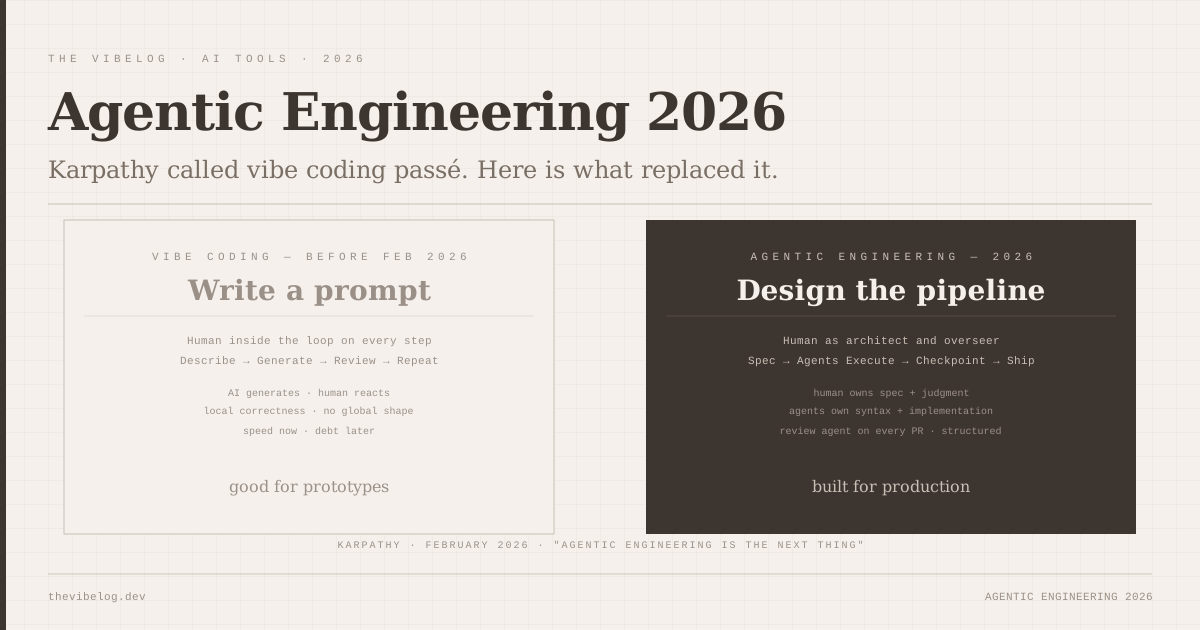
The practical difference between vibe coding and agentic engineering comes down to where the human sits in the process.
In vibe coding, the human writes a prompt, reviews the output, writes a correction prompt, reviews the corrected output, and iterates until the feature is done. The human is inside the loop on every step. The AI generates; the human reacts.
In agentic engineering, the human designs the pipeline. Which agent handles initial code generation? Which one handles security review? Which one runs tests and interprets the results? Where in that pipeline does human review happen — at every step, or only at defined checkpoints? The human is outside the individual steps and inside the overall architecture.
The difference in skill required is significant. Writing a good prompt for a specific task is a skill anyone can develop in days. Designing an agent pipeline that produces reliable, secure, reviewable output across a range of tasks is an engineering discipline. It requires understanding what agents are good at, what they systematically get wrong, how to structure tasks so agents can execute them without ambiguity, and how to design review checkpoints that catch agent errors before they propagate.
This is not a subtle distinction. Teams that vibe-coded their way to a working product and then tried to extend it with more vibe coding discovered the hard way that the speed advantage does not scale linearly — the more code you have, the more context an agent needs, and the more opportunities for inconsistency. Agentic engineering addresses that by adding structure to what was previously ad-hoc.
What Orchestrating Agents Looks Like in Practice
In concrete terms, an agentic engineering workflow for a new feature looks something like this:
The engineer writes a specification — not a prompt, a specification. What the feature does, what data it operates on, what the success criteria are, what the failure modes are, what the security requirements are. This is the thing vibe coding mostly skips and agentic engineering makes mandatory.
That specification goes to a generation agent — Claude Code, Cursor Composer, or a similar tool with full-codebase context — which produces an implementation. The specification is precise enough that the agent can follow it without making architectural assumptions.
The generated code goes through a review agent — CodeRabbit or an equivalent — which runs automatically and produces a structured review: potential bugs, security issues, style violations, missing test coverage. The engineer reads the review, not the code. The review is the human-facing summary of what the agent generated.
If the review surfaces issues, corrections go back to the generation agent. If the review is clean, the feature goes through automated tests. If tests pass, a human approves the final merge. The human’s involvement was: writing the spec, reading the review, and making the merge decision.
This pattern is what the agentic coding guide covers in depth — the design of these pipelines and the specific tool configurations that make them reliable. The conceptual shift Karpathy named is the move from treating agents as glorified autocomplete to treating them as collaborators with defined responsibilities.
The Skills That Transfer and the Skills That Don’t
Not everything from vibe coding translates to agentic engineering.
What transfers: The ability to describe requirements in language the AI can execute. Understanding of what AI tools are good at (locally correct code, standard patterns, common integrations) versus what they get wrong (edge cases, global consistency, performance). The discipline of reviewing AI output rather than trusting it. Basic security literacy — knowing to look for OWASP vulnerabilities in generated code.
What needs to be added: System design for agent workflows. Understanding of agent failure modes specific to autonomous execution — context drift over long tasks, tool misuse when agents have broad permissions, hallucination in areas where the agent’s training data is thin. The ability to write specifications precise enough that an agent can execute them without coming back for clarification. And judgment about when an agent’s output is correct but wrong — technically valid code that satisfies the spec but misses what the spec was trying to accomplish.
The most important new skill is what Karpathy described as the human acting as “oversight.” In vibe coding, oversight is reactive — you see the output and decide whether it is acceptable. In agentic engineering, oversight is structural — you design the process to surface the things that need human judgment at the right moments, rather than reviewing everything or reviewing nothing.
The Tool Stack Has Changed
The tool stack for agentic engineering differs from the vibe coding stack in meaningful ways.
Cursor is still relevant for interactive, session-by-session work. But the tools that matter most in agentic workflows are the ones that can operate autonomously without per-step human input.
Claude Code is the generation agent most widely used for complex, multi-file tasks. The 1 million token context window means it can hold a large codebase in context and make changes that are globally consistent with the existing code — a property that vibe coding with diff-based tools cannot guarantee. It is terminal-based, which means it fits naturally into automated pipelines.
Devin handles the autonomous backlog clearing use case — well-scoped tickets like library upgrades, test coverage expansion, and migration work that do not require product judgment. As covered in the Devin review, the economics work for teams where 20–30% of backlog items are clearly specifiable. Devin’s computer use self-verification (testing its own output in a real browser) is the capability that moves it from agentic coding toy to production tool.
CodeRabbit and AI code review tools are the review agent layer. Automating the first pass of every PR review — catching the 52.5% of issues that CodeRabbit catches in benchmark testing — is the single change that most clearly distinguishes agentic engineering from vibe coding. The review agent runs on every commit. The human reads the review, not the diff.
MCP servers are the connective tissue. Model Context Protocol allows AI agents to access external tools, databases, APIs, and services in a structured way. An agent that can read your internal documentation, query your analytics database, and check your deployment logs before making a code change makes better decisions than one generating in isolation. Designing the MCP server infrastructure your agents have access to is itself an engineering task — one that determines what your agents can know and do.
Why “Engineering” Is the Right Word
The pushback on Karpathy’s framing has been predictable: vibe coding was never just “vibes,” and agentic engineering sounds like a rebranding of what experienced developers were already doing. Both critiques have merit.
But the intent behind “engineering” matters. Karpathy specifically said you cannot outsource architectural understanding or the ability to catch subtle logical errors. The human role is not just oversight of whether the code works — it is ownership of the decisions that determine whether the system is the right system.
That is a higher bar than vibe coding’s implicit message, which was that good prompts could produce good systems without the human needing to understand the system. The evidence from twelve months of vibe coding at scale — the technical debt accumulation, the 90-day reckoning described elsewhere on this blog, the architectural breakdown from local-correct code without global coherence — is that this was not entirely true.
Agentic engineering does not require you to write code. It does require you to think in systems. The agents produce the syntax; the engineer provides the architecture, the review criteria, and the judgment about what is actually correct versus merely technically valid.
Is Vibe Coding Actually Dead?
No. The practice of generating code through natural language prompts and iterating on the output is more popular in May 2026 than it has ever been. 92% of US developers are doing it.
What is over — or what should be over — is the version of vibe coding that treated prompt quality as a substitute for engineering judgment. The “just describe what you want and ship it” model produces the debt that teams are hitting right now.
The transition Karpathy named is not from prompting to not-prompting. It is from unstructured prompting to structured orchestration. From generating output to designing processes. From reacting to agent output to specifying what agents should produce and reviewing whether they did.
Most developers are somewhere in the middle of this transition. The ones who are furthest along are the ones whose agentic workflows look like what Karpathy described: agents with defined responsibilities, human review at structured checkpoints, specifications that are precise enough to execute, and an engineer who understands the system the agents are building even if they are not writing the code.
That combination — agent speed with engineering judgment — is what the next two years of software development look like. Whether you call it agentic engineering or something else is less important than whether you are building it into how you work.
Karpathy February 2026 framing from The New Stack “Vibe coding is passé” analysis and Buttondown verified newsletter “The End of Vibe Coding,” February 2026. Agentic engineering definition from Andrej Karpathy statements reported by evoailabs Medium, April 2026. Tooling context from Frank’s World of Data Science and AI analysis. Grey Journal agentic engineering transition coverage, May 2026.