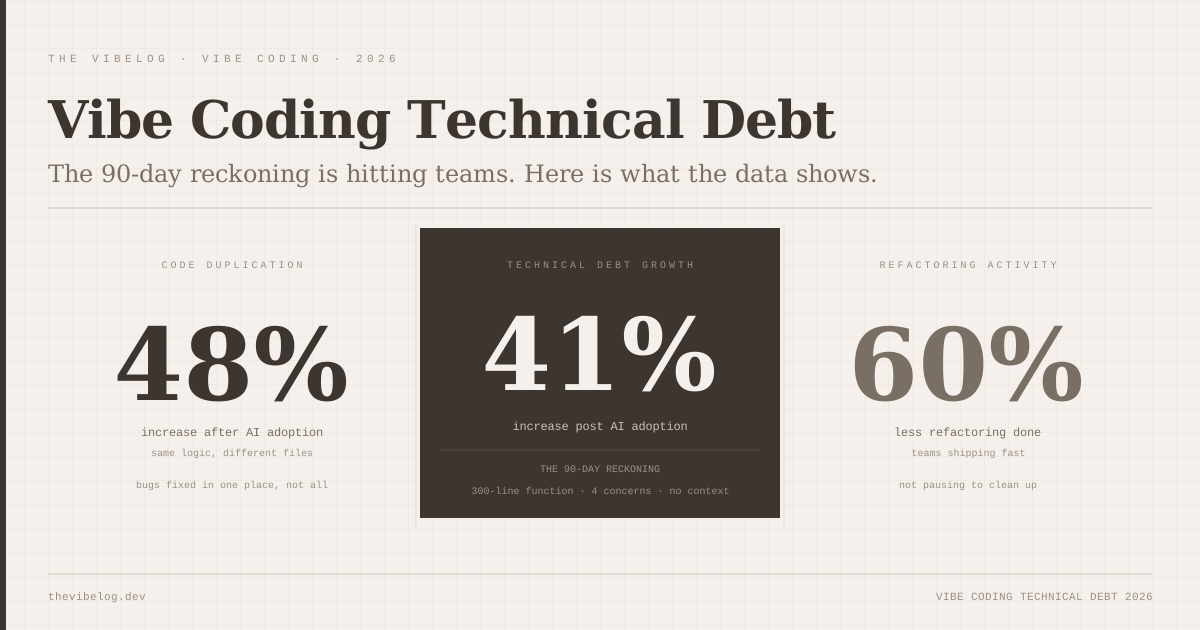
Around ninety days after a team ships their first vibe-coded product, a pattern appears. Someone opens a function to fix a small bug. The function is 300 lines long. It handles form validation, database writes, an email notification, and some business logic that references a constant defined five files away. There is no comment explaining why the email goes out only in certain conditions. The commit message says “add user flow.” The ticket has been closed.
That is the 90-day reckoning, and it is hitting teams everywhere in 2026.
Technical debt from AI-generated code has become a serious enough operational problem that Salesforce analysts named 2026 “the year of technical debt” specifically because of vibe coding adoption. The data is specific: technical debt increases 30–41% after AI coding tool adoption, according to engineering analyses published in early 2026 by Pixelmojo and Autonoma AI. Code duplication rises 48%. Refactoring activity drops 60%. And developers are shipping this code faster than ever, which means the debt accumulates at a proportionally faster rate.
This is not an argument against vibe coding. It is an argument for understanding exactly what kind of debt you are taking on when you use it — and how to stop.
What Actually Accumulates — The Four Failure Modes
Not all code is equally prone to vibe coding debt. The problems concentrate in recognisable places.
Duplicated logic across files. An AI tool solving a prompt generates the code it needs for that prompt. It does not search your codebase for an existing utility that does the same thing — and if it does, it does not consistently find it. The result: validation logic written three times in three different files. A date formatting function that exists in four variations. The same database query pattern copied and modified in six controllers. Duplication at this scale is not a cosmetic problem — it means bug fixes need to be applied in multiple places, and the places are not always obvious.
Functions with multiple unrelated responsibilities. An AI tool follows its instructions and adds adjacent functionality without creating clean boundaries. “Add a user registration endpoint” produces an endpoint that validates the email, hashes the password, inserts the record, sends a confirmation email, logs the event, and returns a response — all in one 80-line function. Each piece is locally correct. The function as a whole is impossible to test unit-by-unit and difficult to modify safely.
Missing error handling for paths that fail infrequently. The AI generates code that handles the case you described. It often does not generate code for the cases you did not describe: the database that is temporarily unavailable, the external API that returns 429, the file upload that is 1KB over the limit. Happy-path code works in testing and fails in production at 3am when none of the conditions you tested for are present.
“Works but nobody knows why” functions. The most expensive kind. Code that produces correct output through a chain of operations that make sense to the AI at generation time but have no apparent logic to a human reading it six months later. No author, no context, no obvious test case that explains the input-output relationship. These functions become load-bearing walls — everyone is afraid to touch them because nobody understands them.
The Borrowed Velocity Problem
The phrase “borrowed velocity” comes from the Autonoma AI analysis of vibe coding debt patterns, and it is the most accurate description of what is happening at the team level.
Vibe coding genuinely makes teams faster in the first 30–60 days. Features ship. Demos work. The backlog clears. That speed feels earned. It is partly earned — AI tools are genuinely productive. But a portion of that speed is borrowed from future maintenance time that has not arrived yet.
When it arrives, the cost is higher than expected because the debt is invisible until you try to change something. A vibe-coded codebase that passes all its tests and runs correctly in production shows no external sign of the debt it carries. The sign appears when the team tries to add a new feature and discovers that three existing features depend on an implicit behaviour that was never explicitly designed, only generated.
The 60% drop in refactoring activity during vibe coding adoption is the quantification of this problem. Teams ship faster precisely because they are not slowing down to refactor. The refactoring cost accumulates unpaid until the maintenance load forces it — typically around the 90-day mark on the first feature-rich product.
Architectural Breakdown — Local vs Global Correctness
The core technical reason vibe coding accumulates debt faster than traditional development is the difference between local and global correctness.
Local correctness means a function does what it says it does, given its inputs. AI tools produce locally correct code with high reliability. If you ask for a function that validates an email address, you get a function that validates email addresses.
Global correctness means the function fits coherently into the system — it shares conventions with other functions, propagates errors in the expected way, uses the same data structures as related operations, and does not assume things about the broader system that are not guaranteed. AI tools produce globally correct code only when the prompt includes enough context about the broader system, and most prompts do not.
The result is a codebase where every function is reasonable in isolation and the system as a whole has no coherent shape. Error handling conventions differ between modules written in different sessions. Data transformation happens in different layers depending on which session generated which module. The auth check is in the middleware in some places and in the controller in others. Each inconsistency is a small problem. Together they produce a codebase that is difficult to reason about and expensive to extend.
How to Audit Your Vibe-Coded Codebase
A debt audit for vibe-coded code runs four checks, and all four can be automated.
Complexity. Flag any function over 50 lines or with a cyclomatic complexity above 10. Tools: ESLint’s complexity rule, or a dedicated complexity analyser like complexity-report for JavaScript/TypeScript. Functions that exceed these thresholds are the candidates for splitting. Not every flagged function is a problem, but every one is worth looking at.
Duplication. Cross-file duplication does not show up in standard linters. Use jscpd (copy-paste detector) or SonarQube’s duplication analysis. Set a threshold — five or more lines duplicated across files — and review everything above it. Utilities that appear more than twice are candidates for extraction to a shared module. Utilities that appear more than four times are a problem.
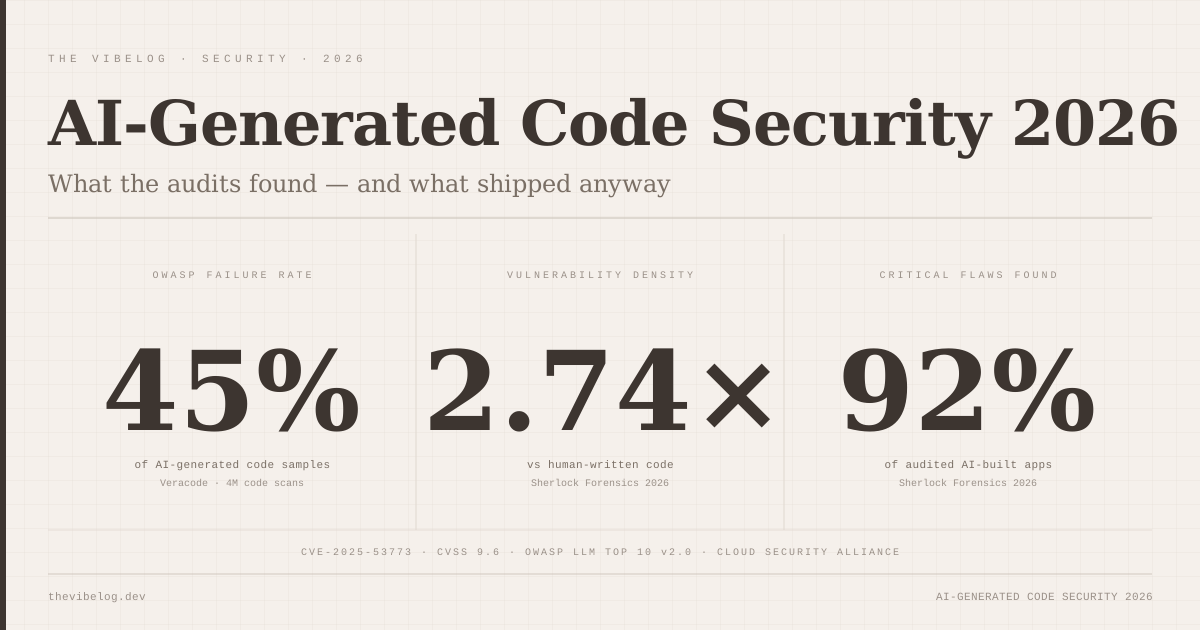
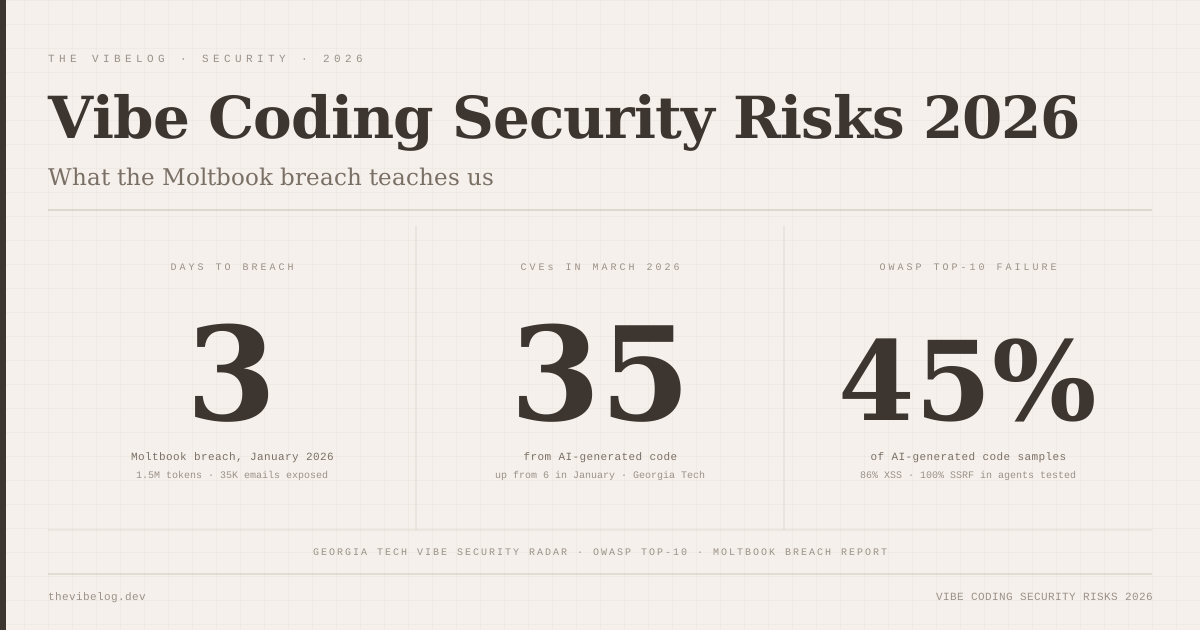
Security. Run Semgrep on the codebase with the OWASP Top-10 ruleset. As detailed in the AI-generated code security post, 45% of AI-generated code contains OWASP Top-10 vulnerabilities. Static analysis catches the common patterns — SQL injection via string concatenation, missing input validation, hardcoded credentials — that vibe coding produces with consistent frequency.
Dependencies. Run npm audit (or your package manager’s equivalent) and flag anything with high or critical severity that has an available fix. AI-generated package.json files often pull in the most recent dependency at generation time, which may no longer be the most recent version by the time you are running the audit. Outdated dependencies with known vulnerabilities are debt that accrues interest daily.
Run this audit on a two-week schedule during active development, not just before releases. Debt found at 60 days is a refactoring task. Debt found at six months with three more features built on top of it is a rewrite.
How to Vibe Code Without Accumulating Debt
The practices that prevent vibe coding debt are all pre-generation decisions, not post-generation cleanup.
Define the architecture before you prompt. Sketch the data model — what entities exist and how they relate — before you write any generation prompts. Decide where validation happens, where auth checks happen, how errors propagate. Describe this in a short context document (or a comment in the codebase) and reference it in your prompts. An AI tool given a coherent architecture to work within produces more globally consistent code than one generating the architecture as it goes.
One function, one responsibility. Every prompt for a function should specify exactly what it does and what it explicitly does not do. “An endpoint that validates the user email and returns success or the specific validation error — it does not send any emails or update any database records” produces a function that is easy to test and easy to find when you need to change how email validation works.
Mandate context on anything non-obvious. The “works but nobody knows why” problem is solved by prompting explicitly: “After writing the function, add a single comment explaining the non-obvious design choice, if any.” This is not about explaining what the code does — good function names handle that. It is about explaining why a specific approach was chosen when the alternative would have been reasonable.
Review for duplication before merging. Before merging any AI-generated feature, search the codebase for the utility functions it introduces. If a function called formatDate or validateEmail already exists somewhere, the AI generated a duplicate. Resolving duplicates at merge time costs ten minutes. Resolving them six months later when both versions have diverged costs a day.
The Junior Developer Gap Nobody Is Talking About
The vibe coding debt problem has a secondary consequence that is only starting to appear in hiring data.
54% of engineering leaders plan to hire fewer junior developers in 2026–2027 due to AI tool adoption, according to InfoWorld’s vibe coding analysis. The intended effect is cost reduction. The unintended effect is that the developers who would normally have built the debugging experience needed to navigate vibe-coded codebases are not being hired to build that experience.
The engineers needed in 2027 to maintain and extend vibe-coded systems — people who can read AI-generated code without the AI’s help, identify the debt, and fix it systematically — are the engineers who would have spent 2025–2026 as junior developers reading and modifying code they did not write. That development pipeline is being disrupted at exactly the moment when the maintenance need is growing.
The teams that are going to handle the vibe coding debt crisis of 2027 are the ones that kept their junior developers, gave them real maintenance tasks on AI-generated code, and let them build the debugging skills that AI tools do not need but humans absolutely do.
The Debt Is Not Inevitable
Vibe coding’s productivity gains are real. The 40–60% speed improvements in the vibe coding production analysis are documented by teams that shipped real products. The debt is also real, and the teams that manage it best are not the ones who avoided vibe coding — they are the ones who treated the review and audit steps as non-negotiable.
The architecture decisions you make before you prompt determine whether the generated code is debt or an asset. The review habits you build in the first thirty days determine whether the debt audit at ninety days reveals a manageable problem or a crisis.
The 90-day reckoning is coming for every team that is shipping fast right now. The question is whether it is a scheduled maintenance event or an emergency.
Technical debt statistics from Pixelmojo AI coding technical debt crisis analysis and Autonoma AI 90-day reckoning report, 2026. Code duplication and refactoring data from Amplifi Labs vibe coding hidden risks analysis. Junior developer hiring data from InfoWorld vibe coding gateway analysis. Salesforce Ben 2026 predictions report.