Devin was announced in 2024 as the world’s first fully autonomous software engineer. It ran SWE-bench at 13.86%, which made headlines. Then the industry moved: Claude Code hit 87.6% on SWE-bench Verified, GPT-5.5 followed at 88.7%, and Devin’s headline number stopped being the benchmark story.
What Devin became instead is a different product: not the benchmark leader, but the tool designed for a specific use case that the benchmark tools are not built for. Autonomous backlog clearing. Unsupervised execution on well-defined tasks. The engineering team member that works overnight without supervision and shows up with a stack of PRs in the morning.
Whether that is worth $500 per month depends entirely on how much of your backlog fits that description.
The pricing reality — what you actually spend
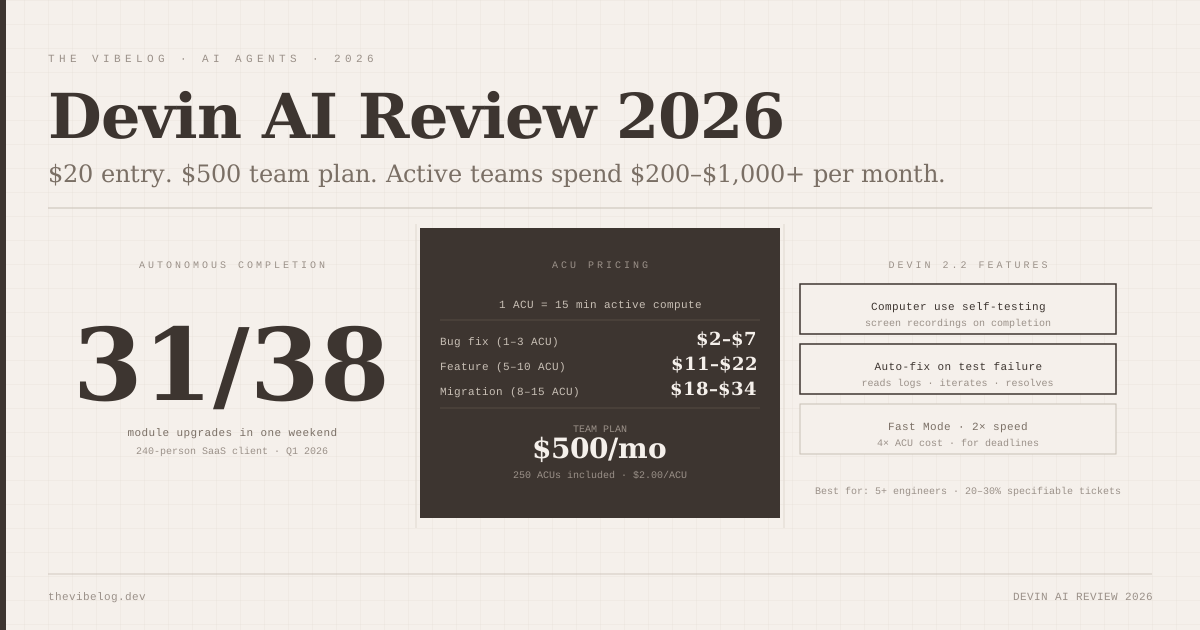
Cognition dropped Devin’s entry price to $20 per month with the 2.0 release. That number is real, but it is the floor, not the cost.
Devin runs on ACUs — Autonomous Coding Units. One ACU equals roughly 15 minutes of active compute. The rates:
- Core plan: $20/month + $2.25 per ACU
- Team plan: $500/month, includes 250 ACUs at $2.00/ACU
- Enterprise: Custom pricing, VPC deployment, SAML SSO
The math on real work:
- Bug fix (1–3 ACUs): $2.25–$6.75
- Feature implementation (5–10 ACUs): $11–$22
- Database migration or dependency upgrade (8–15 ACUs): $18–$34
- Legacy codebase refactor (15–40 ACUs): $34–$90
A team assigning five tasks per day — a reasonable backlog throughput — spends $50–$100 per day. Monthly, that is $1,500–$3,000 on the Core plan before the Team tier’s bulk discount applies.
The Team plan at $500/month with 250 ACUs included is the inflection point. If you can keep Devin consistently loaded with 250 ACUs of work per month, $500 is the right tier. Below that threshold, Core’s pay-as-you-go pricing is cheaper. Above it, the bulk rate drops the per-ACU cost from $2.25 to $2.00.
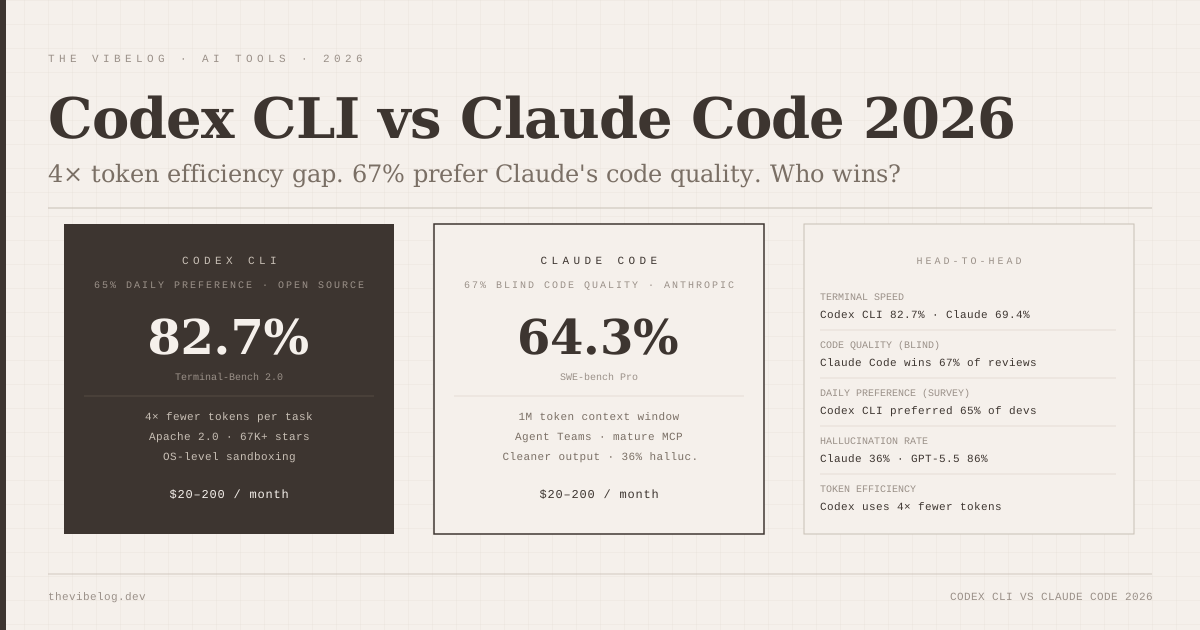
This is meaningfully more expensive than Claude Code, which runs at $100–200/month for heavy users with unpredictable API costs, or Codex CLI at similar all-in rates. But Devin is not competing on price-per-interaction — it is competing on whether fully autonomous execution is worth the premium over collaborative tools that require a developer to stay in the loop.
What Devin 2.2 actually does
Devin 2.2, the current version as of May 2026, added a capability that changes what autonomous coding means in practice: computer use for self-verification.
Earlier Devin versions wrote code and ran tests. If tests passed, Devin assumed the work was done. If tests failed, it tried to fix them. The limitation: tests do not always cover what a feature is supposed to do as a user experience.
Devin 2.2 can now launch the application it just built on its own Linux desktop, click through user flows, compare the behavior against the specification, and send back screen recordings so you can see exactly what it tested and what it found. When something breaks, Devin reads the error, fixes the code, tests again, and only asks for human input when it cannot resolve the issue autonomously.
This is the version of “autonomous” that the original announcement promised: the agent completes the full loop from specification to verified working code without human intervention at each step.
Fast Mode, also added recently, runs at 2x speed at 4x ACU cost. The trade is money for time — for tasks with hard deadlines, paying 4x the ACUs to get the result in half the time is a real option.
The enterprise proof points — with honest caveats
The concrete enterprise results for Devin in 2026 are credible enough to take seriously.
One 240-person SaaS client assigned Devin 38 module upgrades over a weekend. It completed 31 of 38 unsupervised. The remaining 7 required human intervention — all for the same reason: breaking API changes in the upgraded libraries that the specification had not anticipated. Devin identified the problem in each case; it did not know how to resolve API decisions that required product judgment.
Nubank, the Brazilian fintech, reported 4x speed improvement on specific categories of engineering work after deploying Devin with fine-tuning. Cognition has documented enterprise cases with 12x efficiency claims for tightly scoped backlogs.
The honest caveat: these are curated examples from the vendor and their customers, reported in the context of selling the product. The 31/38 completion rate on module upgrades is a real number — and it also shows clearly where Devin stops. The 7 failures were all architectural decisions embedded in what looked like mechanical upgrades. That is the failure mode that every autonomous agent has and that benchmarks like SWE-bench underweight: tasks that look like engineering but contain hidden product decisions.
The Cognition context — Windsurf, Devin, and what it means
Cognition AI now owns both Devin and Windsurf. As noted in the Windsurf Review, the acquisition raised questions about whether Windsurf would eventually become a Devin UI — an IDE layer for supervising autonomous agents rather than a tool for interactive development.
That question applies at the Devin level too, in reverse. Devin’s fully autonomous model and Windsurf’s IDE-with-agentic-layer are currently described as distinct products for distinct use cases. The architectural direction — Agent Command Center, parallel sessions, shared agent harness — is moving toward a unified platform where the distinction between “developer uses an IDE” and “developer supervises an agent” becomes blurry.
Whether that convergence helps or hurts depends on what you are trying to do. If you want to write code yourself with AI assistance, the convergence is unwelcome. If you want to supervise a fleet of agents processing your backlog, it is exactly what you would design.
Who should actually use Devin
The team profile that Devin works for is specific enough to be worth stating plainly:
Devin is worth it if:
- You have 5+ engineers and a backlog where 20–30% of tickets are clearly specifiable (library upgrades, test coverage, data migrations, refactoring to new patterns)
- You can keep it consistently busy — idle ACU capacity is money not returned
- You have the engineering discipline to write specifications clearly enough for autonomous execution
- You want PRs created and reviewed while your team sleeps
Devin is not worth it if:
- Your tickets are mostly ambiguous product decisions wrapped in engineering language
- You are an individual developer — Claude Code at $20/month is objectively better value
- Your work requires constant architectural judgment calls that do not reduce to specifications
- You need the highest code quality output — Claude Code produces cleaner code in blind reviews
The agentic coding guide on this blog covers the broader landscape of agentic workflows — and the pattern there applies here. Agentic tools perform best on well-scoped, deterministic work. Devin is the furthest end of that spectrum: fully autonomous, high ACU cost, high throughput on the right workload.
The teams getting 12x efficiency improvements are the ones with the right backlog composition. The teams spending $1,000/month to get slower output than a developer working with Claude Code are the ones who did not audit their tickets before signing up.
The bottom line
Devin 2.2 is a genuinely capable autonomous agent. The computer use self-verification closes a real gap in autonomous coding reliability. The enterprise results on well-defined backlogs are credible.
The economics work for teams where the ACU cost is less than the engineering time it replaces. For a 240-person SaaS company running 38 module upgrades, paying Devin’s ACU costs for a weekend of work versus pulling 2–3 engineers off their regular work for a sprint is a straightforward ROI calculation.
For everyone else — individual developers, small teams with complex work, teams without the operational discipline to write clear specifications — the $100–200/month you would spend on Claude Code or Codex CLI for collaborative assistance delivers more value per dollar and higher code quality in the output.
Pricing from Devin pricing page as of May 2026. ACU equivalency from Cognition documentation. Enterprise case studies from Cognition AI published case studies, Q1 2026. WeavAI Devin 2.0 review, May 13, 2026. Devin 2.2 features from Cognition official blog post.