Pull request review is the bottleneck that every engineering team eventually rationalises away. You merge before review is complete because the feature is urgent. You skim the diff because the reviewer understands the context and trusts the author. You miss the security issue in the function that was not in the diff but depended on a function that was.
AI code review tools exist to catch what humans miss when humans are busy. The question is which one catches enough of the right things to justify its cost — and whether any of them catch the issues that actually matter.
The market and why it exists now
The AI code review market is hitting roughly $2–3 billion in 2026 and growing at 30–40% annually. The growth is directly tied to two trends happening simultaneously: AI generates 46% of new code on GitHub, and that AI-generated code contains OWASP vulnerabilities at 2.74x the rate of human-written code.
Approximately 40–50% of professional developers now use some form of AI code review, up from 15–20% two years ago. The teams adopting it fastest are not the ones with the most developers — they are the ones who started shipping AI-generated code at scale and discovered their existing review processes were not built for the volume or the failure modes.
The most common entry point is a tool that posts automated comments on every pull request. The most common disappointment is that those comments are generic. The most useful implementations are the ones where the AI understands the codebase — not just the diff.
CodeRabbit: the default choice for most teams
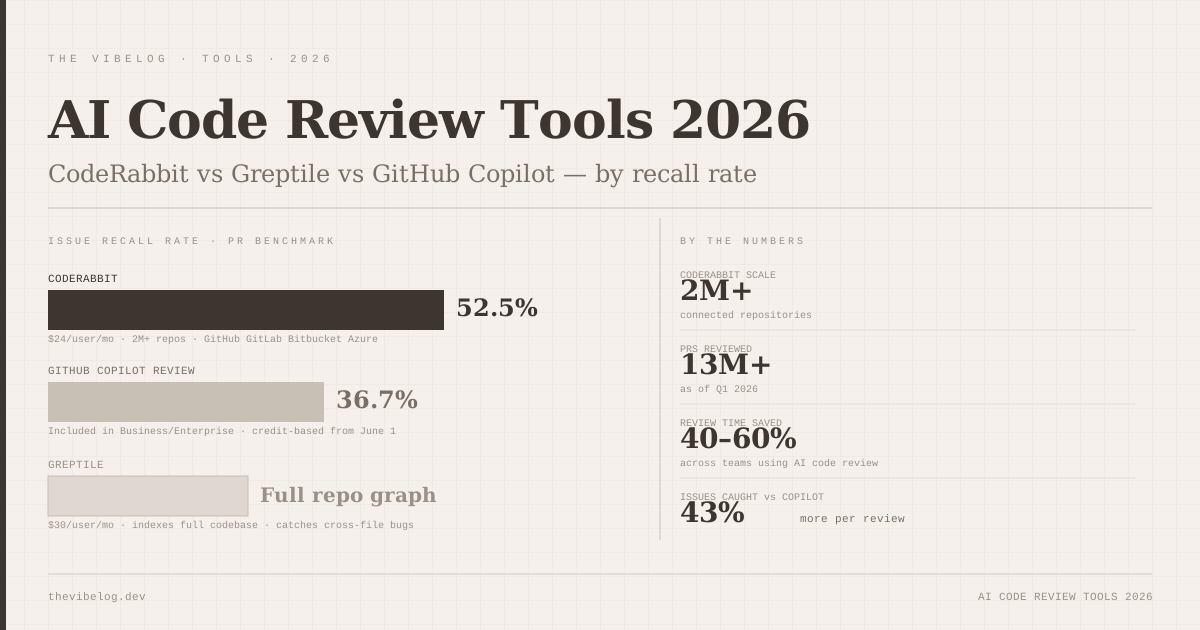
CodeRabbit is the largest dedicated AI code review product, with over 2 million connected repositories and 13 million pull requests reviewed as of early 2026. The 8,000+ paying customers include Chegg, Groupon, Life360, and Mercury.
The product works by reviewing pull request diffs using a combination of LLM analysis and built-in security rules. When a PR lands, CodeRabbit posts a summary, walkthrough, and specific line-level comments within seconds. The review covers logic issues, security patterns, documentation gaps, test coverage, and code style — the full surface area of what a human reviewer would assess.
The recall figure that matters: CodeRabbit catches 52.5% of issues in benchmark testing. GitHub Copilot’s built-in code review catches 36.7% — a 43% gap in issues caught per review. For teams choosing between adding CodeRabbit ($24/user/month) versus relying on Copilot’s built-in review (included but limited), that gap translates directly into bugs that either get caught at review or get caught in production.
Platform support: CodeRabbit works across GitHub, GitLab, Bitbucket, and Azure DevOps. This is the only tool in the category with full four-platform coverage. For organisations that have not standardised on a single platform, or that host different repositories across platforms for different teams, this removes the integration overhead that makes other tools impractical.
Pricing reality: Free tier for open-source projects with unlimited repositories. Pro at $24/user/month annual. The comparison to GitHub Copilot Enterprise ($39/seat/month) at lower recall is the argument CodeRabbit makes in its own marketing — and it is a legitimate one. Getting better code review for $15/seat/month less than what Copilot Enterprise costs is a real efficiency gain.
The gap CodeRabbit has not closed: it does not understand your codebase. It understands the diff. A change in one function that breaks an invariant in a distant module — something a developer familiar with the codebase would catch because they remember writing that invariant — is not in the diff and CodeRabbit will not find it.
Greptile: the tool that reads your whole codebase
Greptile’s bet is on full-codebase indexing. When you connect a repository, Greptile builds a code graph — it maps dependencies, traces how components relate, and indexes git history. When a PR arrives, Greptile’s review traces the change through the graph rather than analysing the diff in isolation.
The practical difference: a diff-based tool sees that you changed a function signature. Greptile sees that three other modules import that function and checks whether the callers still match the new signature. A diff-based tool sees you added a new endpoint. Greptile checks whether your authentication middleware pattern is applied consistently with how other endpoints in the codebase handle it.
This catches a category of bugs that diff-based tools cannot: cross-file dependency bugs, architectural consistency violations, and regression introductions where the changed code itself is correct but it breaks an assumption somewhere else in the system.
Pricing: $30/user/month with no free tier. More expensive than CodeRabbit by $6/user/month — about 25% higher.
Benchmark caveat: The bug detection numbers for Greptile versus CodeRabbit conflict depending on the source. Third-party benchmarks give CodeRabbit approximately 82% recall versus Greptile’s 44%. Greptile’s own benchmarks report the reverse — they claim to catch more than 50% additional bugs compared to CodeRabbit. The discrepancy is partly methodological: which class of bugs you are measuring matters enormously for which tool wins. Greptile catches cross-file architectural bugs that CodeRabbit misses; CodeRabbit catches common patterns and OWASP issues more consistently.
The honest picture is that Greptile is better for complex codebases where architectural consistency is the main risk, and CodeRabbit is better for broad PR hygiene across all the common failure modes.
GitHub Copilot code review: the built-in option
Since June 1, 2026, GitHub Copilot’s code review feature is credit-based — it consumes AI credits from your monthly plan allocation. The transition was covered in the Copilot pricing post on this blog. The net effect: teams that relied on Copilot code review as part of their “included” Business or Enterprise plan now need to account for credit consumption.
At 36.7% recall versus CodeRabbit’s 52.5%, Copilot code review is the weakest performer on issue detection. What it has that the dedicated tools do not: it is already in your GitHub workflow with no additional integration required, it uses the same model selection as the rest of Copilot (Claude, GPT-5.5, Gemini — your choice), and for teams that are not primarily concerned with maximising defect detection, it is a reasonable option without additional cost or tooling.
Copilot code review is a generalist feature in a generalist product. It is better than nothing and worse than CodeRabbit on the metrics that code review is specifically supposed to optimise.
The security layer that none of them replace
A meaningful limitation applies to all three tools: AI code review is probabilistic, not deterministic. These tools apply LLM analysis to code — they produce predictions about likely issues, not guarantees about specific vulnerabilities.
For OWASP Top-10 security vulnerabilities specifically, a dedicated static analysis tool in CI — Semgrep is free and covers the most common failures — is more reliable than LLM-based review. The combination that actually covers both categories is AI code review for logic and maintainability issues, plus a security linter in CI for OWASP coverage.
The AI code security post covers the specific failure modes in AI-generated code that make this non-optional: 78% of AI-built applications stored credentials in plaintext, 45% of AI-generated code fails OWASP benchmarks. AI code review tools catch some of this; they do not catch all of it.
The 40–60% review time reduction — what it actually means
Teams using AI code review consistently report 40–60% reductions in time spent on reviews. This number is real and worth understanding specifically.
The time saved is primarily in the first-pass review — reading the diff, catching obvious issues, understanding what changed and why. AI tools do this instantly and post the results before a human reviewer sits down. When the human reviewer opens the PR, they see the AI summary, the flagged issues, and the walkthrough. They can focus on the things that require judgment — architectural decisions, product context, edge cases the AI did not consider — rather than starting from scratch.
What the 40–60% figure does not capture: human reviewers still need to review the AI’s comments for accuracy. False positives create noise. Developers learn to tune out consistently incorrect AI feedback, which erodes the signal-to-noise ratio over time. The teams getting the most value from these tools actively configure them — setting up custom rules, suppressing noisy checks, adding project-specific instructions — rather than running defaults indefinitely.
Which tool for which team
CodeRabbit: Default choice for most teams. Best for organisations on multiple platforms, teams wanting the highest recall at the lowest cost relative to Copilot Enterprise, and open-source projects (free tier is genuinely useful). If you have not tried AI code review before, start here.
Greptile: Best for complex legacy codebases where architectural consistency is the primary risk, teams where cross-file dependency bugs are the expensive failure mode, and organisations where the extra $6/user/month is not a constraint. Not a good fit for early-stage teams with simple codebases — the codebase graph adds value in proportion to the complexity it can trace.
Copilot code review: Best for teams already on GitHub Copilot Business or Enterprise who want zero additional tooling. Acceptable for light review coverage. Not the right choice if defect detection is the primary objective.
All three together: not necessary. CodeRabbit plus a security linter in CI covers the important bases better than any AI code review tool alone — and costs less than Copilot Enterprise.
CodeRabbit repository and PR counts from CodeRabbit blog, Q1 2026. Recall figures from Morph LLM code review benchmark, April 2026. Market size from AI code tools market analysis, 2026. Developer adoption statistics from GetPanto AI coding statistics report, 2026. Review time reduction from CodeRabbit customer case studies.