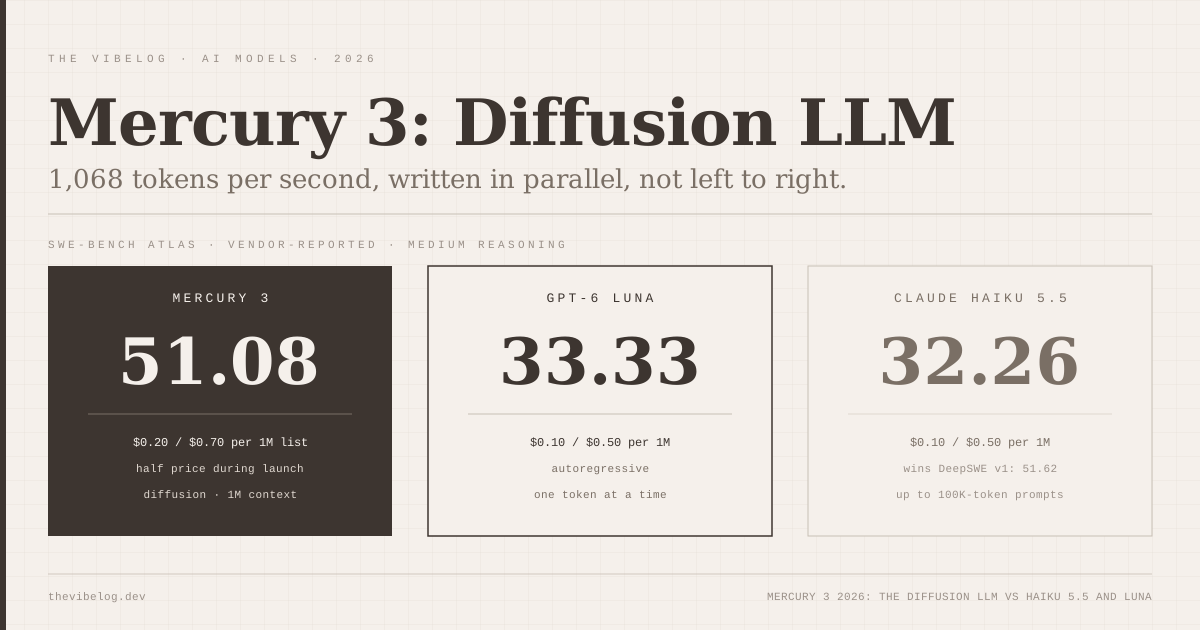
Mercury 3 is the first diffusion language model that posts benchmark numbers in the same range as the cheap frontier tier, and it does it at a claimed 1,068 tokens per second. Inception released it on October 19, 2026, and its launch chart has Mercury 3 beating Claude Haiku 5.5 and GPT-6 Luna on 8 of 12 benchmarks.
That is a big claim from a small lab, and every number in it is vendor-reported. I went through Inception’s launch post, the API docs, the benchmark chart and the first independent hands-on review to work out what a diffusion LLM actually buys you and where the launch story gets thin.
What Is a Diffusion Language Model?
A diffusion language model generates a whole block of text as a rough draft, then refines many token positions in parallel over several passes. Claude, GPT and Gemini are autoregressive: each token waits for the one before it, so output speed is capped by how fast the model can run one forward pass after another.
Diffusion flips that. The model fills in a block, scores it, and fixes the weak spots everywhere at once. The Neuron’s reviewer compared it to an editor revising several parts of a draft at the same time instead of a writer typing left to right, which is the cleanest description I have seen.
The payoff is throughput. Parallel refinement uses GPU compute that autoregressive decoding leaves idle, which is how Inception gets four-digit tokens per second on standard NVIDIA hardware without custom chips.
The open question has always been quality. Inception’s headline claim for Mercury 3 is that this gap has closed: “The scaling laws that drove progress in autoregressive models hold for diffusion too.” According to The Neuron, Inception says Mercury 3 has over 40 times the total parameters of Mercury 1 with roughly three times the aggregate intelligence at similar throughput.
If that claim survives independent testing, diffusion stops being a speed trick and becomes a real architecture choice for agents.
Mercury 3 Specs and Pricing
Here is what Inception has published, cross-checked against its docs and OpenRouter’s listing:
- Release: October 19, 2026
- Speed: 1,068 output tokens per second on NVIDIA GPUs (vendor-measured), “4–8x faster” than the compared models
- Context window: 1M tokens, up from 260K on Mercury 2.5
- API: OpenAI-compatible chat completions; on OpenRouter as
inception/mercury-3withtools,tool_choice,response_formatandreasoning_effortsupported - Reasoning effort:
instant,low,medium,high, and the Inception docs saymercury-3defaults tolow - Where: Inception API, OpenRouter, Baseten and Vercel, plus 100 million free API tokens for new accounts
- Weights: none, it is a proprietary API model
That reasoning default deserves a flag. The benchmark chart was run at medium. If you call the API without setting reasoning_effort, you get low, which is faster but is not the model in the chart.
| Model | Input / 1M | Cached input / 1M | Output / 1M | Context |
|---|---|---|---|---|
| Mercury 3 (launch) | $0.10 | $0.01 | $0.35 | 1M |
| Mercury 3 (list) | $0.20 | $0.02 | $0.70 | 1M |
| Claude Haiku 5.5 (≤100K prompt) | $0.10 | $0.01 | $0.50 | 1M |
| GPT-6 Luna | $0.10 | n/a | $0.50 | n/a |
| MiniMax M3.1 Flash | $0.15 | $0.015 | $0.60 | n/a |
(Source: Inception launch post; Claude Platform Docs; MiniMax launch post; OpenAI pricing via CellCog. Mercury cached price = 90% off input.)
The launch pricing is the trap. Inception has not said when the 50% discount ends, and at list price Mercury 3’s output costs 40% more than Haiku 5.5 or Luna. If your workload is output-heavy, budget at $0.70, not $0.35.
One thing does favour Mercury on long prompts. Claude Haiku 5.5’s docs charge $0.50 input and $2.50 output once a prompt crosses 100,000 tokens, and coding agents cross that line constantly. Inception’s launch post lists a single rate and mentions no long-context surcharge. For a 300K-token codebase prompt, list-price Mercury 3 would be the cheaper of the two by a wide margin, if its quality holds at that length.
The full side-by-side for every current model is on the AI model pricing tracker.
Mercury 3 vs Claude Haiku 5.5 vs GPT-6 Luna: Benchmarks
Inception’s blog post itself contains no benchmark table. The numbers come from a chart image, transcribed by CellCog and cross-checked against BenchLM’s model page, which notes every score is from Inception’s medium-reasoning run.
| Benchmark | Mercury 3 | GPT-6 Luna | Claude Haiku 5.5 |
|---|---|---|---|
| GPQA Diamond | 89.23 | 86.36 | 84.51 |
| IFBench | 76.84 | 61.82 | 54.65 |
| MultiChallenge | 60.35 | 51.49 | 52.48 |
| SWE-Bench Atlas | 51.08 | 33.33 | 32.26 |
| DeepSWE v1 | 46.31 | 37.76 | 51.62 |
| BrowseComp+ | 55.18 | 50.50 | 45.78 |
| DeepSearchQA | 71.33 | 60.00 | 65.22 |
| τ³-bench Banking | 30.24 | 23.00 | 13.06 |
| MRCR v2 | 75.50 | 62.72 | 78.40 |
| AA-LCR v1.1 | 77.67 | 78.30 | 74.70 |
| AA-Omniscience | 46.44 | 46.94 | 37.22 |
| GDPval (Elo) | 1,237.2 | 1,204.0 | 1,225.0 |
(Source: Inception’s Mercury 3 launch chart, medium reasoning, vendor-reported, as transcribed by CellCog and BenchLM.)
- Mercury 3 51.08
- GPT-6 Luna 33.33
- Claude Haiku 5.5 32.26
Source: Inception, Mercury 3 launch chart (Oct 2026), via CellCog
The coding rows are where I would push back hardest. SWE-Bench Atlas shows an 18-point lead over Haiku 5.5, which is enormous for models at the same price. DeepSWE v1 goes the other way, with Haiku 5.5 ahead by 5 points.
Two coding benchmarks disagreeing that sharply usually means one of them rewards something specific about the model’s style. My guess is that Atlas, a codebase question-and-answer style eval, suits a model that reads fast and answers precisely, while DeepSWE’s multi-step repair tasks still favour Haiku’s agent tuning. Neither number tells you how Mercury 3 behaves inside a real harness like Claude Code or Codex after 40 tool calls.
The instruction-following gap is the more surprising result. IFBench at 76.84 against Haiku’s 54.65 is a 22-point lead, and format adherence is exactly what small models used as subagents and routers need.
On Inception’s chart Mercury 3 is the strongest of the three on general reasoning and instruction following, while Haiku 5.5 still wins the agentic coding benchmark and long-context recall.
What Independent Testing Shows So Far
Very little, and that is the honest answer. Artificial Analysis had not published speed or quality numbers when this post went up, and BenchLM lists Mercury 3 as unranked with 8 of its 668 tracked benchmarks covered.
The best outside look is The Neuron’s hands-on review, which ran eight prompts through OpenRouter for a total of $0.0416. That is not a benchmark, but the pattern is useful:
- Coding was the strongest result. It produced a single-file HTML dungeon crawler that passed a syntax check and 2,000 randomized map checks with zero failures, though full gameplay was not verified.
- Constraint following slipped. A 250-word story came back at about 274 words and broke the one-room setting.
- Facts wobbled. It correctly rejected a fictional 1987 NASA mission but added an incorrect supporting claim about Shuttle launches.
- Speed was not reproduced. The reviewer said the API felt fast but could not confirm 1,068 tokens per second.
The reviewer’s verdict was “exciting and inexpensive” with rough edges in precision. That matches what I would expect from a model whose chart lead is in reasoning and whose weak spot is accuracy on specifics: AA-Omniscience at 46.44 is a knowledge score, and it is a tie with Luna, not a win.
Until third-party evals land, treat the 8-of-12 claim as a reason to test Mercury 3, not a reason to migrate.
Where Mercury 3 Fits in a Coding Agent Stack
Speed matters most when a model sits in a loop. A browser agent, a search tool or a coding subagent might make dozens of short sequential calls per task, and each one waits for the full response. At 1,068 tokens per second, a 500-token tool plan comes back in under half a second of generation time, where a 100 tokens-per-second model takes five.
That is the slot I would test Mercury 3 in:
- Subagents and routers. Codebase search, file summaries, test-log triage, deciding which tool to call next. This is the work I described Claude Haiku 5.5 doing in the Haiku 5.5 subagent setup, and Mercury’s IFBench lead suggests it will follow output formats more reliably.
- Inline edits and autocomplete. Latency is the whole product here, and a developer waiting on a suggestion feels every 100 milliseconds.
- Voice and realtime agents. Inception ships a separate Mercury Voice model tuned for time to first answer token, and the
instanteffort level exists for this.
I would not make it the main agent on a long refactor yet. Haiku 5.5’s DeepSWE lead, the missing third-party agentic results and the medium-vs-low reasoning default all point the same way. If you run agentic coding workflows where one bad step costs ten more tool calls, a faster wrong answer is not a saving.
Integration is cheap to try. Because the API is OpenAI-compatible, any harness that lets you set a base URL and model name works. On OpenRouter it is one model string change. Set reasoning_effort: "medium" explicitly so you are testing the benchmarked configuration.
Inception also sells Mercury Decide for high-volume classification and claims it beats TypeSafe Jev on JevBench and LegalBench, without publishing figures. If you are evaluating that category, the AI decision models comparison covers Jev, Clef and pplx-decider with real numbers.
The Same-Day Rival: MiniMax M3.1 Flash
Mercury 3 did not launch alone. MiniMax released M3.1 Flash on the same day at $0.15 input, $0.015 cached and $0.60 output per million tokens, claiming 200+ tokens per second, a vendor-reported 73.7% on DeepSWE v1.1 and an agentic-task cost about 70% lower than its predecessor. MiniMax also confirmed it was the anonymous “Space Bunny” model testers had been using.
That DeepSWE number is on v1.1, not the v1 in Inception’s chart, so the two are not directly comparable. What the pair does show is that the sub-$1 output tier now has four serious options from four labs, and the price floor is set by launch discounts rather than list prices.
Should You Switch to Mercury 3?
Not yet for your main coding agent. Yes for a test on anything latency-bound.
The case for testing is strong. A model that is 4–8x faster than Haiku 5.5, beats it on instruction following and has no long-prompt surcharge would be a better subagent for most agent stacks. The 100 million free tokens make the experiment nearly free.
The case for waiting is that every quality number is Inception’s own, the launch price has no end date, and the only independent review found the kind of small accuracy slips that compound in agent loops. I would run it alongside Haiku 5.5 on a week of real subagent traffic, at medium effort, and compare failure rates rather than benchmark rows.
If you are worried about what fast, cheap models mean for security work, the same week brought Anthropic’s free OSS Scanner for open-source maintainers, which shows the opposite end of the spectrum: slow, expensive frontier models run where accuracy is the whole point.
Mercury 3 is the strongest evidence yet that diffusion can compete on quality, and the right response is a controlled test, not a migration.