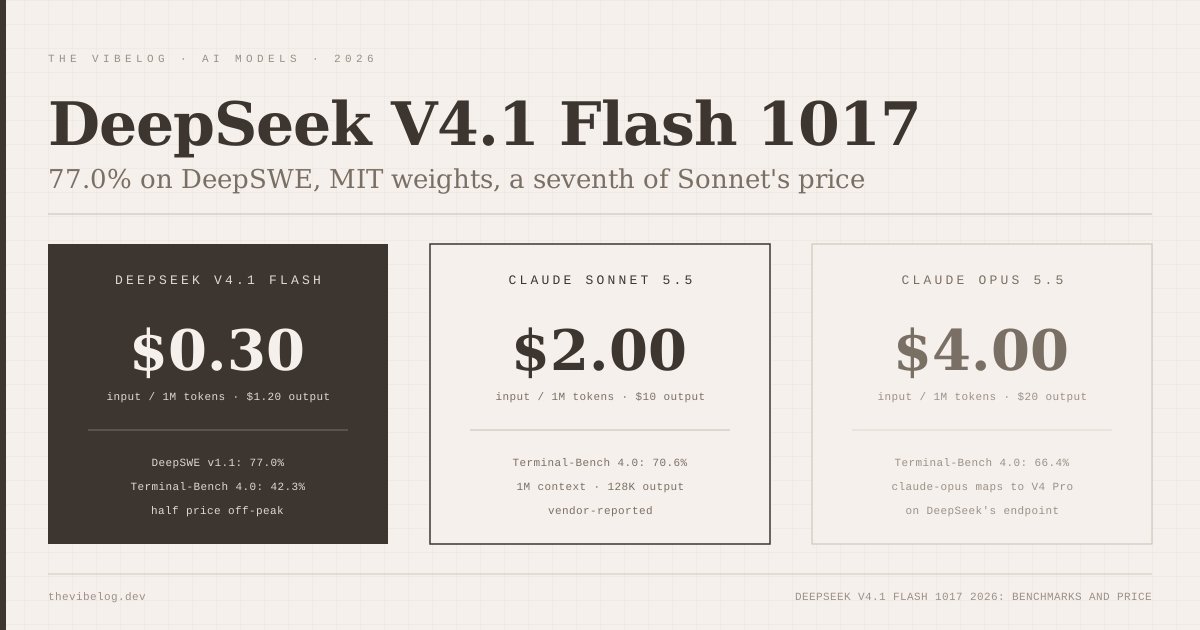
DeepSeek V4.1 Flash 1017 is the cheapest model I would now consider pointing Claude Code at. DeepSeek released it late on October 17, 2026, as open weights under the MIT license, and reports 77.0% on DeepSWE v1.1 at the same price as before: $0.30 per million input tokens and $1.20 per million output tokens.
That DeepSWE score is three points ahead of Claude Opus 5 in DeepSeek’s own table. It is also 9.5 points behind Opus 5 on Terminal-Bench 4.0, and DeepSeek chose not to compare against Opus 5.5 or Sonnet 5.5 at all.
So the real question is not “is it as good as Claude.” It is whether a model that costs roughly a seventh of Claude Sonnet 5.5 per token is good enough for the work you actually hand to an agent.
What Is DeepSeek V4.1 Flash 1017?
DeepSeek V4.1 Flash 1017 is a minor update to V4.1 Flash, the model DeepSeek shipped in September. The Hugging Face model card says it brings improvements “across reasoning, coding, agentic tasks, and visual benchmarks,” along with reduced task execution time and shorter outputs.
The basic facts, from the card and DeepSeek’s pricing page:
- License: MIT for both the code and the weights
- Size: Hugging Face lists 763B parameters; the card does not state an active-parameter count
- Context: 1M tokens, with up to 384K output on the API
- Input: text and images (vision is supported on
deepseek-flash, not ondeepseek-v4-pro) - Formats: BF16 and FP8 tensors in the repository
- API name:
deepseek-flash, which now serves the 1017 version
The “shorter outputs” claim is the one I care most about for agent work, and it is also the vaguest. tbreak’s coverage quotes DeepSeek promising “faster task completion, and shorter outputs than the previous version,” but neither DeepSeek nor the outlets publish a percentage. Fewer output tokens per task would cut cost more than any price change, so I would want to measure it on my own workload before quoting it.
The old names deepseek-v4-flash and deepseek-v4-flash-vision-exp are retired. Requests that use them are now served by V4.1 Flash 1017 and billed at the Flash price.
DeepSeek V4.1 Flash Benchmarks vs Claude and GPT
Every number below is vendor-reported by DeepSeek on its model card. DeepSeek notes that Terminal-Bench 4.0 was run in the Claude Code harness and DeepSWE v1.1 in the Mini-SWE-V2 harness.
| Model | DeepSWE v1.1 | Terminal-Bench 4.0 | ProgramBench | NL2Repo-Bench |
|---|---|---|---|---|
| DeepSeek V4.1 Flash 1017 | 77.0 | 42.3 | 29.1 | 68.2 |
| DeepSeek V4.1 Flash | 74.2 | 31.2 | 20.3 | 65.4 |
| Claude Opus 5 | 74.0 | 51.8 | 37.0 | 75.3 |
| GPT-5.6 Sol | 73.0 | 39.9 | 23.0 | 56.8 |
| Kimi K3 | 67.5 | 12.6 | 17.5 | 58.0 |
| GLM 5.3 | 66.9 | 37.9 | 19.0 | 58.0 |
(Source: DeepSeek-V4.1-Flash-1017 model card on Hugging Face, Oct 2026; all scores vendor-reported)
- DeepSeek V4.1 Flash 1017 77%
- DeepSeek V4.1 Flash 74.2%
- Claude Opus 5 74%
- GPT-5.6 Sol 73%
- Kimi K3 67.5%
- GLM 5.3 66.9%
Source: DeepSeek, DeepSeek-V4.1-Flash-1017 model card (Oct 2026)
Three things stand out to me.
The jump from the September release is real on agentic work. Terminal-Bench 4.0 went from 31.2% to 42.3%, and ProgramBench from 20.3% to 29.1%. Those are the benchmarks where an agent has to plan, run commands and recover from errors, which is exactly where cheap models usually fall apart.
The comparison set is a generation old. Claude Opus 5 and GPT-5.6 Sol are not the current frontier. Anthropic reports Claude Opus 5.5 at 66.4% and Claude Sonnet 5.5 at 70.6% on Terminal-Bench 4.0, though harness differences mean those figures are not directly comparable with DeepSeek’s run. Read honestly, V4.1 Flash 1017 is still well short of current Claude models on long terminal tasks.
DeepSWE is its best showing. That benchmark rewards resolving well-specified repository issues. If most of your agent tasks look like “fix this failing test” or “implement this ticket,” the gap to Claude is smaller than the Terminal-Bench numbers suggest.
DeepSeek also reports wins on Automation-Bench v1.0.6 (60.5 vs Opus 5’s 50.3) and Apex Bench v1.1 (72.1 vs 65.8). I would wait for independent runs, such as Artificial Analysis, before leaning on any of these.
My read: a large step up from September and competitive with last generation’s frontier on issue-style coding, but not a Claude Sonnet 5.5 replacement for long autonomous terminal sessions.
DeepSeek V4.1 Flash Pricing vs Claude Sonnet 5.5
This is where the model earns its place. DeepSeek kept the price unchanged with the 1017 update.
| Model | Input (cache miss) | Cached input | Output |
|---|---|---|---|
| DeepSeek V4.1 Flash (peak) | $0.30 | $0.006 | $1.20 |
| DeepSeek V4.1 Flash (off-peak) | $0.15 | $0.003 | $0.60 |
| DeepSeek V4 Pro 0813 (peak) | $1.32 | $0.044 | $3.96 |
| Claude Sonnet 5.5 | $2.00 | $0.10 | $10.00 |
| Claude Opus 5.5 | $4.00 | $0.20 | $20.00 |
(Source: DeepSeek Models & Pricing page and Anthropic list prices, per 1M tokens, Oct 2026. Full list on the AI model pricing tracker)
Off-peak is half price. DeepSeek defines peak as 01:00 to 04:00 and 06:00 to 10:00 UTC, Monday to Friday, excluding Chinese public holidays. Everything else, including weekends, is off-peak. For a European or American team, most of the working day falls outside those windows.
To make the gap concrete, take an illustrative agent task with 1.5M input tokens, of which 1.2M are cache hits, plus 60K output tokens. At list prices, ignoring cache-write premiums:
- DeepSeek V4.1 Flash (peak): about $0.17
- Claude Sonnet 5.5: about $1.32
- Claude Opus 5.5: about $2.64
That is roughly 7.8x cheaper than Sonnet 5.5. Treat it as a ceiling on the savings, not a forecast. Different tokenizers count the same code differently, and a model that needs two attempts where Sonnet needs one erases a lot of the gap. I made the same point about routing in the Together Link guide to open models in Claude Code: the per-token price is only half the cost equation.
Search and Fetch APIs
DeepSeek also opened its Search and Fetch APIs to outside developers. The pricing page lists both at $0.75 per 1,000 successful requests, deducted from the same balance as token usage.
There is a deadline here worth putting in your calendar. Server-side tool calls from DeepSeek Harness, Claude Code and Codex are currently free, and DeepSeek says per-request billing starts at 00:00 Beijing time on November 1, 2026.
Bottom line on price: for bulk agent work outside peak hours, V4.1 Flash costs single-digit percentages of what Claude Sonnet 5.5 does.
How to Use DeepSeek V4.1 Flash in Claude Code
DeepSeek runs an Anthropic-compatible endpoint, so Claude Code works with environment variables alone. These come straight from DeepSeek’s Claude Code integration guide:
export ANTHROPIC_BASE_URL=https://api.deepseek.com/anthropic
export ANTHROPIC_AUTH_TOKEN=<your DeepSeek API Key>
export ANTHROPIC_MODEL=deepseek-flash[1m]
export ANTHROPIC_DEFAULT_OPUS_MODEL=deepseek-flash[1m]
export ANTHROPIC_DEFAULT_SONNET_MODEL=deepseek-flash[1m]
export ANTHROPIC_DEFAULT_HAIKU_MODEL=deepseek-flash
export CLAUDE_CODE_SUBAGENT_MODEL=deepseek-flash
export CLAUDE_CODE_EFFORT_LEVEL=max
export CLAUDE_CODE_AUTO_COMPACT_WINDOW=786432
Then cd into your project and run claude as normal. The guide also has a PowerShell version for Windows.
A few details from DeepSeek’s Anthropic API reference that will bite you if you skip them:
- Model name mapping. Any model name starting with
claude-opusis routed todeepseek-v4-proand billed at the V4 Pro price. Names starting withclaude-sonnetorclaude-haikugo todeepseek-flash. That is why the guide overrides the Opus slot explicitly. Leave it out and every/model opusswitch costs you about four times more. - Ignored fields.
cache_control,mcp_servers,top_k,service_tierandcontainerare ignored. Your local MCP servers still work, because Claude Code runs them on your machine, but anything that relies on server-side MCP will not. - Thinking. The
thinkingparameter is supported butbudget_tokensis ignored. Onlyeffortis honoured inoutput_config. - Web search. DeepSeek says its API supports Claude Code’s web search natively, billed under the Search API terms once the free period ends.
One security note. Put that key in your shell profile or a local secrets manager, not a hosted dashboard. Today’s post on the OpenCode Console breach is a good reminder of what happens when third-party keys sit in someone else’s database.
One billing note: this setup bills your DeepSeek balance, not your Claude plan. If you already pay a flat rate for Claude Max, cheap tokens elsewhere only save money on work that would otherwise push you past your limits.
You also lose some things by swapping the model. Claude Code’s prompts, tools and subagent design are tuned for Claude models, and nothing in DeepSeek’s docs claims parity on long sessions. I would start with a separate shell alias for DeepSeek and keep your normal Claude setup untouched, which is the same approach the guide to reducing Claude API costs recommends for routing cheap work to cheap models.
Self-Hosting the Open Weights
The MIT license is the most permissive of any frontier-adjacent model release this month. You can fine-tune, distil and redistribute without a revenue cap or a usage label.
The catch is size. At 763B parameters, even the FP8 weights need a multi-GPU server. DeepSeek’s card gives vllm serve and SGLang Docker examples but no minimum hardware spec.
DeepSeek recommends temperature 1.0, top_p 1.0 and max_tokens of at least 256K. The repository ships no Jinja chat template. Instead it provides a Python reference encoder that handles multi-turn chat, tool calls, thinking mode and numeric reasoning effort, so check your serving stack supports it before you plan a deployment.
For most teams, the official API at $0.30 per million input tokens will be cheaper than running the hardware yourself.
Should You Switch to DeepSeek V4.1 Flash?
I would not replace Claude Sonnet 5.5 or Opus 5.5 as the main model for long, unsupervised agent sessions. DeepSeek’s own Terminal-Bench 4.0 numbers put it well behind Opus 5, and Opus 5 is no longer the top Claude model.
I would use it for three things:
- High-volume, well-specified tasks like test fixes, lint cleanups and small tickets, where its DeepSWE result is most relevant
- Subagents and background work that you review anyway, where a 7x price gap adds up fast
- Off-peak batch jobs, where the half-price window makes it close to free
The honest tradeoff is that you are betting vendor-reported benchmarks hold on your codebase. Run your own 20-task comparison against your current model before you move anything important, and keep the Opus slot pinned so you do not get billed at V4 Pro rates by accident.