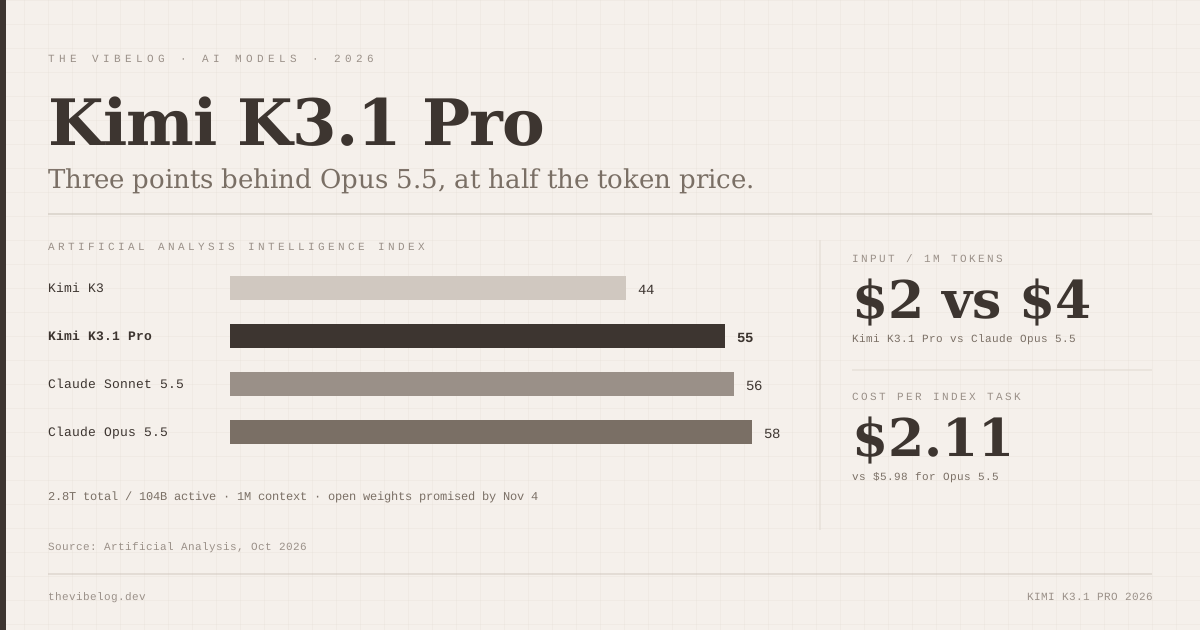
Kimi K3.1 Pro is the closest an open-weight model has come to Claude Opus 5.5, and it costs half as much per token. Moonshot AI released it on October 23, 2026, and Artificial Analysis now ranks it fourth on its Intelligence Index with a score of 55, three points behind Opus 5.5 and one behind Claude Sonnet 5.5.
There are two catches. The weights are not out yet, and the price comparison that matters for most developers is against Sonnet 5.5, not Opus. I went through Moonshot’s launch post, Artificial Analysis’s independent runs and the early coverage to work out where Kimi K3.1 Pro actually earns its place.
What Is Kimi K3.1 Pro?
Kimi K3.1 Pro is a post-trained version of Kimi K3 with a 1 million token context window, aimed at coding, finance work and long agent tasks. Moonshot calls it its “most capable open-weight model to date” and describes it as a 3T-class model. Artificial Analysis lists the exact shape as 2.8 trillion total parameters with 104 billion active per token, taking text and image input.
The architecture did not change from K3, which Moonshot shipped in July. The gains come from more reinforcement learning. VentureBeat’s write-up lists RL across hundreds of task domains plus work on long-context processing, isolated tool environments and environment-quality checks.
The launch has two variants:
kimi-k3.1-pro, the standard modelkimi-k3.1-pro-highspeed, which Moonshot says delivers two to three times the speed at the same quality
It is available today in the Kimi web and mobile apps, Kimi Work 3.1.0 and later, Kimi Code via the /model command, and the Kimi API. Enterprise admins have to switch it on, because organisational access starts disabled.
Here is my one-line read: this is a serious model, and it is the first open-weight release where I would run the comparison against Opus at all.
Kimi K3.1 Pro Benchmarks: The Independent Numbers
Artificial Analysis scores Kimi K3.1 Pro at 55 on its Intelligence Index, up 11 points from Kimi K3’s 44. That puts it fourth overall, behind Claude Opus 5.5 at 58 and Claude Sonnet 5.5 and Meta’s Muse Wonder Full at 56.
- Claude Opus 5.5 58
- Claude Sonnet 5.5 56
- Muse Wonder Full 56
- Kimi K3.1 Pro 55
- Kimi K3 44
Source: Artificial Analysis, Kimi K3.1 Pro launch benchmarks (Oct 2026)
The more useful view is the head-to-head. Artificial Analysis’s comparison page runs both models on the same harness:
| Benchmark (Artificial Analysis) | Kimi K3.1 Pro | Claude Opus 5.5 |
|---|---|---|
| Intelligence Index | 55 | 58 |
| Terminal-Bench 4.0 | 67% | 60% |
| AutomationBench-AA | 73% | 70% |
| GDPval-AA v2.1 (Elo) | 1,846 | 1,866 |
| SciCode | 61% | 67% |
| Humanity’s Last Exam | 52% | 61% |
| CritPt | 25% | 32% |
| AA-Omniscience | 30 | 46 |
(Source: Artificial Analysis, Oct 2026)
The pattern is clear. Kimi wins on agentic execution, the terminal and business-workflow tasks where you give it tools and a goal. Opus wins on deep reasoning and knowledge: science coding, frontier physics and factual recall.
The Terminal-Bench number deserves a closer look. Artificial Analysis says 67% is the highest score any model has posted on its Terminal-Bench 4.0 run, ahead of Sonnet 5.5 at 64%. That is a 54-point jump from K3’s 13%, which is the single biggest change in the release.
Knowledge is still the weak spot. On AA-Omniscience, which penalises confident wrong answers, Kimi scored 30 against Opus’s 46. Its hallucination rate fell from 53% to 44% versus K3, and accuracy rose from 48% to 51%. That is better, though I would still not use it for anything where a made-up API signature costs you an afternoon.
Moonshot’s Own Numbers (Vendor-Reported)
Moonshot’s launch tables use its own harness for Kimi and take competitor scores from their published reports, so treat these as vendor-reported.
| Benchmark (vendor-reported) | Kimi K3.1 Pro | Claude Opus 5.5 | GPT-6 Astra |
|---|---|---|---|
| Terminal-Bench 4.0 | 65.7% | 66.4% | 58.2% |
| SWE-Marathon | 51.7 | 46.3 | 42.5 |
| DeepSWE v1.1 | 75.5 | 74.2 | 74.1 |
| BenchCAD (with tools) | 92.7 | 96.2 | 95.9 |
| Terminal-Bench Science 0.1 | 38.1 | 63.3 | 68.1 |
(Source: Moonshot AI via VentureBeat and Yotta Labs, Oct 2026)
Notice that Moonshot’s own Terminal-Bench 4.0 number, 65.7%, puts Kimi just behind Opus, while Artificial Analysis’s independent run puts it seven points ahead. Different harnesses and effort settings produce different numbers. I would not lean hard on either one.
Terminal-Bench Science is the honest row. Kimi trails GPT-6 Astra by 30 points there, which matches the Artificial Analysis picture of weaker scientific reasoning.
Moonshot also reports a claim-level hallucination rate of 8.3% on its Hard benchmark with tools, down from K3’s 23.4%, and better than the 15.0% it measured for Opus 5.5. That is Moonshot’s own benchmark, so weigh it accordingly.
Kimi K3.1 Pro Pricing vs Claude, GPT and DeepSeek
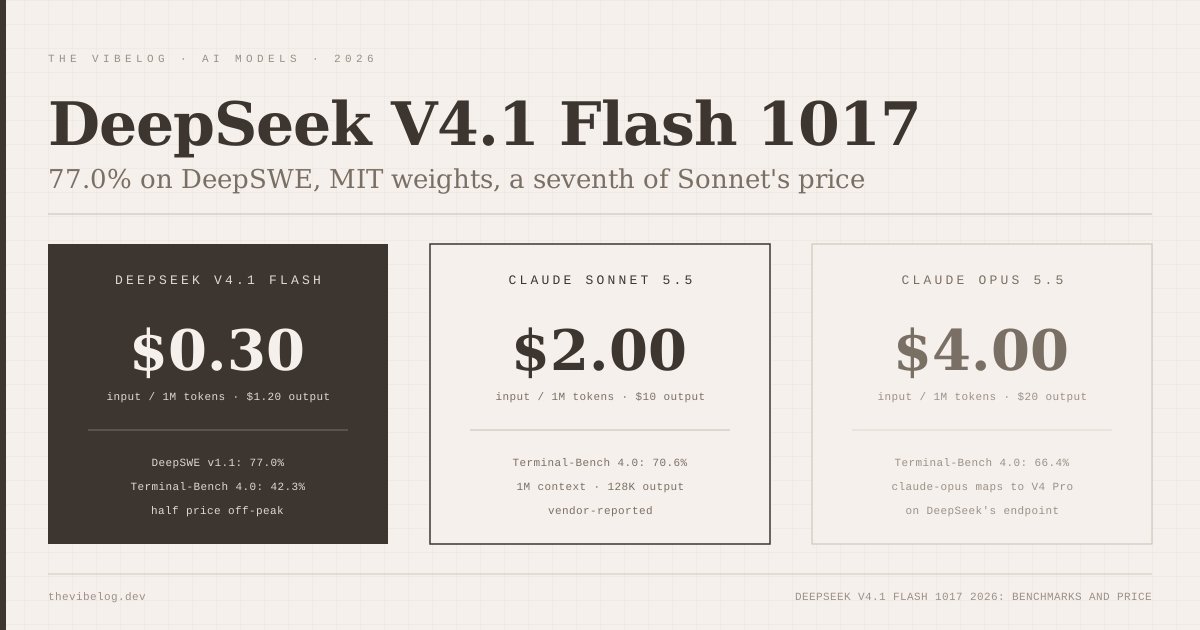
Kimi K3.1 Pro costs $2 per million input tokens, $0.20 cached and $10 output, which is a third less than Kimi K3. The Highspeed variant doubles that to $4 and $20, with the same $0.20 cache-hit price.
| Model | Input / 1M | Cached / 1M | Output / 1M |
|---|---|---|---|
| Kimi K3.1 Pro | $2.00 | $0.20 | $10.00 |
| Kimi K3.1 Pro Highspeed | $4.00 | $0.20 | $20.00 |
| Claude Sonnet 5.5 | $2.00 | $0.10 | $10.00 |
| Claude Opus 5.5 | $4.00 | $0.20 | $20.00 |
| DeepSeek V4.1 Flash 1017 (peak) | $0.30 | $0.006 | $1.20 |
(Source: Artificial Analysis, VentureBeat, vendor pricing pages, Oct 2026)
Against Opus 5.5, Kimi is half price per token. Per task, the gap is wider, because Kimi uses fewer tokens. Artificial Analysis measured $2.11 per Intelligence Index task for Kimi against $5.98 for Opus, with 55K output tokens per task against Opus’s 119K. That is about 65% cheaper for work that scores three points lower.
Against Sonnet 5.5, Kimi has no price edge at all. Same input and output price, Sonnet charges half as much for cache reads, and Sonnet scores one point higher on the index. If you are already on Sonnet, this release gives you no reason to switch on cost.
DeepSeek V4.1 Flash 1017 is the other comparison. VentureBeat notes Kimi costs roughly 6.7x more for uncached input and 8.3x more for output at DeepSeek’s peak rates. I covered that model in the DeepSeek V4.1 Flash 1017 breakdown, and for high-volume agent loops it is still the cheaper bet.
Cache writes are a separate line item. The Kimi billing docs say caching is automatic for repeated prefixes with a five-minute default lifetime, and K3-series cache writes are billed by retention (five minutes or one hour). Yotta Labs lists $2 and $4 per million for those writes on K3.1 Pro. Changing reasoning effort mid-conversation also invalidates the prefix cache, which is easy to trip over in an agent harness.
For the full table of current model prices, see the AI model pricing tracker.
Kimi K3.1 Pro Open Weights: What We Know
Moonshot says full weights will be released by November 4, 2026, and the license has not been announced. That is the single most important caveat in this release.
Until the weights land, Kimi K3.1 Pro is an API model from a Singapore-hosted provider, according to Moonshot’s privacy policy as cited by VentureBeat. Zero Data Retention is available to API customers, which helps, but it is not the same as running it on your own hardware.
Yotta Labs points out that Kimi K3 shipped under a custom Kimi K3 License that is not OSI-approved. If K3.1 Pro follows suit, read the terms before you build a commercial product on a fine-tune.
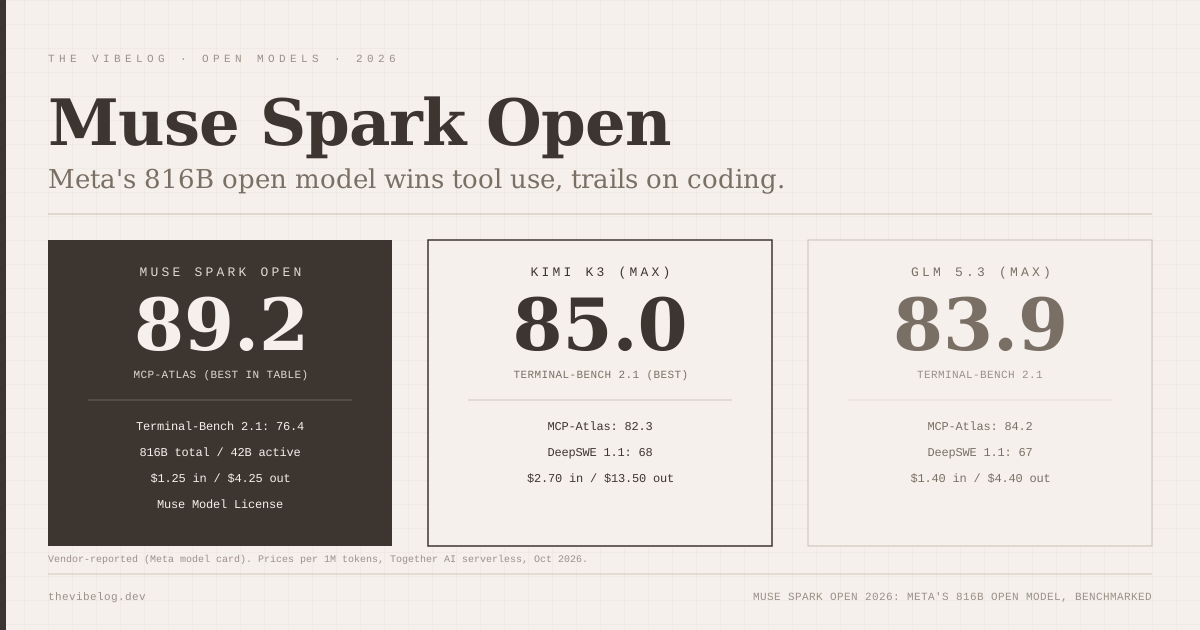
Running it yourself will not be cheap either. Moonshot has not published hardware requirements. Yotta Labs estimates about 1.56 TB on disk if the checkpoint uses the same MXFP4 format as K3, which would mean a multi-node cluster. That is an estimate, not a spec, but a 2.8T-parameter model is never going to fit on one box. Compare that with the 816B Muse Spark Open from Meta, which already needs around 700 GB of accelerator memory in NVFP4.
The Cyber Filtering and the Influencer Allegations
Two less flattering details belong in any honest write-up.
First, Moonshot deliberately weakened the model’s offensive security skills before the open release. It removed cyber-related data from mid-training and RL. On its internal xdev-bench-hard exploit test, an unfiltered checkpoint solved 90.5% of tasks and the final model solved 81.0%. Moonshot says it does not want open weights to extend the frontier of cyber capability.
That is a reasonable call, and it is interesting that Artificial Analysis still measured 95% on its CyberGym-E2E run and 64% on its Cyber Index, with no safety refusals. Defensive security teams may find that useful. Everyone else should note that “filtered” does not mean “incapable”.
Second, VentureBeat reported allegations that creators were paid to promote Kimi without disclosure. An X user posted screenshots of purported campaign instructions that told creators not to use the paid partnership label and to describe Kimi as an open-source equivalent of Claude Opus 5.5 at a fraction of the price. The screenshots have not been independently authenticated, and it is not known who issued them or whether any undisclosed posts went live. Moonshot had not responded as of October 25.
I would hold judgment on the allegation itself. The practical lesson is simpler: read the independent benchmarks, not the launch-week threads.
Should You Use Kimi K3.1 Pro?
Use Kimi K3.1 Pro if you are paying Opus prices for agentic terminal and workflow tasks and can accept a small drop in reasoning quality. On Artificial Analysis’s numbers, you get a model that beats Opus on Terminal-Bench and AutomationBench for about a third of the cost per task.
It is a weaker fit in three cases:
- You are on Sonnet 5.5 already. Same price, slightly higher score, cheaper cache. Stay put. The GPT-6.1 Sol vs Sonnet 5.5 comparison is the more relevant decision for you.
- You need self-hosting now. Wait for the November 4 weights and the license text.
- Your work leans on scientific or factual accuracy. Opus’s lead on HLE, CritPt and AA-Omniscience is large enough to matter.
Latency is the other thing to check. Artificial Analysis measured 58 output tokens per second for standard Kimi against 96 for Opus 5.5, so the Highspeed variant exists for a reason. If you are wiring it into an interactive coding agent, budget for Highspeed’s $4 and $20 rates, which brings you back to Opus pricing.
My take: Kimi K3.1 Pro is the strongest open-weight release of the year on paper, and the benchmark gap to Anthropic’s flagship is now three points. If the weights ship on time under a usable license, it changes the self-hosting conversation. Until then, it is a cheaper Opus alternative for agent loops rather than a Sonnet killer. For the wider picture of how Opus stacks up, the Claude Opus 5.5 vs GPT-6 comparison covers the closed-model side, and the Cursor Computer Use comparison from today covers what these models are increasingly being asked to drive.