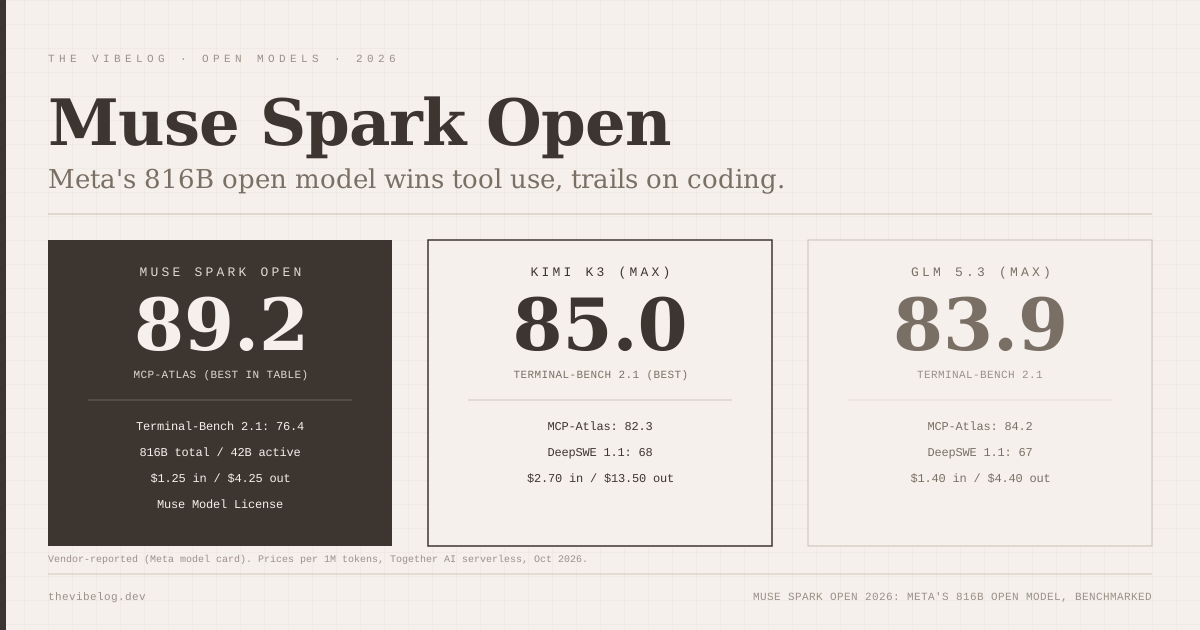
Meta’s Muse Spark Open is the first open-weight model from Meta Superintelligence Labs, released on October 15, 2026 with 816 billion parameters and a license that lets most developers use it for free. Meta calls it “the most capable US open-weight model to date.” On Meta’s own benchmark table, that claim holds for agent and tool-use tests and fails for coding, where Kimi K3 and GLM 5.3 still lead by 7 to 9 points.
That split is the whole story. If you build MCP-heavy agents, this is the strongest open model Meta’s table measured. If you want an open model to drive a coding agent all day, the Chinese models are still ahead, and they cost about the same per token.
I read Meta’s launch post, the Hugging Face model card, Hugging Face’s deployment writeup, Together AI’s pricing and VentureBeat’s analysis. Every benchmark below is vendor-reported unless I say otherwise.
What Is Muse Spark Open?
Muse Spark Open is a sparse mixture-of-experts model with 816B total parameters and 42B active per token, released as downloadable weights. It is built on Muse Spark 1.2, the hosted model Meta shipped in August, with extra safety post-training so it can run without Meta’s own service guardrails, according to SiliconANGLE’s launch coverage.
The specs from the Hugging Face model card:
- Architecture: 62 layers, 256 experts with 8 active per token, grouped-query attention with 128 query heads and 16 KV heads
- Context: 1M tokens (1,048,576)
- Input: text, image, video and audio, through a 1.8B-parameter Perception Encoder
- Output: text only
- Precision: BF16 and NVFP4 checkpoints
- Reasoning effort: low, medium, high and xhigh, with xhigh as the default and no way to turn reasoning off
That last point matters for cost. Hugging Face’s writeup says the four effort levels map to internal budgets of 16, 64, 256 and 512, and the default is the most expensive one. If you route cheap classification work to this model without setting reasoning_effort, you will pay for xhigh thinking on every call.
In short, this is a frontier-sized open model aimed at agents, with Meta’s own Llama-era MoE ideas scaled up and a 1M window on top.
Muse Spark Open Benchmarks vs Kimi K3 and GLM 5.3
Meta’s model card compares Muse Spark Open against four open-weight rivals, all run at their highest reasoning settings. Here are the rows that matter for developers:
| Model | Terminal-Bench 2.1 | DeepSWE 1.1 | MCP-Atlas | JobBench |
|---|---|---|---|---|
| Muse Spark Open | 76.4 | 60 | 89.2 | 61.8 |
| Kimi K3 (max) | 85.0 | 68 | 82.3 | 54.3 |
| GLM 5.3 (max) | 83.9 | 67 | 84.2 | 61.4 |
| Qwen3.8 (2.4T-A95B) | 82.0 | 57 | 84.5 | 52.7 |
(Source: Muse Spark Open model card, Hugging Face, vendor-reported)
Muse Spark Open finishes last of the four on Terminal-Bench 2.1 and third on DeepSWE 1.1. Those are the two benchmarks closest to what a terminal coding agent actually does: run commands, read output, edit files, repeat.
It wins on MCP-Atlas, which tests tool use across 220 tools on 36 live MCP servers, per SiliconANGLE. A 4.7-point lead over Qwen3.8 there is real. It also wins JobBench, though only by 0.4 points over GLM 5.3.
- Kimi K3 (max) 85%
- GLM 5.3 (max) 83.9%
- Qwen3.8 2.4T-A95B 82%
- Muse Spark Open 76.4%
- Inkling 55.1%
Source: Meta, Muse Spark Open model card on Hugging Face (Oct 2026)
What surprised me is how Meta published this. The table is Meta’s own, and it shows Meta losing the coding rows. Vendors usually pick benchmarks they win. Here the headline claim (“most capable US open-weight model”) is carefully scoped to US labs, and the numbers make clear why.
The independent picture is murkier. Meta reports an Artificial Analysis Intelligence Index of 39. VentureBeat could not confirm that with a public Artificial Analysis listing at publication, and noted that GLM 5.3 sits at 45, Kimi K3 at 44 and Qwen3.8 at 40 on that index. Even taking Meta’s number at face value, Muse Spark Open ranks below those three.
Other Meta-reported rows worth knowing: 80.4 on OSWorld Verified (Kimi K3 84.8), 72.8 on Toolathlon Verified (Kimi K3 76.5), and 89.0 on GPQA Diamond, where Kimi K3 and Qwen3.8 both score 93.5.
The honest read: Muse Spark Open is a tool-calling specialist that is competitive, not leading, on general coding. For context on how Meta’s closed models fared three days earlier, see our breakdown of Muse Wonder against Claude Opus 5.5.
Muse Spark Open Pricing: API vs Self-Hosting
Hosted access is cheap. Together AI’s launch post lists serverless pricing at $1.25 per million input tokens, $0.15 per million cached input tokens and $4.25 per million output tokens. OpenRouter shows the same rates, and Meta names seven launch partners: Baseten, Fireworks AI, Groq, Modal, Nebius, OpenRouter and Together AI.
Here is how that compares with other models you might route agent work to:
| Model | Input / 1M | Cached input / 1M | Output / 1M |
|---|---|---|---|
| Muse Spark Open (Together) | $1.25 | $0.15 | $4.25 |
| DeepSeek V4 Pro (Together) | $1.32 | $0.13 | $3.96 |
| GLM 5.3 (Together) | $1.40 | $0.26 | $4.40 |
| Kimi K3 (Together) | $2.70 | $0.27 | $13.50 |
| Claude Sonnet 5.5 (Anthropic) | $2.00 | $0.10 | $10.00 |
(Sources: Together AI blog and pricing page, Anthropic prompt caching docs, Oct 2026. Full list on our AI model pricing tracker.)
Muse Spark Open is the cheapest on input and a few cents behind DeepSeek V4 Pro on output. Against Kimi K3, the output gap is more than 3x, which is where agent bills actually come from.
Two catches. VentureBeat notes Groq caps context at 131,072 tokens while Fireworks offers the full 1,048,576, so “1M context” depends on the provider you pick. And the default xhigh reasoning effort means output token counts will run high unless you lower it.
Self-hosting is a different budget entirely. The model card asks for at least 700GB of accelerator memory for NVFP4 and 2TB for BF16. Hugging Face’s writeup gives the concrete setups:
- BF16: about 1.5TB of safetensors, served across 4 nodes of 8 H200 GPUs (tensor parallel 32)
- NVFP4: a single B200 node in Transformers, or four GB300 GPUs in SGLang
- vLLM NVFP4: Blackwell GPUs only, with the example capped at 131,072 tokens of context
- Full 1M context: the KV cache alone is about 266GB in BF16, roughly 250KB per token
For most teams, the hosted price beats owning the hardware by a wide margin. Self-hosting makes sense for data residency or air-gapped work, not for saving money.
Running Muse Spark Open on Two Mac Studios
The headline demo is Meta running the model on two Apple M5 Ultra Mac Studios linked through MLX, with about 1TB of combined unified memory. Meta used that setup with its Muse Code agent to make iOS changes to Ice Cubes, an open-source Mastodon client, and to review footage in DaVinci Resolve.
It is a good demo. It is also not cheap. VentureBeat points out that the 512GB M5 Ultra configuration Meta used is not expected until late October and has no announced price. For reference, Apple lists the 256GB model at $10,799.
If you want to try it on smaller Apple hardware, Hugging Face lists an MLX 3-bit quant (oQ3e) at about 344GB, and llama.cpp GGUF builds down to Q2_K. Their blog shows the Pi coding agent generating Three.js assets with the 2-bit quant at about 18 tokens per second on a Mac Ultra. That is usable for a demo and painful for an agent loop that reads 50 files.
# llama.cpp, 2-bit quant (per Hugging Face's writeup)
llama serve -hf ggml-org/Muse-Spark-Open-816B-A42B-GGUF:Q2_K

# vLLM, OpenAI-compatible endpoint (per the model card)
vllm serve "meta-models/Muse-Spark-Open-816B-A42B"
The model card’s recommended sampling is temperature 1.0, top_p 1.0 and top_k disabled. Use high or xhigh effort for coding and agent work.
The Mac story proves the model fits on a desk. It does not prove the desk is fast enough for daily agentic coding.
The Muse Model License: What You Can and Cannot Do
This is where developers should slow down. The Muse Model License is not Apache 2.0 or MIT. Per the model card and VentureBeat’s reading of it:
- Allowed: running, modifying, fine-tuning, distilling and redistributing the weights
- Required: a “Built with Muse Spark Open” label in your product, docs or settings
- Restricted: companies that offer the model as an API service and have more than $20 million in gross revenue over any 12 months must notify Meta and sign a separate agreement
- Exempt from that threshold: internal use, research, and embedding the model in your own product
- Prohibited: military and critical-infrastructure uses, per SiliconANGLE
- Broad derivative definition: VentureBeat notes that models improved using Muse Spark Open’s outputs count as derivatives
That last clause is the one I would flag to a legal team. If you distill a smaller model from Muse Spark Open’s outputs, the license follows it.
The Hugging Face access gate also asks for your full legal name, date of birth and organization details, and the form cannot be edited after submission. VentureBeat found the same pattern on some earlier Meta model pages.
Compare that with Meta’s 30B Muse Glimmer from August, which shipped under Apache 2.0, or with JetBrains’ small Mellum2.1, also Apache 2.0. Meta is now running a tiered strategy: permissive licenses for small models, a custom license for the big one, and closed weights for Muse Wonder.
For an indie developer or a startup under $20M revenue, the license is workable. For a cloud provider, it is a negotiation.
Should You Use Muse Spark Open for Coding Agents?
My take, based on the published numbers:
Use it for MCP-heavy agents. An 89.2 on MCP-Atlas is the best score in Meta’s table, and many real agent workloads are mostly tool selection and argument formatting. At $1.25 input, it is a sensible default for an agent that calls 30 internal tools and writes little code. If those tools live on shared servers, our guide to running MCP servers for a whole team covers the transport and auth setup.
Do not make it your main coding model yet. Kimi K3 and GLM 5.3 beat it by 7.5 to 8.6 points on Terminal-Bench 2.1 and 7 to 8 points on DeepSWE 1.1. GLM 5.3 costs only slightly more per token on Together.
Use it if you need a US-origin open model. Some procurement and compliance teams have policies against Chinese-origin weights. For them, this is a real upgrade over the alternatives, and that market is probably who Meta built it for.
Getting it into your coding agent is easy. OpenCode, Pi and other model-agnostic agents can call it through any OpenAI-compatible endpoint. Today’s other post compares OpenCode 2.0 with Claude Code for exactly that kind of multi-model setup. If you would rather keep Claude Code as the harness, Together Link already routes open models into it, although Muse Spark Open is not one of its documented router options yet.
The broader picture is good news for developers. Between Mistral Large 4, Reflection Beam and now Muse Spark Open, October 2026 has produced three large Western open-weight models in two weeks. None of them leads the Chinese models on coding benchmarks yet. All of them push the price of good agent tokens down.
Bottom Line
Muse Spark Open is a strong, cheap, tool-calling model with a license that suits most developers and annoys cloud providers. It is not the best open coding model. Meta’s own benchmark table says so, which is more honesty than most launches offer.
Try it on your MCP workloads through Together or OpenRouter before considering hardware. Keep your coding agent on whichever model wins your own repo’s tests.