Claude for Startups was the best free offer in AI tooling for about three days. On October 6, 2026, Anthropic expanded the program to give eligible startups a free year of Claude Team with up to five premium seats plus $1,000 in API credits. By the end of the week, the program page said Anthropic had received “hundreds of thousands of applications over the past few days” and was over capacity.
If you applied, were approved, or were about to apply, the rules changed under you. I went through the program page, Anthropic’s official terms and the launch coverage to work out what is still on the table, what is paused and what the offer was worth in dollars.
What Is Claude for Startups?
Claude for Startups is Anthropic’s program for early-stage companies, bundling discounted Claude access, API credits, partner perks and time with Anthropic’s Applied AI team. The October expansion was announced at SF Tech Week.
According to TechCrunch’s launch report, the expanded package included:
- A free year of Claude Team, Anthropic’s paid plan for groups, with up to five premium seats
- $1,000 in API credits for building on Claude
- Access to Claude Marketplace, where companies build plug-ins for the service
- Virtual office hours with Anthropic’s Applied AI team
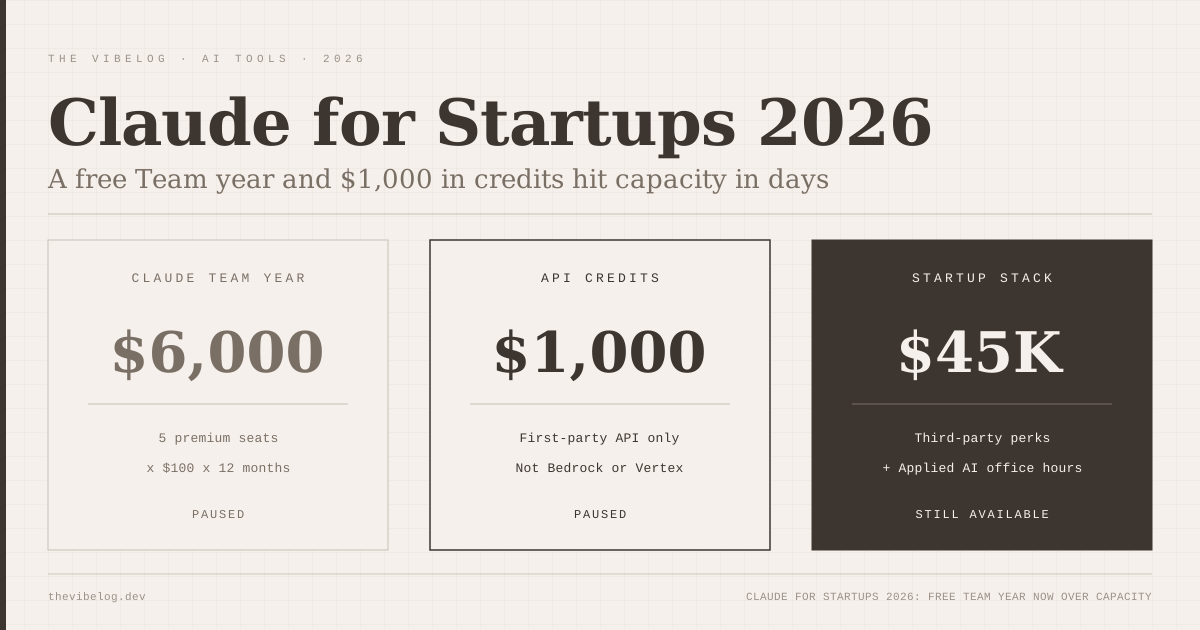
The program page adds two more layers. The Claude Startup Stack is a list of third-party offers “worth up to $45,000” from companies building with Claude. And startups backed by a VC in Anthropic’s partner network “may be eligible to receive up to $100K in additional API credits”, claimed through that investor.
Members who receive credits also automatically get higher API rate limits. For a startup running coding agents, that last point is arguably worth more than the credits.
On paper, Claude for Startups combined a free Team year, API credits, partner perks and higher rate limits into one application.
What Changed: The Claude for Startups Capacity Pause
The program page FAQ now opens the question “Does the Startup Program still offer a free year of Claude Team and $1K in API Credits?” with an admission: “We didn’t anticipate the demand for the Claude Startups program.”
Then the substance. Anthropic says it is “currently over capacity on the Claude Team and $1,000 API credit offers”, that it will “re-review all applications which may result in a change in the status of some applications”, and that “If you’ve already claimed the offer, nothing changes.”
That leaves three groups of founders in very different positions:
| Applicant status | Team year and $1,000 credits | Startup Stack and office hours |
|---|---|---|
| Claimed the offer | Kept | Kept |
| Approved, not yet claimed | At risk in re-review | Kept |
| Not yet applied | Paused, no reopening date | Available to members |
(Source: Claude for Startups FAQ, October 2026)
Anthropic also says it is “reshaping the Claude Startups program to ensure this initiative is of, by and for startup founders.” Read between the lines and the acceptance criteria let in a lot of applicants that were not startups. ExplainX’s write-up cites a secondary summary of a post by the program lead saying exactly that, but the author could not open the original post, so I would not lean on the details.
This is the part that annoys me. “Founded in the last five years or funded in the last two” describes a huge share of every company with a website, and a free $6,000 software plan is a magnet for anyone who can fill out a form. Anthropic should have seen this coming. That said, honouring every claimed offer is the right call, and a lot of companies would have quietly revoked them.
If you were approved but did not claim, the honest advice is to check the Claude Console now and claim anything still available. The official terms, last updated May 22, 2025, give Anthropic the right “to cancel, terminate, modify, or suspend the Program” at its sole discretion, so waiting does not improve your position.
The free Team year and $1,000 credits are paused for new applicants, claimed offers are safe, and approved-but-unclaimed applications are being re-reviewed.
How Much Is the Claude for Startups Offer Worth?
Here is the maths, using the current Claude pricing page.
Claude Team premium seats cost $100 per seat per month billed annually, or $125 billed monthly. Premium seats include “5x more usage than standard seats”, and Claude Code is part of the Team plan. Five premium seats for twelve months:
- Annual billing rate: 5 × $100 × 12 = $6,000
- Monthly billing rate: 5 × $125 × 12 = $7,500
Add $1,000 in API credits and the headline offer was worth $7,000 to $8,500 for a five-person team. The $45,000 Startup Stack sits on top, though Anthropic’s page warns you may not be able to receive or combine all of the partner offers.
| Benefit | Paper value | Status (Oct 12, 2026) |
|---|---|---|
| Claude Team, 5 premium seats, 1 year | $6,000–$7,500 | Paused |
| API credits | $1,000 | Paused |
| VC partner API credits | Up to $100,000 | Via partner VCs |
| Claude Startup Stack | Up to $45,000 | Available |
| Applied AI office hours | n/a | Available |
(Source: Claude pricing and Claude for Startups; seat value is my calculation)
What does $1,000 of API credit actually buy? At Claude Sonnet 5.5’s $2 input and $10 output per million tokens, it covers roughly 250 million input tokens and 50 million output tokens in a typical 5:1 agent mix. At Claude Haiku 5.5’s $0.10 and $0.50, the same $1,000 goes twenty times further. Current prices for every model are on our AI model pricing tracker.
For a startup in its first months, the Team seats were the real prize. The credits disappear in a few weeks of heavy agent use.
The paused part of Claude for Startups was worth up to $8,500 for a five-person team; the still-available partner perks are larger on paper but come from third parties.
Claude for Startups Eligibility and How to Apply
The application itself has not changed. According to the program FAQ:
- Sign in to the Claude Console.
- Fill out the application linked from the program page.
- Wait for review. Anthropic says “We aim to review every application within one week” and emails a decision.
On eligibility, TechCrunch reports companies founded in the last five years or that received funding in the last two years. The FAQ is explicit that you do not need VC funding: “The program is open to bootstrapped, pre-seed, and venture-backed startups.”
The official terms add two practical restrictions. Companies established in, or serving users in, a list of sanctioned countries and regions, including China, Russia, Iran and North Korea, are ineligible. And if Anthropic requests documents and you do not return them within 14 days, “the Program Benefits may be forfeited.” Given the re-review, expect that request.
One restriction trips up a lot of teams. Credits apply only to the first-party Claude API through Claude Console. They “can’t be used on AWS Bedrock, Google Cloud Vertex AI, or other third-party platforms.” If your production stack runs Claude through Bedrock for compliance reasons, the credits do not help you there.
Applying still takes a Console sign-in and a short form, but new applicants should expect partner perks and office hours, not the Team year.
Alternatives If You Missed the Claude for Startups Offer
The program pause does not change the underlying problem: agentic coding is expensive, and startups are price-sensitive. Here is what I would do instead.
Use the plan credits you already have. Claude Max and Team subscriptions now include monthly API credits in the Console: $100 on Max 5x, $200 on Max 20x and up to $500 pooled on Team. Anthropic’s FAQ confirms these are unaffected by the startup program changes. If someone on your team is already on Max for Claude Code, that is $1,200 a year of API credit you might not be using.
Route subagent work to cheaper models. Most agent spend comes from high-volume, low-difficulty calls: search, summarise, classify. Haiku 5.5 handles those at a twentieth of Sonnet 5.5’s input price. If you can run hardware, an open model like JetBrains Mellum2.1 costs nothing per token and runs on an 8.1 GB quantised build. Our guide to reducing Claude API costs covers prompt caching and context trimming, which compound with any of these.
Ask your investor. If you are VC-backed, check whether your firm is in Anthropic’s partner network. The up-to-$100,000 VC track was not part of the over-capacity notice.
Do not plan around credits. This is the broader lesson. Startup credit programs from every AI lab change terms with little notice, and Anthropic’s terms say so in writing. If your unit economics only work with free tokens, they do not work.
If you missed the Team year, the realistic path is plan-included API credits, cheaper models for subagents and the VC partner track, not waiting for the offer to return.
Is Claude for Startups Still Worth Applying For?
Yes, with lowered expectations.
Membership still gets you the Startup Stack, Applied AI office hours every other week, events and, for those who receive credits, higher rate limits. Office hours with the team that builds the models are worth 45 minutes of a founder’s time if you are designing an agent architecture.
What you should not do is build a budget around a free Team year that may or may not return. Anthropic has said it is reshaping the program for “startup founders”, which probably means tighter eligibility checks, not a bigger giveaway.
My read: Anthropic badly underestimated demand, handled the fallout better than most companies would by honouring claimed offers, and will relaunch something narrower. Apply now if you qualify, so you are already a member when it does.
Claude for Startups is still worth joining for the perks and access, but the free Team year should be treated as gone until Anthropic says otherwise.