Most tool comparisons in this space are written against a six-month-old version of the product. Bolt.new V2 shipped Bolt Cloud in 2025, and it changed the picture significantly. v0 launched a full-stack Next.js sandbox that moved it well past “component generator.” Lovable has had native Supabase and Stripe from the start but keeps improving both.
I ran all three against the same MVP spec to understand where they actually differ in 2026 — and to correct some specific misinformation, including errors in an earlier version of this post.
The Test: One SaaS MVP, Three AI App Builders
Same project, same requirements, fresh account each time:
- Landing page with pricing section
- Email/password signup and login
- Simple dashboard showing usage data
- Stripe Checkout for a single paid subscription
- Deployed and accessible on a real URL
I am a developer. I filled gaps and debugged issues myself. I was evaluating each tool as someone who could build this manually but wanted to understand where each one saves real time and where it creates problems.
What Each Tool Actually Is in 2026
Before the results — these tools have meaningfully different philosophies, and a lot of published comparisons miss this because they focus on feature checklists rather than experience.
Lovable is a product builder. The interface is a chat window and a live preview. Code is accessible but not front-and-centre. It handles the entire stack — React, Tailwind, Supabase, Stripe — from a single prompt with zero configuration. It is designed to make non-developers productive.
Bolt.new V2 is a developer-first cloud IDE. You get a file tree, code editor, terminal, and live preview running on real Node.js via StackBlitz WebContainers. It shipped Bolt Cloud in 2025 which added native auth, unlimited Supabase databases, and in April 2026, native Stripe. Feature-for-feature it now matches Lovable on the full-stack side. The experience is fundamentally different.
v0 by Vercel started as a component generator and launched a full-stack Next.js sandbox in 2026. You can now build multi-page apps with API Routes, Server Actions, and Supabase database integration. Auth and Stripe still require manual setup. One-click Vercel deployment is seamless. UI quality is the best of the three.
Lovable: Still the Fastest Path to a Polished Product
Lovable generated a landing page that looked designed — not “good for AI,” actually good. This is consistent. The visual quality advantage over Bolt and v0 is real and comes down to Lovable’s training focus on product design rather than developer tooling.
Auth works first try, every time. Native Supabase means you do not configure anything. Email/password signup, session management, row-level security — all correct, zero setup. You connect your Supabase project once in Lovable settings and it handles the rest.
Stripe is equally smooth. Describe your pricing in plain English: “one Pro plan, $29/month, 14-day trial.” Lovable generates the checkout session, webhook handler, and subscription status table in Supabase automatically. Tested it working end-to-end: checkout created, webhook received, user subscription updated in the database.
GitHub sync lets you export the generated codebase to a repo and continue with normal tools.
Where Lovable frustrates developers: it has strong opinions. Its file structure, React patterns, and query conventions are Lovable defaults, not yours. When you try to prompt it away from those defaults or edit the code directly, it pushes back. The credit system can also drain fast on iterative projects — heavy iteration can exhaust the monthly allowance in the first week on the Pro plan.
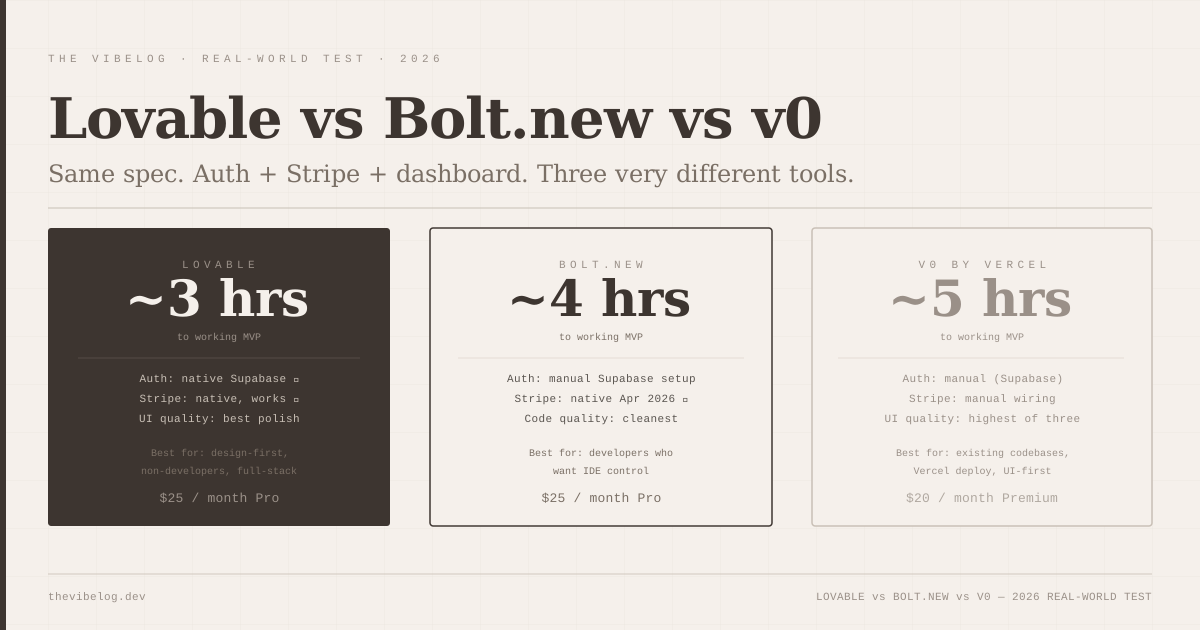
Time to working MVP: approximately 2.5–3 hours. Fastest of the three.
Pricing: Free (5 daily credits, 30/month cap). Pro $25/month, 100 credits/month. Top-ups at $15 per 50 credits.
Bolt.new V2: Equally Capable, Completely Different Experience
Bolt.new V2 is a fundamentally different product from Bolt V1, and most comparisons that describe Bolt as “requires manual Supabase setup” are describing the old version.
Bolt Cloud ships with every project: native authentication (email/password, verification, leaked password detection), unlimited Supabase databases auto-provisioned per project, file storage, and analytics. You do not connect external accounts. You do not manage credentials. A new project has a working database and auth layer before you write your first prompt.
Stripe arrived natively in April 2026. Prompt “Add payments,” it wires up product sync from Stripe dashboard, subscription lifecycle management, webhook processing, and server-side checkout through edge functions. Sensitive data never touches client-side code. PCI compliance handled by Stripe.
The IDE experience is what actually separates Bolt from Lovable. You can see every file. You can open the terminal. You can read and edit the generated code at any point in the session. When Bolt generates an API route, you can read it, understand it, and change it directly. This is a developer tool.
Code quality from Bolt is noticeably cleaner than Lovable and v0 — modular components, TypeScript interfaces on every data model, components under 100 lines each, consistent shadcn/ui for styling. This is partly the WebContainers architecture: the AI writes code into a real runtime and can actually verify it works.
Automated security review runs before deployment and flags issues with one-click fixes. Bolt V2 also added team workspaces, deployment pipelines, and branch management.
Where Bolt frustrates: token consumption on complex projects is harder to predict than Lovable’s credit model. The Pro plan’s 10M monthly tokens roll over, which helps, but a single heavy day refactoring a large codebase can consume a meaningful fraction of your monthly allowance.
Time to working MVP: approximately 3–3.5 hours. Auth and database provisioned automatically, Stripe required a few iterations to configure the pricing tier correctly.
Pricing: Free (1M tokens/month, 300K daily cap). Pro $25/month, 10M tokens with rollover. Same price as Lovable Pro.
v0 Review: Best UI Output, Most Assembly Required
v0’s 2026 expansion into full-stack territory is real and worth understanding. The new sandbox environment can generate multi-page Next.js applications with API Routes and Server Actions. Supabase database integration is available through Vercel’s marketplace — connect your account, env variables sync automatically, and v0 can generate database queries against it.
What v0 still does not do natively: bundle authentication or Stripe. You implement those yourself, either by prompting v0 to generate the code and configuring it manually, or by adding them post-generation. This is the genuine gap compared to Lovable and Bolt.
Where v0 is clearly ahead: the React and Tailwind code it generates is better than either competitor. Accessibility features by default, responsive design, components that professional developers would actually use in a production codebase without rewriting. If component or UI quality is the priority, nothing else comes close.
Vercel deployment is one click. v0 is a Vercel product; the integration is native and requires no additional configuration.
Time to working MVP: approximately 5–5.5 hours. The frontend was the fastest to generate of the three. Auth and Stripe implementation made up most of the difference.
Pricing: Free ($5/month in credits). Premium $20/month, $20/month in credits plus Figma import and API access. Cheaper than Lovable and Bolt at the entry paid tier.
Lovable vs Bolt.new vs v0: The Real Comparison
The feature gap between Lovable and Bolt.new has largely closed in 2026. Both have native auth, Supabase database, and Stripe. Both are $25/month for the Pro plan. The question is not features — it is which experience model matches how you work.
Choose Lovable if you are building a design-first product, are not a developer, or want the fastest time from zero to a polished visual result with minimum configuration. You trade control for speed.
Choose Bolt.new V2 if you are a developer who wants to see, understand, and control the code the AI generates. The IDE experience, clean code output, and automated security reviews make it the stronger choice for anything that will live in production beyond an MVP. You get the same full-stack capabilities as Lovable with more transparency into what was built.
Choose v0 if UI code quality is the priority and you are comfortable assembling the backend yourself, or if you are building on an existing codebase and deploying to Vercel. The component output is genuinely better than both alternatives. The lower price at the premium tier is a real advantage for solo developers.
The developers getting the most out of these tools in 2026 use Lovable for initial product exploration and design validation, then move to Bolt.new once they need production-grade code they actually understand. v0 sits alongside either one for UI work on existing projects.
For context on how the AI models powering these tools compare when doing serious development work, the Claude Code vs Cursor vs Copilot comparison is worth reading alongside this. And for what comes after one-shot generation — multi-step autonomous coding workflows — agentic coding covers where the category is heading.
Pricing from official pricing pages, May 2026. Bolt.new native Stripe announced April 2026 via bolt.new/blog. Bolt Cloud auth and Supabase from bolt.new/blog/bolt-v2. v0 full-stack sandbox from vercel.com/blog/introducing-the-new-v0. Build times from personal testing — complexity and prompt quality affect results.