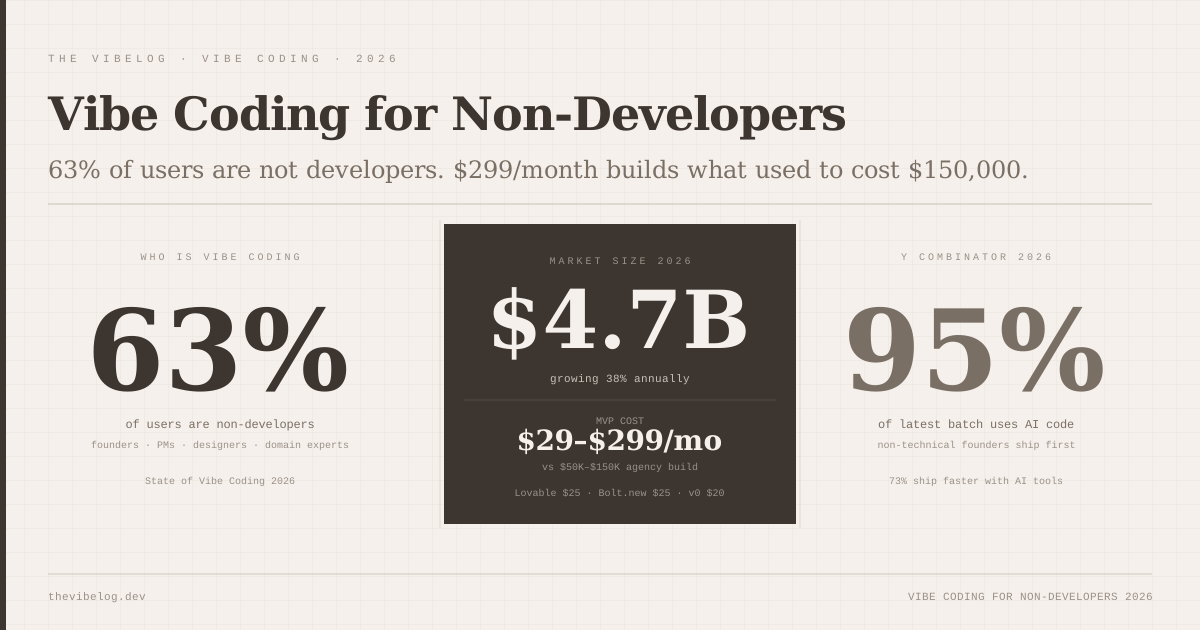
63% of the people using vibe coding tools in 2026 are not developers. They are product managers, founders, designers, sales engineers, and domain experts who have never written a function definition in their life. They are shipping software anyway.
According to the State of Vibe Coding 2026 report from Taskade, the majority of vibe coding users come from outside software engineering. 73% of non-technical founders report shipping faster with AI tools than they did with traditional development. The $4.7 billion vibe coding market is not a developer productivity story — it is a story about who gets to build software.
Whether that is good news or a problem depends on what gets built and whether anyone reviews it before it ships.
Who Is Actually Using Vibe Coding — The Demographics
The picture of who uses vibe coding in 2026 is significantly different from the picture of who traditionally builds software.
63% of vibe coding users identify as non-developers. Among that group: product managers building internal tools they would previously have had to spec and wait for; founders building MVPs without hiring a development agency; designers building interactive prototypes that go directly to production; domain experts in law, finance, and medicine building tools for their specific industry without needing an engineer to translate the requirements.
The breakdown of what they are building: 44% are generating user interfaces, 20% are building full-stack applications, 11% are building personal software solutions. The remaining 25% covers a range from automation scripts to data tools to integrations between existing systems.
This shift was predicted but happened faster than expected. Y Combinator’s most recent batch (early 2026) contains AI-generated code in 95% of companies. A meaningful portion of those were built by founders with limited technical background who used vibe coding tools to get to a working demo without hiring engineers first.
What Non-Developers Are Building That Works
The categories where non-developer vibe coding produces results that survive contact with real users are specific enough to be worth naming.
Vertical SaaS for niche industries. A lawyer building a case management tool for small law firms. A nutritionist building a client meal planning system. A property manager building a maintenance request tracker. The domain knowledge required to know what the tool should do is the hard part — the technical implementation is now within reach of a non-developer with the right tools. This is where 63% non-developer adoption makes sense: the domain experts who previously had to explain their requirements to a developer can now express them directly to an AI.
Internal business tools. Tools that automate internal workflows, manage spreadsheet data, generate reports, or connect internal systems. These do not need to be beautiful or handle edge cases perfectly — they need to make one specific job faster. Vibe-coded internal tools often have rough edges that a non-developer can tolerate because they know exactly what the tool is for and how to use it correctly.
Customer-facing portals on top of existing data. A customer portal that reads from an existing database. A reporting dashboard for clients. An online booking interface. These sit on top of data that already exists and add a UI layer that previously required a frontend developer. With tools like Lovable or Bolt.new, that UI layer is now buildable by the person who knows what the customers need to see.
Content tools and CMS customisation. Content management, editorial workflows, review and approval systems. These have specific business rules that the people running the business understand better than any contractor would, and they are the right complexity level for non-developer vibe coding — clear rules, mostly CRUD operations, minimal concurrent access concerns.
The Cost Comparison That Made This a Movement
The traditional path from “I want to build this product” to “this product exists” went through a development agency or a technical co-founder. Agency costs for an MVP ranged from $50,000 to $150,000. Finding a technical co-founder means giving up equity and months of search. The vibe coding alternative costs $29–$299 per month.
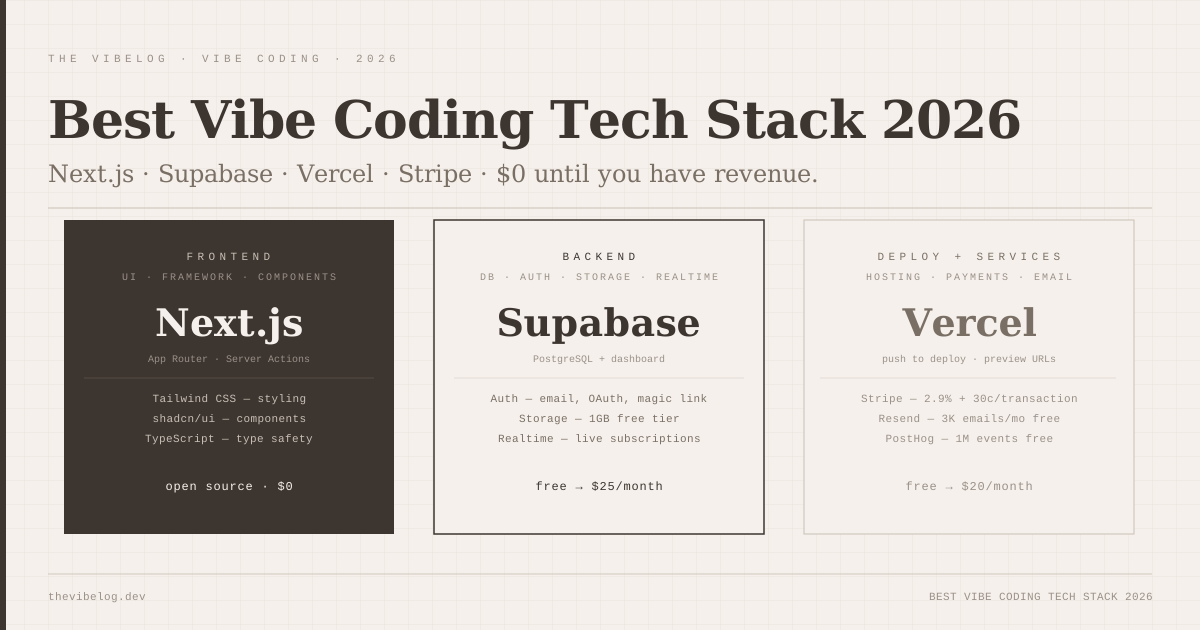
Lovable Pro: $25/month. Bolt.new Pro: $25/month. v0 Premium: $20/month. Hosting on Vercel or Cloudflare: $0–$20/month for early-stage traffic. Supabase or Firebase on the free tier: $0 until meaningful scale.
A non-technical founder can ship an MVP in a weekend and have it live for under $100/month before they have their first paying customer. That economics change has moved vibe coding from a developer productivity tool to a founding strategy.
The caveat is that $29–$299/month covers the platform. It does not cover the cost of fixing security issues, scaling problems, or architectural decisions that turn out to be wrong. Those costs show up later. Teams report 51% faster task completion and 73% of non-technical founders ship faster — but the 40% of AI-generated apps that contain exploitable bugs are also a real number, and those bugs cost something when they get exploited.
Best Vibe Coding Tools for Non-Developers in 2026
Not all vibe coding tools are equally accessible to people without a programming background. The tool selection matters more for non-developers than for experienced developers who can work with any interface.
Lovable is the lowest-friction option for non-developers. Describe an application in plain language — “a booking system for a yoga studio with class schedules, sign-ups, and instructor management” — and Lovable generates a full-stack React application with Supabase auth, database tables, and Stripe payment integration, all configured. No external accounts to set up, no environment variables to manage, no deployment pipeline to configure. The cost of this simplicity is less visibility into the generated code — you see the output, not every file.
Bolt.new is the step up when you want more visibility. The interface shows every generated file in a tree view with a code editor. You can read the code, edit specific files, and understand what was built. The embedded Android emulator, native auth, and auto-provisioned databases give the same zero-configuration experience as Lovable with more transparency. Better for non-developers who want to learn alongside building.
v0 by Vercel is the right tool for UI-first work. If what you need is a specific interface — a dashboard, a landing page, a form — and you already have or can connect a backend, v0 produces the cleanest UI code of any tool in this category. Less appropriate for full-stack applications where you also need database and auth setup.
What Non-Developers Still Need to Understand
Vibe coding does not eliminate the need to understand what you are building. It changes what you need to understand.
Data modeling. What does your application store? How do different types of data relate to each other? A booking system stores users, classes, bookings, and payments — and the relationships between them (a booking connects a user to a class and a payment) determine how the database is structured. Getting this wrong is expensive to fix later. You do not need to write SQL, but you need to understand the shape of your data.
Authentication boundaries. Who can see what? A customer should see their own bookings, not all bookings. An admin should see all bookings. These access rules need to be correct in the generated code — AI tools get them right most of the time and wrong enough of the time that you need to verify the specific rules you care about.
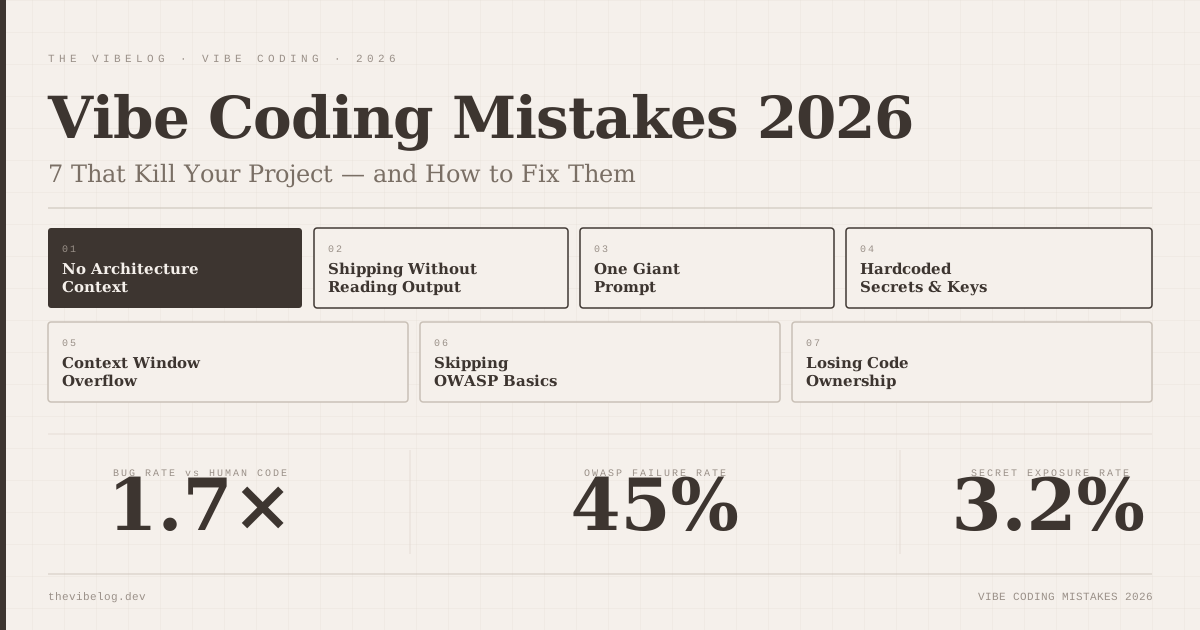
Security fundamentals. 45% of AI-generated code contains OWASP Top-10 vulnerabilities per security testing conducted across five major vibe coding platforms. As a non-developer building for real users, you cannot review the code at the security audit level an experienced developer can. What you can do: use Lovable’s built-in security review before deploying, use platforms that run automated security scanning, and ask the AI explicitly “does this endpoint require authentication to access?” and verify the answer.
Knowing when to bring in a developer. Vibe coding scales further than most people expect, and it stops working at a point that is hard to predict in advance. When you hit architectural limits — the database can’t handle your query patterns, the auth system can’t support the access rules you need, the generated code is producing cascading bugs you can’t diagnose — bringing in an experienced developer to review and repair is faster than continuing to iterate with AI tools on a broken foundation.
Where Non-Developers Hit the Ceiling
The 63% non-developer adoption number exists alongside a candid fact: non-developers hit ceilings that developers do not, and they hit them without always recognising what the ceiling is.
Debugging without a mental model. When something breaks in an app a developer wrote, they know where to look. When something breaks in an AI-generated app that a non-developer does not fully understand, the debugging process is often another set of prompts — which works until it does not. “The booking form stopped working” is not enough information for the AI to diagnose a broken database constraint.
Performance at scale. Vibe-coded MVPs frequently have database queries that work at 100 users and slow to unusable at 10,000 users. The AI generates queries that return the right data, not queries that return the right data efficiently. A non-developer cannot typically read a slow query plan, which means performance problems are often invisible until they become crises.
Compliance and regulated industries. HIPAA for health data, SOC 2 for enterprise customers, PCI compliance for payment processing. These requirements go beyond generating correct code — they require specific infrastructure choices, audit trails, and security controls that a non-developer without expertise in the compliance framework cannot verify through vibe coding alone.
Complex business logic that grows over time. The tool that works for 10 rules can stop working cleanly at 50 rules. Vibe-coded applications built without a clear data model and clean architecture accumulate technical debt faster than traditionally built applications, because the AI optimises for making each individual prompt work rather than maintaining an overall architecture.
None of these ceilings are reasons not to start. They are reasons to start with clear eyes about when you will need additional expertise, rather than discovering the limit when it becomes a production problem.
Adoption statistics from Taskade State of Vibe Coding 2026 and Second Talent vibe coding statistics 2026. Y Combinator batch data from Superframeworks vibe coding tipping point analysis, 2026. MVP cost comparison from OPC Community solo founder vibe coding guide. Security statistics from Hostinger vibe coding statistics report, 2026. Tool comparison from roadmap.sh best vibe coding tools 2026.