The most interesting thing Webflow shipped in 2026 is not in the site builder. AEO — Answer Engine Optimisation — is a tool that measures how AI search engines represent your brand and helps you improve it. That is a different problem than building a website, and it is the problem that is growing fastest.
Traditional SEO is a known game. You know what to optimise. AI search — how ChatGPT cites you when someone asks a question, how Perplexity summarises your services, whether Gemini includes your name when recommending a category — is less understood and less tooled for. Webflow is one of the first website builders to ship a product for it.
What Webflow AI Added in 2026
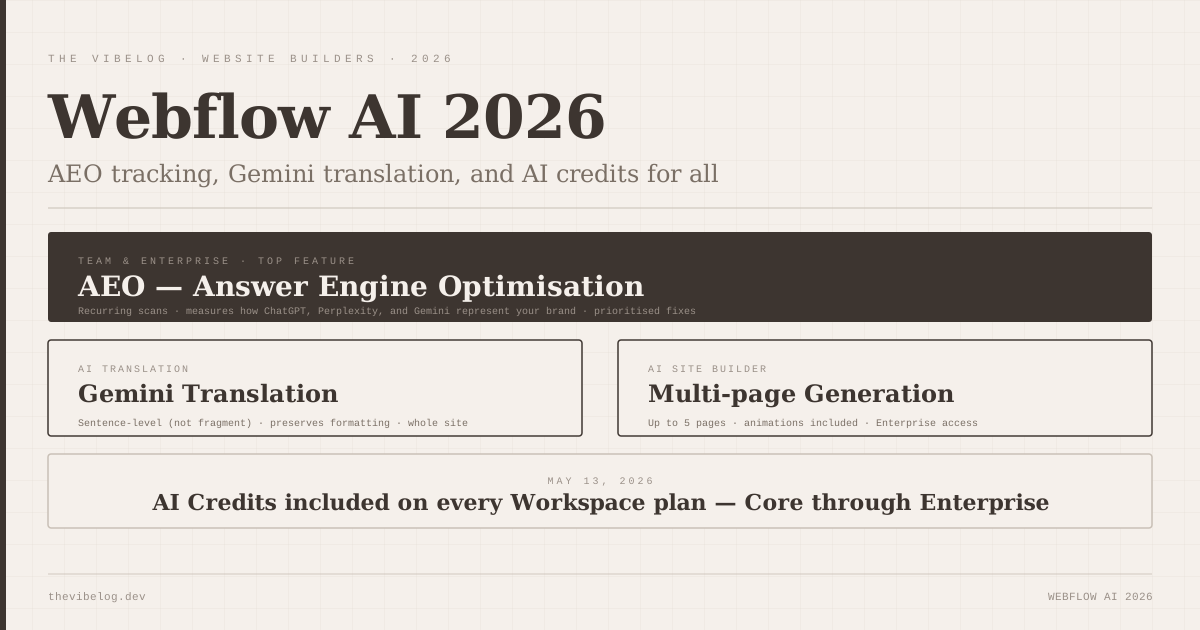
The 2026 Webflow AI additions fall into four categories: AEO tracking, AI translation improvements, site builder updates, and credit democratisation.
None of these change what Webflow fundamentally is. Webflow is a visual website builder for designers — no native backend, no database, no user auth beyond Webflow Memberships. The AI additions make existing Webflow capabilities faster to execute. They do not expand the platform’s scope.
That is worth stating clearly because Webflow is sometimes evaluated against Lovable or Bolt.new. It is the wrong comparison. Webflow is building tools for designers managing content sites. Lovable and Bolt.new are building tools for developers or non-developers building applications. Different problems, different right answers.
AEO: Why This Feature Matters Now
The AEO feature on Webflow Team and Enterprise plans does something no other major website builder has shipped at scale: it measures, on a recurring basis, how your site and brand appear in AI-generated search results.
The mechanics: AEO agents scan your site automatically on a schedule, test how AI answer engines are representing your content, and return prioritised recommendations. The recommendations focus on content structure — clear entity definitions, attribution, direct answers to questions, factual specificity — the signals that AI engines use to decide whether to cite a page.
AI search engines prefer content that is unambiguous, authoritative, and structured. A page that clearly defines what a company does, names its specific services with concrete details, and answers likely questions directly is more likely to be cited than a page with the same information written for keyword density. AEO is the tooling for optimising toward that standard rather than the SEO standard.
The Team and Enterprise plan requirement is a limitation. Webflow’s Core plan users — the small business owners and freelancers who arguably have the most to gain from AI search visibility — do not get AEO. That friction point is real and worth noting before making a plan decision based on this feature.
That said, having the measurement at all is a step ahead of where most website builders are. The question of how to show up in AI search is one most marketing teams are asking with no clear tooling for the answer.
AI Translation: Gemini and the Sentence-Level Difference
Webflow’s AI translation now uses Gemini, and the architectural shift — from fragment-level to sentence-level translation — matters more than the headline.
Previous translation approaches treated text nodes independently. A heading like “Get started for free today” would have each word or phrase translated separately, then reassembled. The result in languages with different word order — Japanese, Arabic, German — was often grammatically wrong or unnaturally structured. Formatted text (bold, italic, linked text) would sometimes lose its formatting in the process.
Sentence-level translation through Gemini processes the entire contextual unit. The output handles word order correctly for the target language and preserves the original formatting because it is treating the formatted text as a meaningful whole, not a collection of fragments.
For Webflow’s core audience — agencies and businesses with multilingual markets — this is a practical improvement. The one honest caveat: Gemini translation is good, not professional-translator quality. For sites where the exact phrasing of marketing copy carries brand weight — a luxury brand, a professional services firm, anything where tone matters — human review of translated copy is still the right call. For most business sites, the Gemini output is sufficient.
AI Site Builder: Multi-Page, Animations, Enterprise Access
The AI site builder added multi-page support in 2026, allowing up to five pages to be created in a single generation flow. You can now describe a homepage, an about page, a services page, a blog index, and a contact page and have them all generated with consistent design, navigation, and styling.
Animation support during site creation is the other addition. You can describe the animations you want — entrance effects, scroll-triggered transitions, hover states — and the AI builder includes them in the initial site structure. Previously, animations were a post-generation configuration step.
The AI site builder is now available to Enterprise customers, which Webflow has been explicit about positioning as a way for large teams to explore concepts and spin up new sites quickly before committing to full production development.
None of this changes the fundamental scope of what the AI builder produces. It generates a starting point — visually consistent pages with placeholder content and proper structure. The Webflow editor is where the site becomes specific and polished. The AI builder gets you to 30%; you take it to 100% in the editor.
AI Credits Across All Plans: May 13, 2026
Starting May 13, 2026, AI credits are included in every Webflow Workspace plan from Core through Enterprise. Before this date, AI features were either limited or explicitly gated behind higher-tier plans.
The practical effect is that AI content generation, SEO metadata automation, and the site builder are now accessible to all paying Webflow users. This aligns with how Webflow is repositioning AI: not as a premium add-on, but as the standard way to work faster on any plan.
The credit allocation scales by plan tier. Core plan users have enough credits for regular use of AI content generation and SEO automation. Enterprise users have higher allocations for teams doing large-scale AI-assisted site management.
Webflow in 2026: What the AI Additions Cannot Do
The 2026 AI additions are real improvements. They do not change what Webflow is.
Webflow is a website builder. It does not have a native backend. There is no database layer users control. User authentication beyond Webflow Memberships — email/password login, social OAuth, session management — requires integrating an external provider. Payment processing requires connecting a payment service; there is no native checkout for general-purpose transactions.
If you are building a web application — something where users have accounts, data is created and stored per user, and workflows involve backend logic — Webflow is not the tool. The Lovable vs Bolt vs v0 comparison covers the right options for that scope.
Where Webflow remains the correct choice: content sites, marketing sites, portfolio sites, agency client work, e-commerce via Webflow Shops, and any project where visual design quality, CMS flexibility, and professional hosting matter more than custom backend logic. For that category of project, Webflow 2026 is significantly more capable than Webflow 2024.
Verdict
The AEO feature is worth the price of attention on its own. The rest of the 2026 additions — multi-page AI builder, Gemini translation, AI credits across plans — represent steady improvement to the existing Webflow feature set.
If you are a Webflow user, the platform got better in ways that matter for your daily work. If you are evaluating Webflow for the first time, the question is still the same one it has always been: is this a website or an application? Webflow is excellent at websites in 2026. The AI additions make it faster and smarter at being excellent at that specific thing.
For teams concerned about AI search visibility — and they should be, as AI answer engines handle an increasing share of informational queries — AEO on the Team/Enterprise plan is one of the few concrete tools currently available for the problem. The agentic coding guide covers how the broader AI search landscape is shifting the optimization targets for content and technical teams alike.