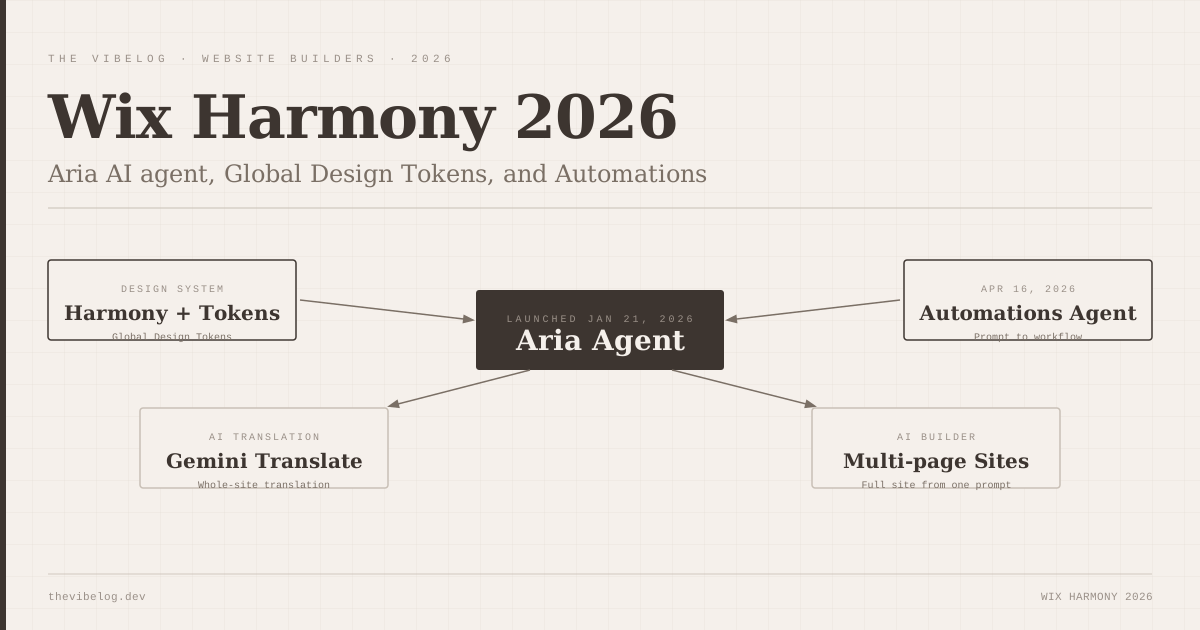
Wix Harmony launched on January 21, 2026, and it is a more fundamental change than the company’s previous AI releases — Aria is not a chatbot that writes copy, it is an agent that actually executes design and workflow changes on your site.
I have been using Wix since the mid-2010s, on and off, mostly for client projects where the budget was small and the maintenance needed to be zero. That version of Wix — drag-and-drop, slightly chaotic, capable but not credible next to Webflow — is still the mental model most developers carry. Harmony changes enough of that calculus that the old mental model is worth revisiting.
What Wix Harmony Actually Is in 2026
Wix Harmony is Wix’s AI-first rebuild of its creation experience. It is not a separate product or a plugin layer — it is the new underlying approach to how you build and modify sites on the platform, powered by Aria, Wix’s AI agent.
The difference from previous Wix AI features is execution scope. Earlier AI in Wix generated content or suggested layouts. Aria executes: tell it to update your colour palette, it updates the colour palette. Tell it to redesign a section, it redesigns it. Tell it to add a Stripe checkout, it adds one. The natural language interface is not a veneer over a form — it is the actual primary way the agent operates.
This sits on top of a set of infrastructure changes that make the AI changes coherent across a whole site, rather than one-off edits that break elsewhere.
Aria: The AI Agent at the Core of Wix Harmony
Aria is worth treating as its own topic because the distinction between “AI feature” and “AI agent” is meaningful here.
An AI feature helps you do something. An AI agent does things. Aria accepts natural language instructions and takes action — it modifies pages, adjusts design systems, creates automation workflows, generates metadata. You can ask Aria to redesign your pricing page for mobile, and it will do it across the actual page structure, not just suggest what you might do.
Concretely, Aria handles:
- Design changes: Update colour palettes, adjust spacing, change typography choices across the site
- Page redesign: Restructure individual pages or sections based on a description of what you want
- Commerce setup: Add commerce capabilities from a plain English prompt — product pages, checkout flows, the underlying configuration
- Automation creation: Build and modify Wix Automations workflows using natural language (this expanded significantly in April 2026 — more on that below)
- SEO metadata: Generate title tags, meta descriptions, and structured recommendations through the AI SEO Suite
- Translation: Translate the entire site into multiple languages using Gemini integration
The quality of Aria’s output depends heavily on how the request is scoped. Specific, outcome-oriented prompts work well. Vague prompts produce vague results — the same pattern you see with any AI agent, as described in the agentic coding patterns guide. The difference is that Aria’s scope is your website rather than a codebase, so the feedback loop is visual and immediate rather than requiring a test run.
Global Design Tokens: What They Actually Solve
Global Design Tokens are a design systems concept applied at the website builder level, and they are one of the most practically useful changes in Harmony for anyone managing a site that has grown organically.
Here is the problem they solve: in the old Wix editor, if you wanted to update your brand’s primary colour, you updated it in every place it appeared. Section backgrounds, button colours, heading treatments — each one separately, and you would inevitably miss some. Over time, sites drifted. A rebrand became a multi-hour manual audit.
With Global Design Tokens in Harmony, brand attributes — primary and secondary colours, typography scales, spacing — are defined once as tokens. Change the token, the change propagates everywhere that token is referenced. Aria can modify tokens directly from a conversation: “Update the primary brand colour to this hex, apply it across the site.” That is a genuine workflow improvement, not marketing language.
For agencies managing multiple client sites, the tokens approach also means brand guidelines are enforceable at the system level rather than dependent on whoever built each section following the same conventions.
Automations Agent: April 2026 Update
On April 16, 2026, Wix shipped the Automations Agent — a significant expansion of what Aria can do in the workflow layer.
Wix Automations lets you build trigger-action workflows: form submission sends a welcome email, new order creates a task, abandoned cart triggers a follow-up sequence. These were previously configured through a visual interface that was functional but required understanding the automation model to use effectively.
The Automations Agent adds an AI co-pilot that accepts natural language descriptions of what you want the automation to do, then creates or modifies the workflow accordingly. “When someone submits the contact form, create a task in my CRM and send me a Slack notification” becomes something Aria can configure directly.
This matters because automations are where a lot of Wix sites underperform their potential. The tool exists; most small business owners and non-technical site owners never fully configure it because the learning curve is not obvious. An agent interface that creates workflows from a plain description lowers that barrier substantially.
Whether this makes Wix competitive with dedicated automation tools like Zapier for complex use cases — no, probably not. But for the workflows that live at the “site + CRM + email” intersection, it is now significantly easier to set up without being a power user.
AI Translation: Gemini-Powered, Full-Site
Wix’s AI Translation in Harmony uses Gemini to translate a site into multiple languages in a single operation. The technical approach is worth noting: it translates formatted text as complete sentences, not as fragmented strings. That distinction matters for languages where word order or grammar structure differs significantly from English — fragment-level translation produces broken, unnatural results in languages like Arabic, Japanese, or German.
Translating a full commercial site used to mean exporting strings, running them through a translation service or contractor, reimporting, then auditing for layout breaks. For smaller sites — a local services business, a restaurant, a freelancer’s portfolio — that process was enough friction that it simply did not happen. One-click translation with Gemini removes that friction entirely.
The tradeoff is quality. Machine translation through Gemini is good but not professional-translator quality for nuanced or brand-voice-sensitive copy. For a legal services firm or a company where the exact phrasing of marketing copy matters, you would still want human review of the translated output. For a bakery’s website? The Gemini output is probably fine.
AEO: Wix Now Tracks How AI Search Sees Your Site
This is the feature in Harmony that most closely reflects where search is actually going in 2026.
AEO — Answer Engine Optimization — is Wix’s tooling for tracking and improving how AI answer engines (ChatGPT, Perplexity, Gemini, Claude) represent your brand and content. As AI-powered search handles a larger fraction of informational queries, appearing in AI-generated answers is becoming as important as appearing in traditional SERP results. It is a different optimisation target: structured, authoritative, directly answerable content rather than keyword density.
The AEO feature on Wix Team and Enterprise plans runs AEO agents on a recurring schedule, automatically scanning your site and returning prioritised recommendations. The focus is on whether your content is structured in a way that AI answer engines can parse and cite accurately — clear entity definitions, attributed data, direct answers to common questions.
This is the right problem to be solving. The sites that get cited in AI search results in 2026 have clear structure, specific claims, and entity signals that AI engines can extract. For a comparison of what makes content legible to AI engines, the MCP servers and AI tool integration guide covers the underlying model context patterns.
The AEO tooling is currently Team/Enterprise only, which means the small business segment that arguably needs it most has to upgrade to access it. That is a real limitation.
AI Credits, Wix Studio, and Plan Structure
As of May 13, 2026, Wix added AI credits to every workspace plan from Core through Enterprise. This is a meaningful shift from the previous approach where AI features were gated or token-limited in ways that were not always clearly communicated.
The practical effect: Core plan users can now use Aria for design changes, translations, and SEO metadata without hitting a wall immediately. Enterprise plans have higher credit allocations with the AEO agent access added on top.
It is worth being clear about Wix Studio versus Wix Harmony as a distinction, because they are often conflated.
Wix Studio is the professional-grade editor — the one with advanced layout controls, CSS grid support, responsive breakpoint controls, and Velo (Wix’s JavaScript framework for backend logic and custom APIs). Studio is where agencies and developers build sites that require granular control over both layout and code. Velo Tools and Integrations expanded further in 2026, with more APIs and backend triggers.
Wix Harmony is the AI-first creation layer. It runs across the Wix platform, including inside Studio. When a Studio user tells Aria to update Global Design Tokens or create an automation workflow, they are using Harmony within the Studio environment.
The 2026 focus for Studio is “agency-level quality with fewer steps” — the AI layer is meant to eliminate repetitive configuration work, not replace the granular controls that agency users depend on. That positioning makes sense. Studio’s value proposition was never “easy” — it was “capable.” Harmony adds speed to that without removing capability.
AI SEO Suite and Performance Engine
Harmony’s AI SEO Suite goes beyond metadata generation. It provides built-in recommendations that Aria can act on directly — title tag optimisation, description improvements, structured data suggestions. The metadata automation means you can maintain SEO hygiene across a large site without doing it page by page.
The Improved Performance Engine deserves a mention because it is often overlooked in the AI feature coverage. Wix’s historical reputation for generating heavy, slow-loading sites has been a genuine liability — particularly for SEO, where Core Web Vitals affect ranking. Harmony includes a lighter code output architecture that reduces page weight. Independent testing has shown improvements, though Wix-generated sites still do not match hand-coded or Webflow sites at the upper end of performance optimisation. The gap is narrower than it was.
The Honest Verdict: Who Should Reconsider Wix in 2026
The traditional knock on Wix from developers and designers was that it was for people who did not know better. That was accurate enough for long enough that the reputation stuck. It is less accurate now than it has been at any point in the platform’s history.
Wix Harmony is a meaningful step up. Aria’s ability to execute site-wide changes from natural language is not a gimmick — it is a genuine productivity tool for non-developers who would have spent hours manually applying changes that Aria handles in seconds. Global Design Tokens make brand coherence maintainable rather than aspirational. The Automations Agent removes a real friction point. The AEO tooling reflects an accurate read of where search is going.
Wix Harmony makes sense for:
- Small business owners and freelancers who want a full-featured site without managing a developer or learning a complex tool. Aria handles the changes they would have had to hire for.
- Marketing teams at small-to-mid-size companies who need to move quickly on site updates, translate for new markets, or set up automation workflows without developer bottlenecks.
- Agencies running high volume at standardised quality — Wix Studio plus Harmony’s AI layer can produce faster turnaround without the per-site cost of a bespoke approach.
Where Wix Harmony still does not compete:
- Complex custom web applications. Velo is capable but Wix’s architecture is still a website builder, not an application framework. If your project involves complex business logic, custom authentication flows, or non-standard data structures, Lovable, Bolt.new, or a proper development stack will serve you better.
- Performance-critical sites where every millisecond matters. The Performance Engine improvement is real; reaching 95+ Lighthouse scores on Wix still requires more effort than on a hand-coded or Webflow site.
- Developers who want to own and understand the code. Wix does not export a portable codebase the way Bolt.new or Lovable does. What you build on Wix stays on Wix.
The honest summary: Aria and the infrastructure changes underneath it move Wix from a “good enough for simple sites” tool to a genuinely capable option for a wider range of projects than it was 18 months ago. If the last time you seriously evaluated Wix was before January 2026, the platform that exists now is not the one you remember.
Wix Harmony announced January 21, 2026. Automations Agent shipped April 16, 2026. AI credits added to all workspace plans May 13, 2026. AEO feature available on Team and Enterprise plans. AI Translation uses Gemini. Sources: Wix official blog and product announcements.