The question has been asked at every conference, in every tech forum, and at every family dinner for three years. Will AI replace software developers?
The 2025–2026 data on whether AI will replace developers is genuinely complicated. Both the optimists and the pessimists are right about parts of it, and wrong about others, and the conflation of different numbers into the same argument has made the conversation mostly useless.
Let me try to separate them.
The Software Developer Job Numbers That Look Good
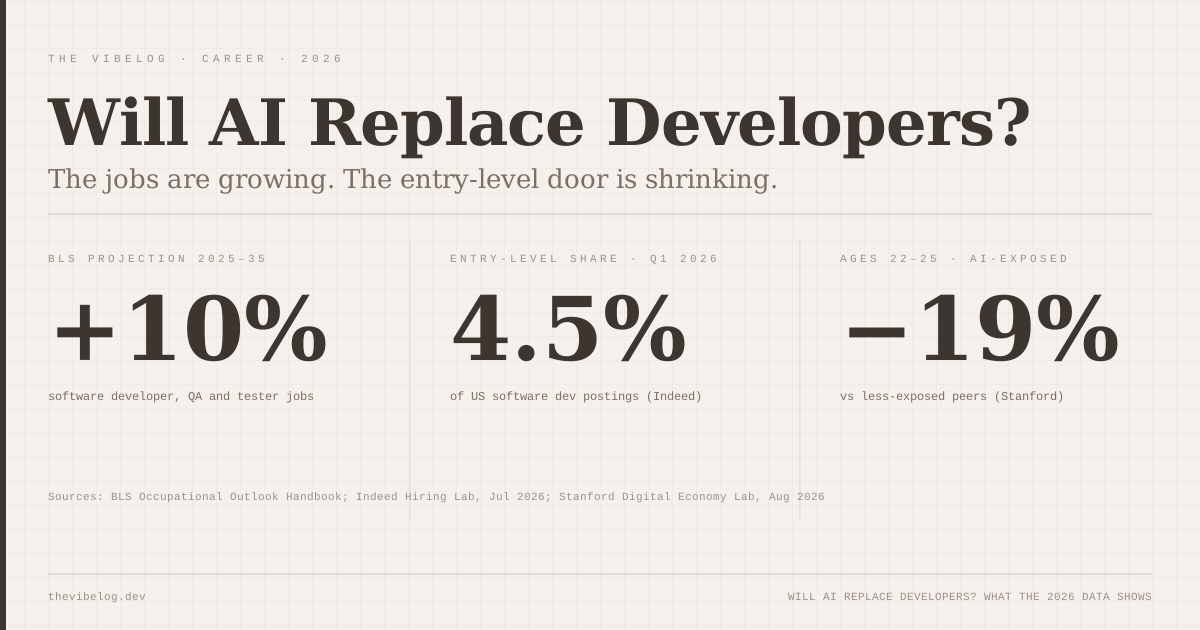
The Bureau of Labor Statistics projects employment of software developers, QA analysts and testers to grow 10% from 2025 to 2035, much faster than the average for all occupations. That is about 185,400 new jobs and roughly 106,100 openings a year. The World Economic Forum’s Future of Jobs Report 2025 put software and applications developers among the fastest-growing roles through 2030. And BCG’s April 2026 analysis concluded that “AI will reshape more jobs than it replaces”, calling software engineering an “amplified role” whose headcount “has risen steadily” since ChatGPT.
Postings are moving too. Indeed Hiring Lab reported in July 2026 that US software development job postings grew almost 15% after late February 2025, while overall job postings fell 7%.
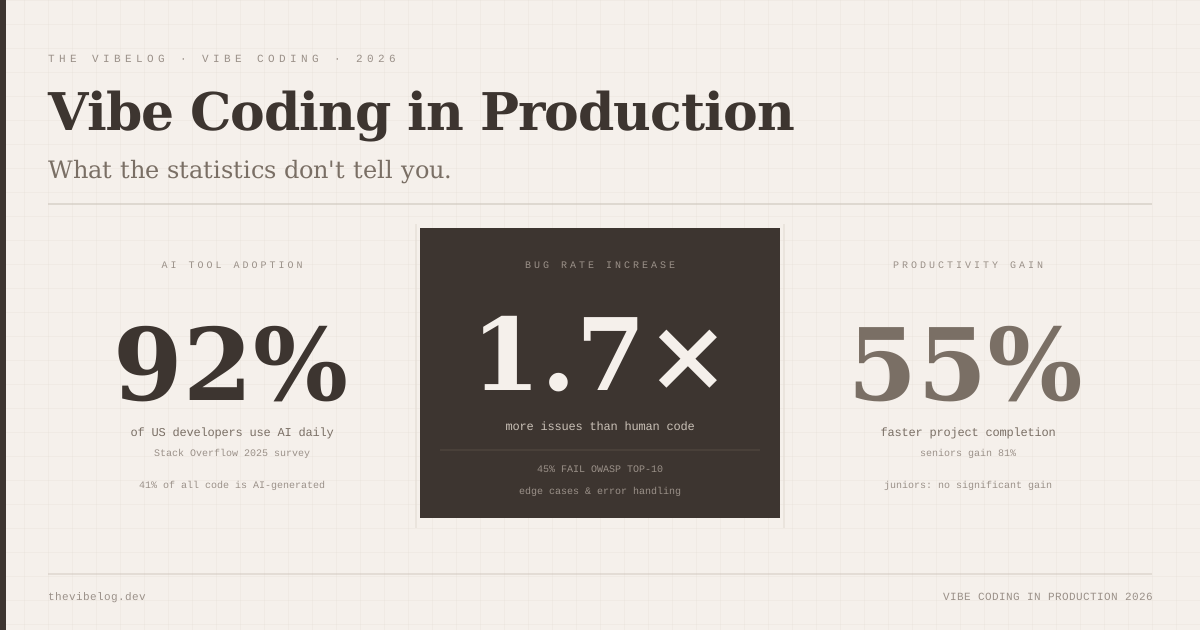
Adoption is close to universal. In the 2025 Stack Overflow Developer Survey, 84% of respondents said they were using or planning to use AI tools, up from 76% the year before. The productivity gains are real in controlled settings: in GitHub’s 2022 experiment, developers using Copilot finished a coding task 55% faster than those without it.
These are legitimate numbers. They are not cherry-picked. They are also not the full picture.
The Entry-Level Developer Job Numbers That Look Bad
The 12-month average of US “computer programmer” employment fell 27.5% from about 2023 to early 2025, according to Washington Post analysis of BLS Current Population Survey data, its lowest level since 1980. BLS now projects that category to shrink another 7% by 2035.
The young-worker data is worse. The August 2026 revision of Stanford Digital Economy Lab’s “Canaries in the Coal Mine” paper finds that employment of 22 to 25 year olds in AI-exposed occupations, software development among them, now sits 19% below where it would be had it kept pace with less-exposed peers. The authors attribute it mainly to reduced hiring, not layoffs.
SignalFire’s 2025 State of Tech Talent report found new graduates made up just 7% of big tech hires, with new-grad hiring down 25% from 2023 and more than 50% from 2019. And Indeed’s July 2026 data shows entry-level roles were only 4.5% of software development postings in Q1 2026, the lowest share of any sector it tracked.
IEEE Spectrum reported in April 2025 on a LinkedIn and GitHub study finding new hires were required to have fewer advanced programming skills, with more weight on human skills like ethical reasoning and leadership. The bar has not simply risen. It has moved.
These are also legitimate numbers.
Why AI Is Restructuring Developer Jobs Rather Than Replacing Them
The apparent contradiction resolves when you stop treating “software developers” as a monolithic category.
The long-term projection of 17% growth and the near-term collapse in entry-level hiring are not contradictory. What they describe is a restructuring: the overall demand for software development work is growing (more software in the world, more systems to build and maintain), while the mix of who does that work is changing radically.
Senior developers using AI tools are producing significantly more output than they were three years ago. A team of eight senior engineers with AI tooling can now do work that previously required twelve or fifteen. The total software output grows; the total headcount needed does not grow proportionally.
The entry-level positions — the roles that existed partly to train junior developers and partly to handle straightforward implementation work — are the ones disappearing. Because AI handles straightforward implementation work now.
Indeed’s numbers make the shape of this visible: 71% of the increase in software development postings between May 2025 and May 2026 came from senior roles, and 37% came from jobs with AI in the title. The Hiring Lab’s seniority analysis puts senior positions at 69.3% of all software development postings in Q1 2026, the highest senior share of any sector.
Here is the part that surprised me. The best controlled study I have found does not say AI helps seniors more. A 2024 Bank for International Settlements field experiment found AI raised code output by more than 50%, with gains statistically significant only among entry-level or junior staff. Juniors get faster with AI. Companies are still hiring seniors, because someone has to own what the faster juniors and the agents produce.
What AI Means for Junior Developers in 2026
If you are a junior developer right now, the most honest thing I can tell you is: the traditional on-ramp into software engineering has narrowed significantly.
The junior role that existed three years ago — where you would be handed a well-defined ticket, implement it with some oversight, and gradually build up a mental model of a codebase — that role is being compressed or automated away at many companies. The expectation for what “junior” means has moved up.
This does not mean you cannot get into software engineering. It means the path is harder. A few things that seem to help, based on what I see from developers who are getting hired:
Genuine specialisation. Not “I know Python,” but “I built a data pipeline that processes X at Y scale and here is the problem I solved doing it.” AI tools have made average generalist output cheap. Specific depth in a problem domain is not cheap.
Demonstrated judgment. The ability to review AI output critically, catch errors, and explain why something is wrong is genuinely valued and genuinely rare among new developers. If you can do this well, say so explicitly and demonstrate it.
Understanding systems, not just syntax. How does the database actually work? What happens when the cache is cold? Why does that request fail under load? These are questions AI tools answer poorly and that matter more as codebases grow.
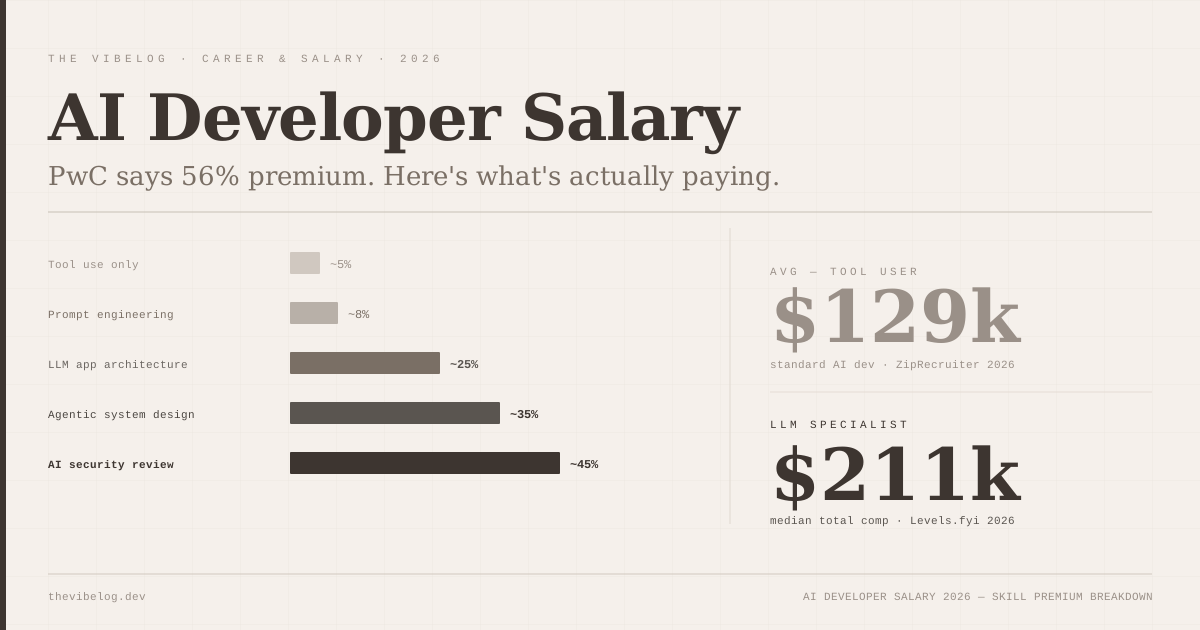
Fluency with agents, not just autocomplete. Directing an agent through a multi-file change and reviewing its diff is now a skill employers screen for. The agentic coding guide covers the workflow, and the AI developer salary breakdown shows which of these skills are actually being paid for.
What AI Means for Experienced Developers
Your job is safer than the coverage suggests. But “safer” does not mean “unchanged.”
The developers I see struggling are the ones treating AI tools as optional, not as a core part of their craft. With 37% of the growth in software postings coming from roles that put AI in the job title, being conspicuously AI-illiterate in a job interview is a meaningful negative signal.
The developers I see doing very well are the ones who have figured out what AI is actually good for — delegating well-defined work, reviewing critically, retaining the judgment that the tools do not have — while continuing to build depth in their domain.
The frame that helps me
BCG’s conclusion — “AI will reshape more jobs than it replaces” — is the most accurate single sentence I have read on this topic.
The software engineering job of 2026 looks different from the job of 2022. The tools are different, the output expectations are different, and the skills that get you paid are different. It is still the same field, solving the same fundamental problem: translating human intentions into working systems.
The developers who are going to have the hardest time are the ones who insist on treating 2022’s job description as the permanent definition of what software engineering is. The ones who are going to be fine are the ones who are curious about the changes, honest about what the tools can and cannot do, and focused on building the judgment that the tools will not have for a long time.
The job is not going away. It is changing faster than anyone expected three years ago, and slower than the most alarming headlines suggest. Both things are uncomfortable. Both things are true.
(Updated October 7, 2026: corrected the BLS projection from 17% growth through 2033 to the current 10% growth from 2025 to 2035; replaced the “nearly 20%” young-developer decline with Stanford’s revised August 2026 figure of 19%; removed the unsourced “down from 9.3%” new-grad comparison, the unsourced 37% career-opportunities, 84% job-postings and 81% senior-productivity claims; corrected developer AI usage, which Stack Overflow reported at 70% using or planning to use AI tools in 2023, not 15%; and added 2026 Indeed Hiring Lab posting data.)