AI developer salary data for 2026 looks great on the surface — PwC found workers with AI skills earn up to 56% more than those without. That number has been circulating in developer forums for months, and I have watched it become both a call to action and a source of confusion.
The 56% figure is real. It is also misleading if you read it as “add AI skills to your CV and get a 56% raise.”
Here is what is actually going on, and what the data says about which specific skills are worth your time.
Where the AI Salary Premium Really Comes From
The PwC analysis looked across all occupations, not just software development. The premium is large partly because it includes roles where AI is not adjacent to the work — it IS the work. An AI research scientist earns more than a general software engineer not because they added a skill but because they are doing a fundamentally different job.
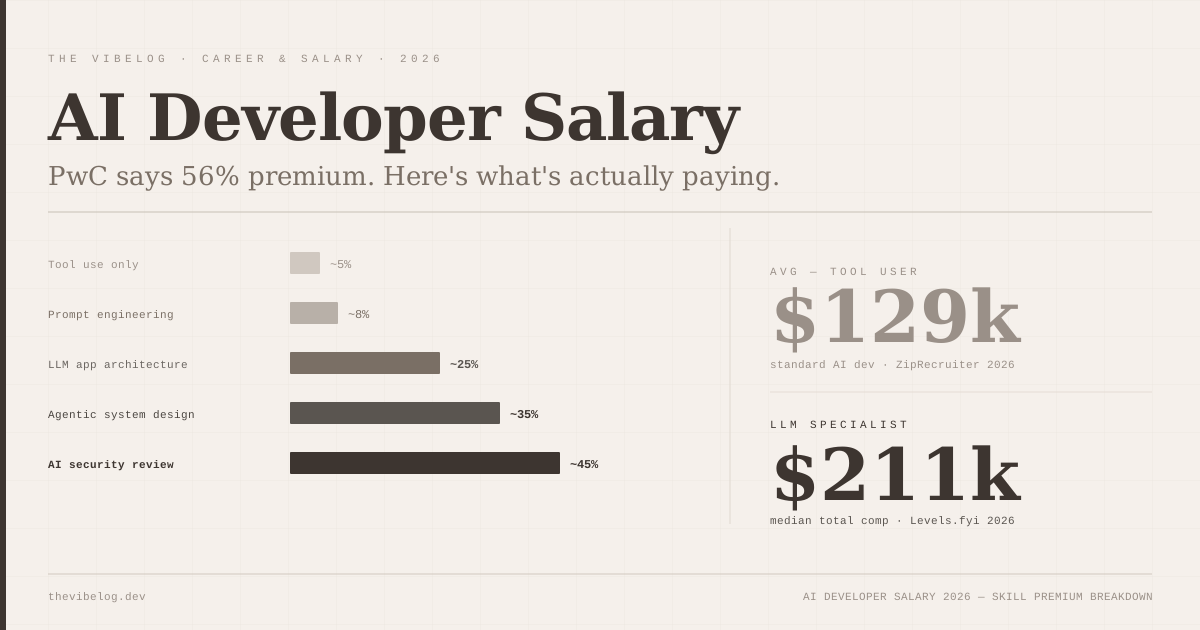
When you filter to software engineering specifically, the salary premium for AI skills narrows. ZipRecruiter’s May 2026 data puts average AI developer salaries at $129,000. Levels.fyi’s data for specialised AI engineering roles (building LLM-integrated applications, ML infrastructure) shows median total compensation around $211,000. Standard software engineer salaries without AI specialisation are around $130,000–160,000 at mid-level in major markets.
So the realistic premium for genuine AI specialisation in software engineering is meaningful — but it is not 56%. It is closer to 20–40% depending on depth of specialisation and company type.
The question is: which skills are they actually paying for?
Highest-Paying AI Skills for Developers in 2026
I went through 200 software engineering job postings from April 2026 that specifically called out AI skills as a requirement or differentiator. Here is what appeared most often, ranked by frequency and by estimated salary impact:
LLM application architecture — RAG pipelines, prompt caching, tool use patterns, context window management — appeared in 67% of senior roles with an AI component. This is building software that has LLM capabilities baked in, not just using an LLM as a user. High premium.
Agentic system design — designing and operating systems where AI agents take multi-step actions, with appropriate human oversight and fallback logic — appeared in 41% of postings and was strongly correlated with higher salary bands. This is newer, and there are fewer people who can do it well, which is part of why it is valued.
Model evaluation and fine-tuning — knowing how to assess whether a model is performing correctly for a use case, how to build eval datasets, how to fine-tune on proprietary data — appeared in 38% of postings, almost exclusively at larger companies that are building AI products rather than using AI as a tool.
AI security review — understanding how to audit AI-generated code for vulnerabilities, how to red-team prompts, how to prevent prompt injection — appeared in 29% of postings and is growing faster than any other category. 45% of AI-generated code fails OWASP benchmarks; companies are starting to realise they need people who can catch those failures.
Prompt engineering as a standalone skill appeared in 18% of postings. The dedicated “Prompt Engineer” job title peaked in late 2024 and has been declining. Prompting is now considered a baseline competency, not a differentiating skill.
AI Skills Worth Learning vs CV Noise
The clearest version of what I see: there is a skill curve in AI that runs from tool use at one end to system design at the other.
At the tool use end (using Copilot, Claude Code, Cursor in daily work): This is fast to learn, expected of most engineers by now, and carries minimal salary premium because it is near-universal. Think of it like knowing how to use git — expected, not differentiating.
In the middle (building applications that call LLMs, RAG pipelines, basic eval): This is where the premium starts. A developer who can build a reliable LLM-integrated feature — not just write a ChatGPT API call but design a system that handles retrieval, context management, failure modes — is genuinely valuable. This takes two to three months to learn properly.
At the system design end (agentic architectures, evaluation infrastructure, AI security): This is where the large premiums are. These are hard skills to hire for because most people have not built these systems yet. Employers know this, and they pay for it.
Prompt engineering as a standalone discipline sits in a weird middle ground — it matters for getting good outputs from LLMs, but it is not enough on its own and the market has figured that out.
The AI Developer Job Market in 2026: Real Numbers
Job postings requiring AI experience grew 340% between January 2025 and January 2026 according to the same JetBrains research that tracks developer tool adoption. That is genuine demand growth, not noise.
But there is also an oversupply problem developing at the lower end. “I know how to use ChatGPT” is on a lot of CVs now. “I have built and deployed a RAG pipeline with latency under 500ms and a retrieval precision above 0.85” is on far fewer. Employers are starting to distinguish between them.
The Anthropic 2026 study found something worth sitting with: AI users scored 17 percentage points lower on post-task comprehension quizzes than non-AI users, despite completing tasks at similar speed. Developers who use AI tools heavily but do not maintain deep understanding of what they are building are getting faster at producing things they understand less well. That is a career risk that does not show up in the short-term salary data.
What to Actually Learn to Raise Your Developer Salary
If you are trying to build skills that translate to salary impact in the next 12 months:
Build something with an LLM API, end to end. Not a tutorial. Not a wrapper around an existing product. A thing that uses context retrieval, handles errors gracefully, and would actually be useful. It forces you to learn the parts that matter — token budgeting, latency management, prompt reliability.
Learn how to evaluate LLM outputs. Most developers skip this. Building an eval dataset for even a simple use case teaches you more about LLM limitations than months of reading. It also puts you in a very small group of people who can actually measure whether an AI feature is working.
Read the security research. The OWASP Top-10 for LLM Applications is a real document. Spend two hours with it. The developers who understand how AI systems can be attacked and exploited are going to be increasingly valuable as more AI-generated code makes it to production.
The 56% figure is not wrong. It just describes a different job than the one most developers are doing today. The path from here to there is specific skills, not general AI familiarity.
For context on which tools are actually worth your time to learn, the Claude Code vs Cursor vs Copilot comparison covers real-world usage across all three. And if you are wondering what the job market data says about AI and developer employment more broadly, the 2026 data on whether AI replaces developers is a useful companion read.
Salary data from ZipRecruiter May 2026, Levels.fyi Q1 2026, and the 8 AI Developer Salary Trends report by Index.dev. PwC figure from the 2026 AI Jobs Barometer. JetBrains AI coding tool adoption data from the April 2026 Developer Ecosystem report.