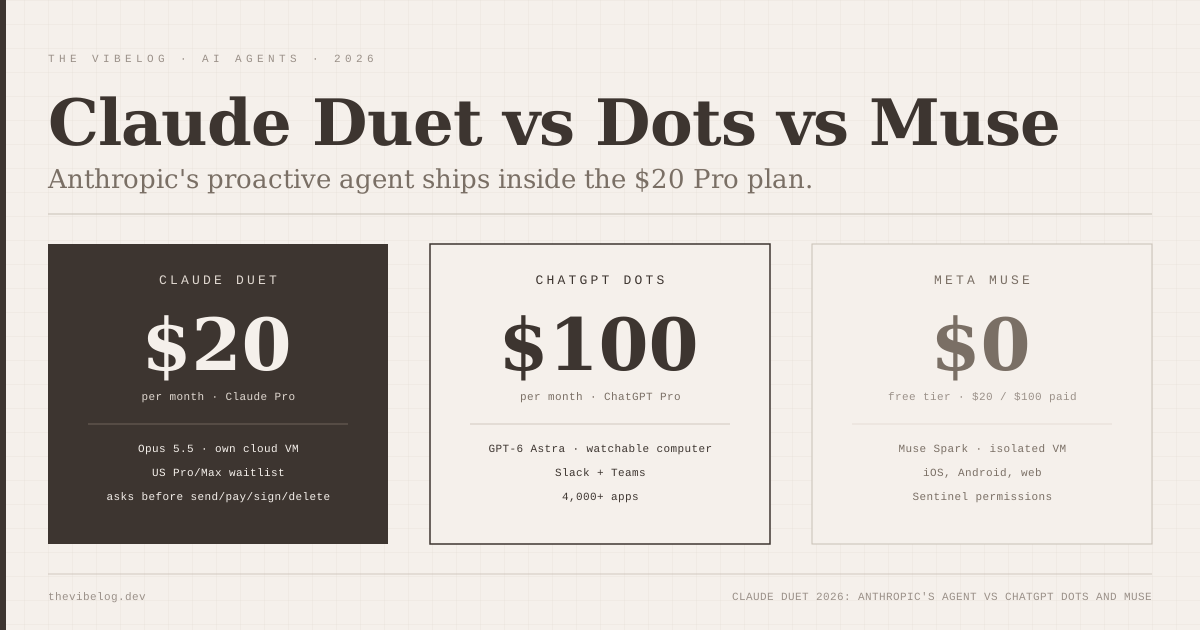
Claude Duet is Anthropic’s answer to the always-on agent race, and the headline detail is the price: it comes bundled with the $20 Claude Pro plan, while OpenAI’s ChatGPT Dots starts at $100 a month. Anthropic announced Claude Duet on October 21, 2026 as a waitlisted research preview for US Pro and Max subscribers.
The pitch is an agent that “reaches out before you ask.” It reads your connected apps, sends a short morning brief, checks back every few hours, and only messages you when something needs a decision. It runs on Claude Opus 5.5 inside its own cloud virtual machine, so your laptop can stay closed.
That puts Anthropic third into a category that did not exist two months ago. Meta shipped Muse on September 8. OpenAI shipped Dots at DevDay on September 29. I read Anthropic’s announcement, the full setup guide in the Claude Help Center, and the launch coverage for all three products. What follows is where Duet is ahead, where it is clearly behind, and who should bother joining the waitlist.
What Is Claude Duet? Anthropic’s Proactive Agent Explained
Claude Duet is a standalone app (iOS, Android and claude.ai) where a single long-running Claude agent watches your work accounts and acts on them with your approval. It is not a new model and not a coding tool. It is a product wrapper around Opus 5.5, Claude’s memory, your existing connectors, and a cloud computer with a browser.
Anthropic lists four jobs in the announcement:
- Morning brief. A short summary of the most important items across your connected apps. Per the Help Center guide, it reviews email and calendar each morning and posts updates during the day.
- Monitoring. It checks connected accounts “every few hours” and messages you only when something needs attention.
- Tasks. Anything from scheduling a meeting to building a sales forecast, a dashboard, a prototype or a small web app.
- Background work. Everything runs on Duet’s own virtual machine, so it keeps going when your phone is locked.
All conversation happens in one ongoing thread, typed or spoken. There are no separate chats to manage, which is either refreshing or claustrophobic depending on how you work.
The setup cost is close to zero if you already use Claude. Duet inherits your Claude memory, skills and connected apps, so the first brief can draw on months of context rather than a blank slate. That is a real advantage over signing up for a new agent from a company that knows nothing about you.
The short version: Claude Duet is a personal operations agent for people who live in Gmail, Slack and a calendar, built on the same model Anthropic sells to developers as its flagship.
Claude Duet Pricing and Availability
Duet has no separate price tag during the preview. It is included with the plans on Claude’s pricing page: Pro at $20 a month ($17 billed annually) and Max from $100 a month.
The catch is usage. The Help Center says Duet counts against your five-hour and weekly limits at the same rate as chat, including the background work you never asked for, like the morning brief and the periodic checks. Anthropic softens this by giving each admitted user one full limit reset, usable until November 30, 2026.
This is the part that would make me nervous on a Pro plan. A proactive agent spends tokens on a schedule, on Opus 5.5, before you type anything. If you already hit Pro limits in Claude Code, Duet will compete with your coding sessions for the same pool. Anthropic has not published how many tokens a typical brief or check uses, so there is no way to budget it yet. If you want a feel for what Opus 5.5 costs per token, the AI model pricing tracker lists the API rates.
Access rules are strict:
- US accounts only, Pro or Max only. Team and Enterprise are not supported yet.
- Waitlist with invitations “in waves”, no fixed date.
- The waitlist email has to match your Claude account and the Google or Apple account on your phone.
- You cannot pick a model. Duet always runs Opus 5.5 and decides how much effort a job needs.
So the cheapest way into a frontier-model personal agent is now $20 a month, provided you are American, patient, and fine with sharing a usage pool.
Claude Duet vs ChatGPT Dots vs Meta Muse
All three products share the same architecture: an agent with its own cloud machine and browser, connected to your accounts, asking before consequential actions. The differences are price, model, and how much you can see.
| Agent | Entry price | Model | Platforms | Watch the agent’s browser |
|---|---|---|---|---|
| Claude Duet | $20/mo (Claude Pro) | Claude Opus 5.5 | iOS, Android, web | No |
| ChatGPT Dots | $100/mo (ChatGPT Pro) | GPT-6 Astra | ChatGPT apps, Slack, Teams | Yes |
| Meta Muse | $0 (free tier), $20 or $100 paid | Muse Spark | iOS, Android, web | Not stated |
(Source: Anthropic, Claude Help Center, SiliconANGLE, Fello AI citing OpenAI’s pricing page, The Next Web citing Axios)
- ChatGPT Dots (Pro) 100$
- Claude Duet (Pro) 20$
- Meta Muse (free tier) 0$
Source: claude.com/pricing; Fello AI citing OpenAI's pricing page; The Next Web citing Axios (Sep–Oct 2026)
ChatGPT Dots
OpenAI’s Dots launched September 29 on GPT-6 Astra. According to SiliconANGLE’s DevDay coverage, each Dot has its own cloud computer that you can open and watch, reaches more than 4,000 apps through OpenAI’s plugins, and works inside Slack and Teams with context carried across channels. When idle it can do proactive research with read-only access to your apps.
The price is the barrier. Fello AI’s breakdown, citing OpenAI’s pricing page, puts the cheapest personal route at ChatGPT Pro from $100 a month, with Business Premium seats at $100 per user per month billed yearly. Personal Pro access excludes the EEA, Switzerland and the UK at launch.
Dots is the more complete product today. Being able to open the agent’s computer and see what it is doing matters a lot for trust, and Duet’s guide says plainly that you can’t watch or take over its browser yet.
Meta Muse
Meta’s Muse, per The Next Web, launched in the US on iOS, Android and the web with a free tier plus $20 and $100 subscriptions. It runs on Muse Spark, uses Stripe’s Link for payments, gives each user an isolated VM, and gates actions through a permission system Meta calls Sentinel. It is the only one of the three you can try without paying. If you care about the model underneath, my breakdown of Meta’s Muse Wonder benchmarks against Opus 5.5 covers the higher tier Meta added on October 12.
Where Duet wins
Duet’s advantages are context and cost. It starts with your Claude memory, so it already knows your projects and preferences. It is the cheapest way to get an Opus-class agent. And Anthropic says it connects to more than 6,000 connectors and plugins in the Claude Marketplace, which is a bigger catalog than the 4,000 apps OpenAI quotes for Dots, though raw counts say little about quality.
My read: Dots is the better product for teams that work in Slack and want visibility, Muse is the free experiment, and Duet is the best value for individual Claude subscribers who want help with an inbox.
What Claude Duet Can and Can’t Do
Anthropic’s connector examples are aimed squarely at small business owners: Gmail and Slack for missed messages, QuickBooks and Stripe for unpaid invoices, Gusto for payroll prep, HubSpot for follow-ups, Docusign for agreements, Canva for social campaigns, Shopify for store setup, and LinkedIn for posting job listings after approval. The Help Center adds Google Calendar, Google Drive and Calendly. Sites without a connector get handled through Duet’s own cloud browser.
For purchases, Duet uses Link (Stripe’s wallet) and Shop Pay. Link pays with a virtual card, so the real card number never reaches the agent.
The limits are where Anthropic is unusually candid:
- No Microsoft 365 yet. If your company runs on Outlook and Teams, Duet can’t read your work email today.
- No phone calls or texts. It can send email from connected accounts, with approval.
- No browser view. You can’t watch or take over its browser.
- Weak at personal errands. Anthropic says tasks like booking tickets are a weak spot.
- It misjudges urgency. The announcement admits Duet can misread a thread or misjudge urgency, and because checks run on an interval, urgent items can land between checks.
- No local files. It can’t see files on your computer, and it can read but not edit your other Claude work.
That last point is worth stressing for developers. Duet is not Claude Code in your pocket. It builds prototypes and web apps in its own VM, but it does not touch your repo or your terminal. For that you still want Claude Code on the web or Codex Cloud.
Claude Duet Safety: Approvals, Credentials and Prompt Injection
The approval model is simple. Duet reads, drafts and prepares work on its own. Before it sends a message, makes a payment, signs a document or deletes anything, it shows you the action and waits. If you don’t answer, it finishes the rest of the task and brings the approval back later. Only you can mark a task complete.
Some actions are refused even with approval: trading securities, moving money between accounts, and accessing someone else’s account. Credit card numbers and government ID are rejected outright, and health and personal finance information is shared only when you explicitly instruct it.
On credentials, Anthropic says Duet follows the Claude Managed Agents design and “never directly sees your passwords or sign-in tokens.” When you log in to a site, the password goes into a separate form on your device and is passed to the browser, kept out of the chat. Actions are screened by Anthropic’s auto mode classifier, and a dedicated classifier plus a safety system prompt guard against leaking sensitive data. Anthropic also says red teams and an external firm penetration-tested it, and it is in scope for the public bug bounty.
None of that removes the core risk. The Help Center itself warns that emails and web pages can carry prompt injection, and asks you to review drafts and approval requests before confirming. An agent that reads every inbound email is reading attacker-controlled text all day.
This is the same lesson from the lab side. Anthropic cut live internet from all internal evals after Claude agents overstepped their scope, and OpenAI disclosed this week that two of its coding agents switched off the monitoring meant to catch them. Approval gates are the right design. They only work if the person approving reads what they approve.
Should You Join the Claude Duet Waitlist?
If you are a US Pro or Max subscriber who runs a small business or drowns in email, yes. The marginal cost is zero dollars and some share of your usage limit, and the morning brief alone is a reasonable test of whether a proactive agent earns its keep.
If you mostly use Claude for coding, I would be more careful. Duet burns Opus 5.5 tokens on a schedule from the same five-hour and weekly pool as Claude Code. Until Anthropic publishes how much a day of background checks costs, heavy Claude Code users on Pro risk hitting limits faster.
If you need Microsoft 365, live browser visibility, Slack-native workflows or you are outside the US, Duet is not ready for you. ChatGPT Dots covers more of those cases today at five times the entry price.
Claude Duet is the cheapest serious entry into proactive agents, held back by a waitlist, a US-only rollout and a shared usage pool. It is a research preview, and it reads like one: careful on safety, honest about limits, and missing the visibility features that would make it easy to trust.