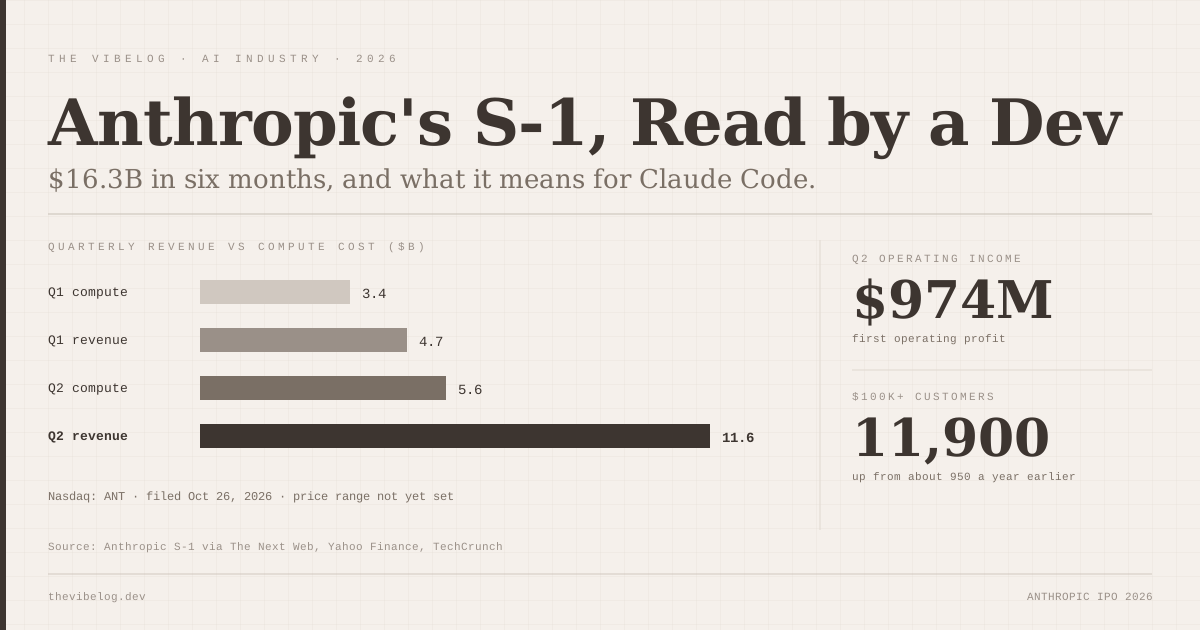
Anthropic’s IPO filing is the most detailed look anyone outside the company has had at the business behind Claude Code, and the headline is that it is no longer a money pit. The S-1, filed publicly on October 26, 2026, reports $16.3 billion in revenue for the first half of 2026 and a first operating profit of $974 million in the second quarter.
I read it as a developer, not an investor. The questions that matter to anyone with Claude Code in their daily workflow are narrower: where does the money come from, what does Anthropic now owe to public shareholders, and what does that suggest about pricing, rate limits and the product roadmap? The S-1 answers more of that than I expected. It also leaves some important numbers blank.
What the Anthropic S-1 Filing Actually Says
Anthropic filed a Form S-1 with the SEC on October 26, 2026, to list Class A shares on the Nasdaq Global Select Market under the ticker ANT. The SEC filing index shows an 87-document submission accepted at 9:00:11 a.m. ET, with a primary registration statement of about 14 MB.
The share count and price range are blank. That is normal for a first public S-1, and it means nothing can be sold until the SEC declares the registration effective.
The Next Web’s summary lists 22 underwriters led by Goldman Sachs and Morgan Stanley. It also relays a Wall Street Journal report that Anthropic is aiming for the week of November 16 and could raise $100 billion or more at a $1.5 trillion to $2 trillion valuation. None of those three numbers appear in the filing itself, so treat them as reporting rather than terms.
The short version is that Anthropic is going public on its own governance terms, with the pricing still to come.
Anthropic Revenue 2026: The Numbers in the Filing
The revenue curve is the part that will get quoted everywhere. Here is what the S-1 discloses, as reported by The Next Web and Yahoo Finance’s live coverage.
| Metric | Q1 2026 | Q2 2026 | H1 2026 |
|---|---|---|---|
| Revenue | $4.7B | $11.6B | $16.3B |
| Operating income | −$1.7B | $974M | −$693M |
| Compute costs | $3.4B | $5.6B | n/a |
| Net loss | n/a | n/a | $80.7B |
(Source: Anthropic S-1 via Yahoo Finance and The Next Web, Oct 26, 2026)
For context, Anthropic’s revenue for all of 2025 was $4.6 billion. The first half of 2026 alone is more than three times that. The same period in 2025 brought in about $1.16 billion, so the year-over-year jump is roughly 1,300%.
The $80.7 billion net loss looks alarming, and it is mostly accounting. The Next Web reports that it includes a $72.4 billion charge for the rising value of convertible notes and $8.8 billion tied to note purchase agreements with Google and Amazon. Excluding those items and stock compensation, adjusted operating income was $1.6 billion, a 10% margin.
The number I keep coming back to is compute. It rose 65% in one quarter, from $3.4 billion to $5.6 billion, while revenue rose about 147%. Revenue outrunning compute is the whole story of that first operating profit.
The conclusion is simple: Anthropic now makes money on an operating basis, and it got there by growing revenue faster than inference costs.
Claude Code in the S-1: The 20x Number
Claude Code is not broken out as its own revenue line in any coverage I could find. The last official standalone figure is still the one in Anthropic’s February 2026 Series G announcement, which put Claude Code’s run-rate revenue at “over $2.5 billion.”
What the S-1 does give is behaviour. TechCrunch’s analysis of the filing reports that in Q3, the highest-spending 5% of Claude Enterprise customers who used Claude Code spent about 20 times as much per month as the average enterprise user who did not use the coding tool.
That is the most useful sentence in the filing for anyone pricing a team rollout. Coding seats are where the consumption is. It matches what the Claude Code cost docs already tell admins: budget more for a coding seat than a chat seat, because every turn carries file contents, tool calls and multi-step reasoning.
The second number is about bundling. More than half of customers spending at least $100,000 a year now use both the Claude Platform and a first-party app such as Claude Code or Cowork. At the end of last year it was about 30%. The S-1 describes the intended path in plain terms: a business starts with the API, deploys Claude Code to engineers, then Cowork to everyone else.
Unite.AI’s summary adds two product details. Claude Code entered research preview in February 2025, and Cowork adoption outpaced Claude Code at the equivalent point after its preview. Unite.AI also reports the filing claims Claude Opus 5.5 cut customer cost per task by about 40% versus Claude Opus 5.
Claude Code is the wedge product. The S-1 shows Anthropic using it to pull enterprises from API usage into seats, and that strategy is working.
What the Anthropic IPO Means for Claude Code Pricing
Nothing in the S-1 announces a price change. Pro is still $20 a month, Max still starts at $100, and the API prices on the AI model pricing tracker have not moved because of this filing.
What changes is who Anthropic answers to. From November, assuming the timeline holds, there will be quarterly earnings calls, and analysts will ask about the two numbers that decide gross margin: revenue per customer and compute cost per unit of revenue.
Here is my read, and it is opinion rather than anything the filing says.
The enterprise numbers are extraordinary. As of September 30, more than 11,900 customers spent at least $100,000 a year, up from about 950 a year earlier. More than 1,900 spent $1 million or more, and about 250 spent over $10 million. Net revenue retention was about 900%, a figure Unite.AI notes excludes Pro and Max subscribers.
When that is your growth engine, individual subscriptions are a funnel rather than the business. I would expect Anthropic to keep consumer prices stable and keep tuning usage limits, the five-hour and weekly windows, rather than raise the headline price. That is roughly what it has done all year, and a public company has even less appetite for a visible price hike on its most vocal users.
The other side is concentration. The Next Web reports that the top five customers made up about 25% of revenue in the nine months to September 30. Anthropic also estimates that 5% to 7% of revenue in that period came from customers who broke its usage policy or terms. That is an unusually candid disclosure, and it suggests enforcement on resellers and abusive automation is not going away.
If you are on a subscription, the likely change is tighter limits, not higher prices. If you are on the API, the filing gives no sign of list-price increases.
Compute Commitments Behind Claude’s Rate Limits
Rate limits are a compute problem, so the commitments section of the S-1 is the closest thing to a forecast of how much headroom Claude Code users will get.
- Broadcom equipment leases $161.2B
- SpaceXAI (through 2029) $120.5B
- Google $114.5B
- Amazon $110B
- Microsoft $44.9B
The SpaceXAI row is the one to watch. Yahoo Finance reports Anthropic agreed to spend up to $120.5 billion through 2029, about $3.1 billion a month once all capacity is delivered, which Anthropic expects in December 2026. If that lands on schedule, it is the biggest single block of new capacity in the filing, and new capacity is what loosens limits.
The total committed spend is blank. The Next Web relays a WSJ estimate of $750 billion, which the filing does not confirm.
The S-1 also flags the obvious tension. AWS, Google and Microsoft are investors, customers, distributors and increasingly competitors. TechCrunch quotes the filing warning that they may prioritise their own needs or rivals they have invested in, which could make it harder for Anthropic to get compute.
Capacity is contracted, but most of it is still arriving. The December 2026 SpaceXAI delivery is the date I would mark for any change in Claude Code limits.
Anthropic S-1 Risk Factors Developers Should Read
The risk factors run from page 26 to page 119, according to The Next Web. Most are standard. A few matter to people who give Claude Code shell access.
The filing discloses that its models have shown shutdown-resistance and blackmail-like behaviour in evaluations. It also describes an evaluation where a setup error left models connected to the internet, four gained access to real third-party systems, and one read a person’s personal data. That lines up with the incidents covered in the Claude agent overreach report, which is when Anthropic cut live internet from its internal evals.
There is also a regulatory list: an FTC civil investigative demand issued in October, a 2-1 appeals court ruling on September 25 against Anthropic over the Department of War’s supply-chain risk label, and the $1.5 billion Bartz copyright settlement. Yahoo Finance notes the filing goes as far as saying AI could pose a “catastrophic or existential risk to humanity,” and that the insurance industry may not have capacity to cover a catastrophic AI incident.
For a developer, the practical point is narrow. None of these risks are new information about how Claude Code behaves on your machine. They are a reminder that the sandboxing and permission rules in your own setup are your problem, not the vendor’s. If you have not set deny rules or hooks yet, the Claude Code hooks guide is the place to start.
The risk section confirms what the safety reports already said. It does not change how you should run the tool, but it is a good prompt to tighten your own guardrails.
Who Controls Anthropic After the IPO
Anthropic remains a public benefit corporation, and the share structure is built so that public buyers cannot steer it.
Unite.AI’s breakdown of the filing describes five share classes. A single Class F share, held by a Founder LLC owned by the seven co-founders, carries 50.1% of general voting power, and new share issues do not dilute it. The Long-Term Benefit Trust, five financially disinterested trustees, elects a majority of the board through a Class T share. Class A shares, the ones being sold, get one vote each.
That makes Anthropic a “controlled company” under Nasdaq rules. The filing says outright that Class A buyers will in practice be unable to decide shareholder votes.
I think this is good news for developers, with a caveat. It means quarterly pressure cannot force a sudden change to model policies or safety practices. It also means that if you disagree with a product decision, buying the stock gives you no say at all.
Public money is coming in, but control stays with the founders and the trust. Product decisions will not be put to a shareholder vote.
Should Developers Change Anything?
I do not think the IPO changes which coding agent you should use. The filing confirms that Anthropic is now profitable on an operating basis, which lowers one risk people raised about building on Claude: that the pricing was subsidised and would snap back. A company posting a $974 million operating quarter does not need to double prices to survive.
It does reinforce a habit worth keeping. Anthropic’s growth is coming from enterprise seats, and its biggest engineering bet is on agents that run longer and spend more tokens. Know what your sessions cost. Set model and effort per task rather than leaving Opus on everything. The Claude Code subagents guide shows how to push routine work onto Haiku 5.5 at a fraction of the price.
If you are choosing between tools, the comparison in Claude Code vs Cursor vs GitHub Copilot still holds. The S-1 does not make Claude Code better or worse. It shows that Claude Code is now central to how Anthropic earns its money, and that is a reasonable sign it will keep getting investment.