SWE-2 Flash is Cognition’s new cheap, fast coding model for Devin, and the most interesting thing about it is a table Cognition published itself. On November 4, 2026, the company said SWE-2 Flash runs three times faster than SWE-2 at one-fifth of the price, and that it “outperforms all American open-weight models, even ones 3x larger.”
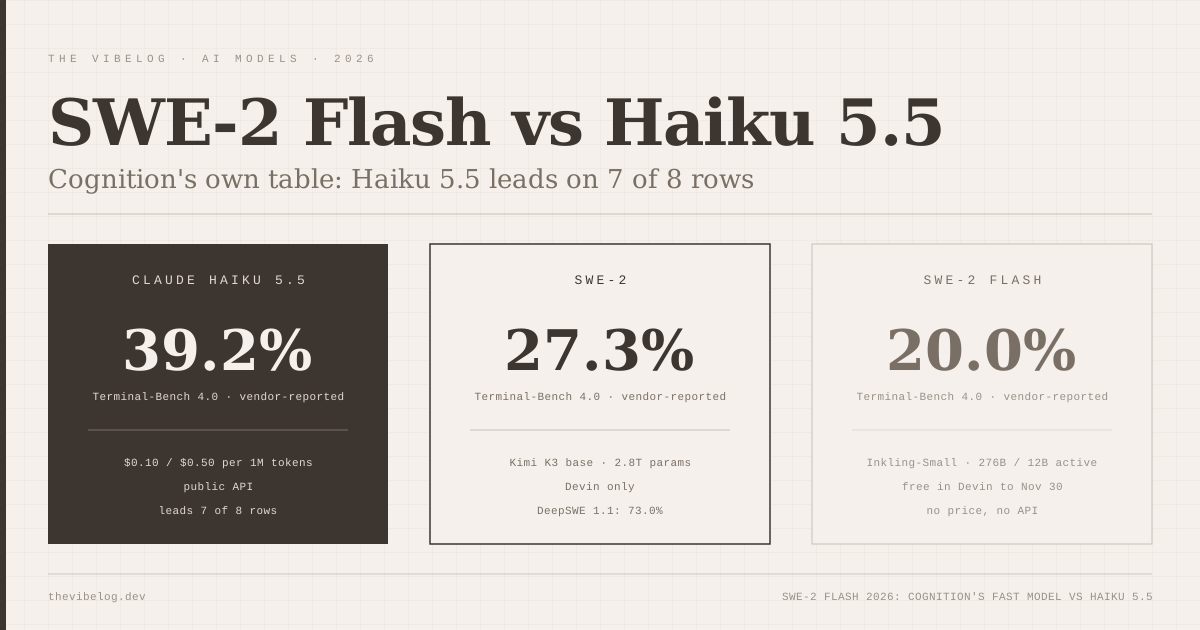
Read the full benchmark grid in Cognition’s launch post, though, and a different model keeps winning. Claude Haiku 5.5 sits in the same table and beats SWE-2 Flash on seven of the eight rows.
That does not make SWE-2 Flash a bad model. It makes it a model whose main selling point is its price inside Devin, and Cognition has not published that price yet.
What Is SWE-2 Flash?
SWE-2 Flash is a coding model post-trained by Cognition from Inkling-Small, a 276B-parameter mixture-of-experts model with 12B active parameters. Thinking Machines Lab released Inkling-Small on July 30, 2026, with full weights on Hugging Face, a context window of up to 1M tokens, and its own reported 80.2% on SWE-Bench Verified.
The quick facts from Cognition’s post and third-party coverage:
- Released: November 4, 2026, by the Cognition Team
- Base model: Inkling-Small (276B total, 12B active)
- Where it runs: Devin Desktop and the Devin CLI only
- Price: “one-fifth the price” of SWE-2, with no per-token figure
- Trial: free for paid Devin users through November 30, 2026, per RuntimeWire
- Weights: not public; a partner-sharing program is “a few weeks” away
- API: none, and OrcaRouter notes there is no model ID or endpoint to call
For context, SWE-2 itself shipped on September 10, 2026. Cognition’s SWE-2 post says it was post-trained from Moonshot’s Kimi K3, a model Cognition lists at 2.8T total and 104B active parameters. So Flash is roughly a tenth of SWE-2’s size, and Cognition’s own size chart says exactly that: SWE-2 at 10.1x.
My read is that this is Cognition building a two-tier lineup the way every lab does now. SWE-2 handles the hard tickets, and Flash handles the cheap, frequent ones.
SWE-2 Flash Benchmarks: The Full Table
Every number below is vendor-reported by Cognition. The post does not name the harness or say whether scores are pass@1, a gap OrcaRouter also flagged.
I cross-checked the comparison figures against what the other vendors published themselves, and they line up. Claude Haiku 5.5’s 39.2 on Terminal-Bench 4.0 matches Anthropic’s number, and DeepSeek V4.1 Flash 1017’s 77.0 on DeepSWE matches DeepSeek’s.
| Model | Terminal-Bench 4.0 | DeepSWE 1.1 | FrontierCode 2.0 | SWE-Bench Pro v2 Hard |
|---|---|---|---|---|
| SWE-2 Flash | 20.0 | 60.1 | 24.0 | 89.9 |
| SWE-2 | 27.3 | 73.0 | 23.8 | 90.6 |
| Claude Haiku 5.5 | 39.2 | 59.3 | 27.7 | 90.2 |
| DeepSeek V4.1 Flash 1017 | 42.3 | 77.0 | 19.3 | 86.3 |
| GLM 5.3 Flash | 41.8 | 63.4 | 14.2 | 88.2 |
| GPT-6 Luna | 16.4 | 66.6 | 21.9 | 80.4 |
| Muse Spark Open | 8.0 | 60.0 | 6.2 | 82.4 |
| Inkling-Small (base) | 0.9 | 17.4 | 3.2 | 56.5 |
(Source: Cognition, Introducing SWE-2 Flash, Nov 4, 2026; all scores vendor-reported)
The other four rows Cognition published tell the same story. On FrontierCode 1.1 Main, Flash scores 45.5 against Haiku 5.5’s 46.4. On Terminal-Bench 2.1 it is 89.2 against 94.4, on SWE-Atlas QA 50.0 against 56.5, and on ExploitBench 34.8 against 38.0.
Count it up and Haiku 5.5 is ahead on seven of eight rows. The single Flash win is DeepSWE 1.1, by 0.8 points.
- DeepSeek V4.1 Flash 1017 42.3%
- GLM 5.3 Flash 41.8%
- Claude Haiku 5.5 39.2%
- SWE-2 27.3%
- SWE-2 Flash 20%
- GPT-6 Luna 16.4%
- Muse Spark Open 8%
Terminal-Bench 4.0 is the row I would weigh most for an agent that runs shell commands all day, and it is Flash’s weakest result. At 20.0% it is half of Haiku 5.5 and below SWE-2’s 27.3%. On long terminal tasks, SWE-2 Flash is a clear step down from both.
The jump from the base model is real, though. Cognition took Inkling-Small from 0.9% to 20.0% on Terminal-Bench 4.0 and from 3.2% to 24.0% on FrontierCode 2.0. That is a lot of capability added in post-training, and it is the strongest evidence in the post that Cognition’s RL recipe works.
Does SWE-2 Flash Beat American Open-Weight Models?
Mostly yes, but the claim is narrower than it sounds. The American open-weight models in Cognition’s table are Inkling-Small, Reflection Beam 1.0 and Meta’s Muse Spark Open.
Flash beats Beam on every row. It beats Muse Spark Open on most rows, including Terminal-Bench 4.0 by 12 points. It loses to Muse Spark Open on SWE-Atlas QA, 50.0 to 54.0, and wins DeepSWE by 0.1 points, 60.1 to 60.0.
Two things make the headline less useful than it looks. First, SWE-2 Flash is not itself an open-weight model, so it is being compared against models you can download while you cannot download it. Second, the strongest cheap models in the same table are DeepSeek V4.1 Flash 1017 and GLM 5.3 Flash, which are open-weight but not American. Both beat SWE-2 Flash on Terminal-Bench 4.0 by more than 20 points.
If you care about where the weights come from for compliance reasons, the claim matters. If you care about which cheap model clears the most tickets, it mostly does not.
I covered the Muse Spark Open benchmarks and the DeepSeek V4.1 Flash 1017 release last month, and both posts are worth a look if you are choosing a cheap model you can actually host.
How Fast Is SWE-2 Flash Really?
Cognition says Flash runs at 200 tokens per second against 60 for SWE-2. The 3x figure comes from a replay, not a live timing. Cognition replayed each model’s own run of one Terminal-Bench 4.0 task, gsea-proteomics, at simulated speeds of 200 and 60 tokens per second, with the transcripts shortened to equal length.
That shows how the speed difference feels. It does not prove that the production endpoint holds 200 tokens per second under load, and Cognition did not publish time-to-first-token. I would treat “3x faster” as a design target until someone outside Cognition times it.
SWE-2 Flash Pricing and Availability
Here is the part that frustrates me. Cognition gives a ratio, one-fifth of SWE-2, and no price. SWE-2 itself never had a published per-token price either. The September post reported mean spend per rollout and said SWE-2 was 64% cheaper than Fable 5.1, which is a comparison, not a rate card.
So “one-fifth of an unpublished number” is all we have. What you can price is the Devin plan around it. As of October 2026, Devin costs $20 a month for Pro, $200 for Max, and $80 a month plus $40 per developer seat for Teams, with usage quotas and extra usage billed at API pricing. My Devin review breaks those plans down.
Compare that with the models SWE-2 Flash is being measured against, which all have public prices:
| Model | Input per 1M | Output per 1M | Public API |
|---|---|---|---|
| SWE-2 Flash | not published | not published | No |
| Claude Haiku 5.5 (≤100K prompt) | $0.10 | $0.50 | Yes |
| GLM 5.3 Flash (Together AI) | $0.15 | $0.50 | Yes |
| DeepSeek V4.1 Flash 1017 | $0.30 | $1.20 | Yes |
(Source: Anthropic, Together AI and DeepSeek pricing pages, verified Oct 2026; see the AI model pricing tracker)
Cognition has also kept the weights back. The post cites “a recent surge in cyber attacks” and says the model was deliberately trained on cyber tasks, taking ExploitBench from 11.3% to 34.8%. Cognition says enterprises and governments will be able to host it on their own infrastructure through a partner program “in a few weeks,” with no terms, licence or application process published yet.
I understand the reasoning. It is also convenient: a model you can only run inside Devin is a reason to buy Devin.
SWE-2 Flash vs Claude Haiku 5.5: Which Should You Use?
If you already pay for Devin, use SWE-2 Flash for routine tickets this month. It is free through November 30, it is the model Cognition tuned for its own agent harness, and Cognition’s target list of automations, code review, feature work and documentation updates is exactly the work a cheap model should take.
Watch the Terminal-Bench gap, though. For tasks that involve long chains of shell commands, migrations or anything that needs a dozen debugging loops, I would keep SWE-2 or a frontier model on those tickets.
If you do not use Devin, nothing here changes your stack. Claude Haiku 5.5 scores higher in Cognition’s own table, runs in Claude Code as the haiku alias, and costs $0.10 per million input tokens on prompts up to 100K. My Claude Haiku 5.5 breakdown covers how to use it as a subagent model.
The decision I would wait on is December. Once Cognition publishes a real price, the comparison becomes possible. Until then, SWE-2 Flash is a good free trial inside a paid product, not a model you can plan a budget around.
If you are thinking about plugging any cheap third-party endpoint into your agent to save money, read today’s other post on prompt adware hidden in Codex jailbreak bundles first. The cheapest gateway is not always the safest one.