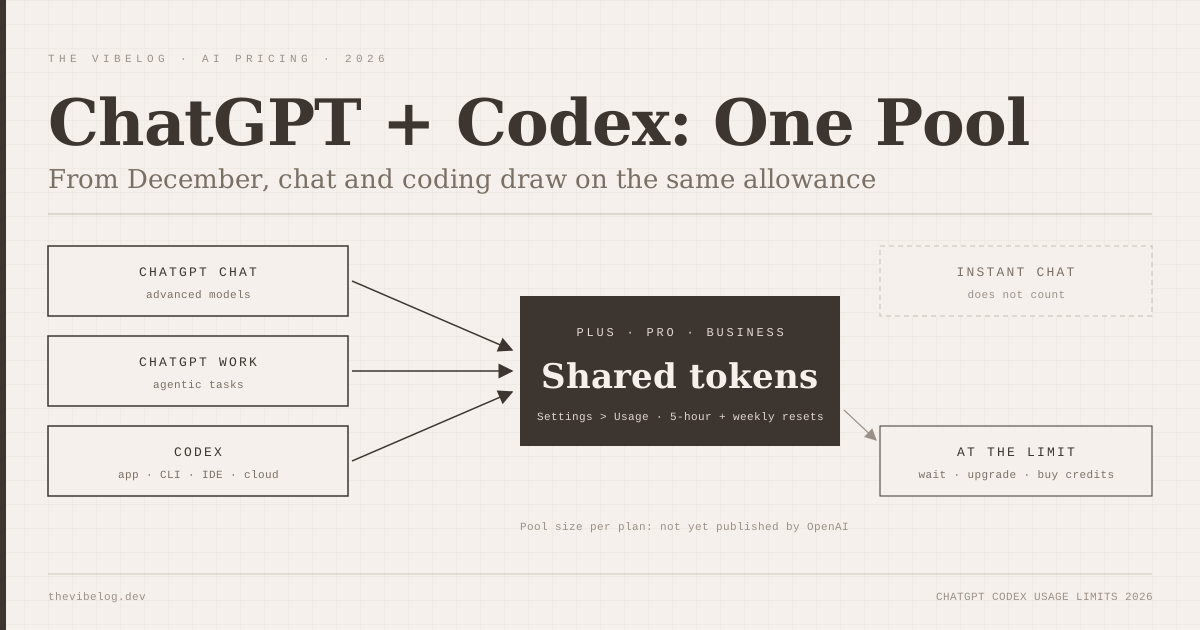
ChatGPT and Codex usage limits are about to become one number. OpenAI’s help article on ChatGPT and Codex usage limits, updated on October 31, says that starting in December, “Plus, Pro, and Business plans’ usage allowance will be shared across ChatGPT and Codex,” according to CellCog’s breakdown of the change.
That means a long Codex refactor and an afternoon of research chats will drain the same tank.
OpenAI says it expects “most users won’t need to wait for their usage to reset more often than they do now.” It has not published a start date, the size of the pool on any plan, or how chat tokens convert against coding tokens. Subscribers got an email about it over the weekend of November 1 and 2, per WindowsForum’s timeline.
I read OpenAI’s current Codex pricing page, the rate card, and the coverage of the help article. Here is what is confirmed, what is still a guess, and how I would set up a Codex workflow before December arrives.
What Changes With ChatGPT and Codex Usage Limits in December
Today, Codex already shares a pool with ChatGPT Work. OpenAI’s Codex pricing page states that Work and Codex share usage, “with the same pricing, credits, and limits,” and that other agentic features such as ChatGPT for Excel on Plus and Pro join that pool once their pricing takes effect.
The December change adds ordinary chat with advanced models to that same pool. Every source I read agrees on the core rules, which come from the help article:
- Plans: Plus, Pro and Business. Free, Go and Enterprise are not mentioned.
- Unit: tokens. “More advanced models and complex tasks generally use more of your allowance.”
- Exemption: “Instant chat will not draw from your usage.”
- Visibility: combined remaining usage and reset times appear in Settings > Usage.
- At the limit: wait for the reset, upgrade your plan, or buy credits.
The change rides along with a product shift. OpenAI is folding the agentic capabilities of Work into the main ChatGPT experience, and SmartScope quotes the help article tying the shared allowance directly to that move. Codex itself stays a separate experience inside the ChatGPT desktop app.
The short version: from December, every non-Instant token you spend in ChatGPT competes with your Codex sessions.
What OpenAI Has Not Said Yet
This is the part that matters for budgeting, and the gaps are large.
There is no exact December date. There are no allowance sizes for any plan, and no word on whether the existing five-hour and weekly windows survive in their current form. There is also no rate card that tells you how many “units” a GPT-6 Astra chat costs against a GPT-6.1 Sol Codex task inside the shared pool.
Business seats are a further unknown. Seats on credit-based pricing already pay token rates for Work and Codex, and CellCog notes OpenAI has not said how those seats change.
The community noticed. SmartScope counted an OpenAI Community thread asking to keep the limits separate at 112 posts from 79 accounts, with no staff reply at the time it checked.
I would not panic over a pool size nobody has seen. I would also not take “most users won’t need to wait more often” as a promise. It is a forecast, and the people most likely to be outliers are exactly the developers running long agentic Codex sessions.
Current Codex Limits and Pricing by Plan
Here is what the pricing page lists right now, before the merge. These are OpenAI’s own estimates for local messages per five-hour window, and the page warns that weekly limits may also apply.
| Model | Plus / Business (per 5 h) | Credits per 1M output tokens |
|---|---|---|
| GPT-6 Astra | 5–45 | 1,250 |
| GPT-6.1 Sol | 15–160 | 250 |
| GPT-6 Sol | 15–150 | 250 |
| GPT-6.1 Terra | 35–285 | 125 |
| GPT-6 Luna | 350–3,000 | 12.5 |
(Source: OpenAI Codex pricing page, checked November 3, 2026)
The plan prices on the same page: Plus is $20 a month, Pro comes in $100, $200 and $500 tiers, Business is $20 per user a month billed annually ($25 monthly), and Go is $8. Pro currently has no five-hour limit, though it still has an included allowance.
Two multipliers on that page will hurt more in a shared world. Fast mode uses 2.5x included usage, and Ultrafast on GPT-6 Astra and GPT-6.1 Sol uses 8x. Image generation burns included limits roughly 3 to 5 times faster than a comparable turn.
- GPT-6 Astra 1,250 credits
- GPT-6.1 Sol 250 credits
- GPT-6 Sol 250 credits
- GPT-6.1 Terra 125 credits
- GPT-6 Luna 12.5 credits
The credit rate card is for credits you buy, not the included pool, so treat it as a ratio rather than a conversion table. The ratio is still the useful part. An Astra token costs five times a Sol token and ten times a Terra token, and nothing OpenAI has said suggests the shared pool will flatten that.
If you want the model-by-model API picture, the AI model pricing tracker has current list prices, and the GPT-6.1 Terra breakdown covers why Terra is the cheap workhorse in that lineup.
What Counts Against the Shared Codex Allowance
Putting the help article and the current pricing page side by side gives a reasonable map of what will draw from the pool. Treat the image and voice rows as today’s rules, since OpenAI has not said whether they change in December.
| Activity | Draws from shared pool? | Notes |
|---|---|---|
| Instant chat | No | The one explicit exemption |
| Chat with advanced models | Yes, from December | New to the pool |
| ChatGPT Work | Yes (already) | Shares with Codex today |
| Codex local and cloud tasks | Yes (already) | Cloud tasks may use more per task |
| Image generation | Yes | About 3–5x faster than similar turns |
| Codex voice (desktop) | Yes | $0.05 per minute against Codex budget |
| Codex with an API key | No | Billed at API rates instead |
(Sources: OpenAI Codex pricing page; CellCog and SmartScope summaries of OpenAI’s help article)
Code review is the odd one. The pricing page says only reviews run through GitHub count as “Code Review usage,” while reviews you run locally count toward your general limits. If your team leans on local /review-style passes, those will compete with chat from December.
The pool is broader than “chat plus Codex”: anything agentic, visual or spoken inside ChatGPT is likely to land in it.
How to Make a Shared Codex Allowance Last
None of these require waiting for OpenAI’s numbers.
1. Default Codex to a cheaper model. A large share of everyday Codex work is reading code, writing tests and making scoped edits, and that rarely needs Astra. Keep Astra for the planning step or the one gnarly bug, and run the rest on GPT-6.1 Sol or Terra.
2. Use Instant for chat questions. Instant is the one thing OpenAI explicitly exempts. If a question would be fine with a fast answer, sending it to a reasoning model now costs you coding time.
3. Keep Fast mode for emergencies. At 2.5x usage, a Fast session that saves you ten minutes can cost you an hour of normal Codex later in the week.
4. Move automation to an API key. The pricing page lists API-key sign-in as pay-per-token at API rates, without cloud features like GitHub review. CI jobs, scheduled scripts and batch refactors belong there, where they cannot starve your interactive work. WindowsForum flags that teams on API keys should check their billing setup rather than assume the subscription pool applies.
5. Watch Settings > Usage for the first two weeks. You will learn your real burn rate faster than any estimate.
The developers who feel this change most will be the ones who never thought about model choice because the separate Codex pool hid the cost.
ChatGPT vs Claude: Who Already Shares Limits?
Anthropic has worked this way for a while. Its help article on Claude Code plans says plainly: “These limits are shared across Claude and Claude Code, meaning all activity in both tools counts against the same limits.” Pro and Max have a five-hour session limit and a weekly limit, and usage credits let you continue past either one.
So OpenAI is converging on the same design rather than inventing a new one. The difference is transparency of the transition.
Anthropic’s limits were shared from the start, so Claude Code users budgeted around them from day one. OpenAI is changing the rules for people who chose Codex partly because it came with its own separate allowance.
If you are weighing the two agents on cost, the Codex CLI vs Claude Code comparison covers the tooling differences, and the Codex Cloud vs Claude Code on the web piece covers the cloud runners that tend to use the most tokens per task.
On limits alone, December removes one of Codex’s structural advantages over Claude Code. It does not make either one the cheaper choice. That still depends on which models you run and how long your sessions go.
Should You Change Plans Before December?
I would not switch anything yet.
There are no pool sizes to compare, so any move now is a bet. If you are on Plus and use Codex daily, the realistic outcome is that heavy chat days now eat into coding days, and the fix is model discipline before it is a bigger plan.
If you are already on Pro, you have the most headroom and the least reason to act. If you run a Business workspace, wait for OpenAI to clarify credit-based seats before you renegotiate anything.
The one thing I would do this week is look at how much of your current usage goes to advanced chat models. That number is your exposure.
One unrelated but useful change also landed this week if you publish content on the web: the major labs agreed on a shared robots.txt signal for opting out of AI training, which I break down in the robots.txt AI training opt-out guide.
Plan around model choice now, and revisit the plan decision when OpenAI publishes the numbers.