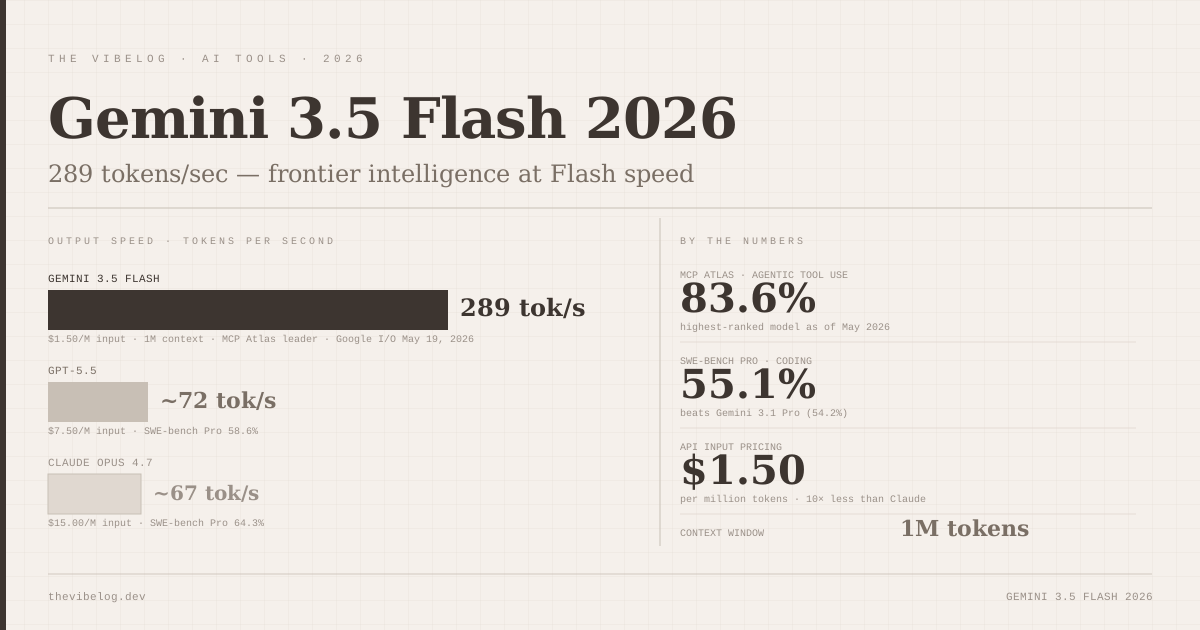
Gemini 3.5 Flash launched at Google I/O on May 19, 2026, with a pitch that Sundar Pichai delivered on stage: “frontier intelligence at Flash speed.” The 289 tokens-per-second output figure he cited — confirmed independently by Artificial Analysis at 284 tok/s — is what makes this model worth examining rather than just filing under “another Google announcement.”
The model that Flash replaced at the top of Google’s practical developer line-up was Gemini 3.1 Pro. Flash beats Pro on coding benchmarks — SWE-bench Pro 55.1% versus Pro’s 54.2% — and at a fraction of the compute cost. That is the first time a Flash-tier model has crossed the performance line of a Pro-tier model on the benchmark most directly tied to software engineering work. The headline Pichai used was accurate: this is Gemini going faster without going backward.
What Gemini 3.5 Flash Actually Does
Gemini 3.5 Flash is a multimodal model: text, images, audio, and video inputs, text output, with a 1 million token context window. It includes configurable thinking capabilities — extended reasoning chains before answering — and that reasoning depth can be adjusted per request. For latency-sensitive tasks you turn the thinking down. For accuracy-critical tasks you turn it up.
The model is available across every Google developer surface from launch: Gemini API, Google AI Studio, Vertex AI, Android Studio, Gemini CLI, and the new Antigravity agent platform. That breadth matters for enterprise adoption — teams that use different Google tools do not need to wait for support to propagate across environments.
As covered in the agentic coding guide, the tool-use integrations of a model matter as much as its benchmark scores in real agentic workflows. Gemini 3.5 Flash covers the same integration surface as Gemini 3.1 Pro with the same API shape, so switching is straightforward.
The Benchmark Picture — Where It Leads and Where It Does Not
At 55.1% on SWE-bench Pro, Gemini 3.5 Flash trails Claude Opus 4.7 (64.3%) and GPT-5.5 (58.6%). The nine-point gap behind the current leader is real. For tasks where complex multi-file reasoning is the primary objective — refactoring a large codebase, implementing a new feature that touches ten different modules — the difference matters.
But SWE-bench Pro measures a specific kind of coding task. The benchmarks where Gemini 3.5 Flash leads tell a different story.
MCP Atlas (83.6%): This benchmark tests multi-step agentic tool use across external APIs and systems. Gemini 3.5 Flash scores the highest of any model currently tested. For developers building agents that chain tools together — read a file, call an API, process the response, write a result — this is closer to the actual workload than SWE-bench. Google built its Managed Agents API and Antigravity platform on top of this model specifically, which suggests they are optimising for this performance profile.
Terminal-Bench 2.1 (76.2%): Higher than Claude Opus 4.7 on this metric, though below the top Codex CLI result on the previous version. Terminal-based automation tasks align well with the throughput advantage — faster output means shorter total task time across batch operations.
CharXiv Reasoning (84.2%): Leads the multimodal visual reasoning benchmark. Relevant for applications processing charts, diagrams, or any visual data alongside text.
Speed (289 tok/s): Roughly 4× the throughput of GPT-5.5 and Claude Opus 4.7, which both run at approximately 67–73 tok/s in independent measurements. In agentic loops where the model calls tools, processes results, and generates the next action repeatedly, faster throughput compounds: 4× faster output means either 4× more iterations in the same time, or 4× lower latency per user-facing interaction. For real-time voice interfaces, coding assistants where developers are waiting, and streaming agents, the gap is not theoretical.
The Pricing Case
At $1.50 per million input tokens and $9.00 per million output tokens, the cost comparison to other frontier models is stark:
- 10× cheaper on input than Claude Opus 4.7 ($15.00/M)
- 5× cheaper on input than GPT-5.5 ($7.50/M)
- 3× more expensive on input than Gemini 2.5 Flash ($0.30/M)
That last comparison matters. TechTimes noted the positioning accurately: “cheap-to-run agent model that costs 3x more per token” compared to the generation it replaces. Whether $1.50/M input versus $0.30/M is worth it depends on whether the benchmark gains translate to your specific workload.
For teams currently running high-volume workloads on GPT-5.5 or Claude Opus 4.7, the move to Gemini 3.5 Flash represents a 5–10× cost reduction on input with comparable or better performance on agentic tasks. At scale — millions of calls per month — that is not a marginal efficiency gain.
Cached input pricing ($0.15/M) is particularly relevant for agentic applications with long system prompts. If your agent has a 10,000-token system prompt with tool definitions and context that gets reused across every call, cached input costs one-tenth of standard input pricing. For a pipeline making 100,000 calls per day against a shared system prompt, the cache pricing effectively eliminates the prompt cost.
Google I/O Rollout — What It Means for the Developer Ecosystem
Gemini 3.5 Flash is the model underneath Google’s new Managed Agents API and the Antigravity 2.0 platform. As discussed in the GPT-5.5 vs Claude Opus 4.7 comparison, the infrastructure built around a model matters as much as its raw performance for practical adoption — a capable model with weak tooling loses to a slightly weaker model with excellent tooling.
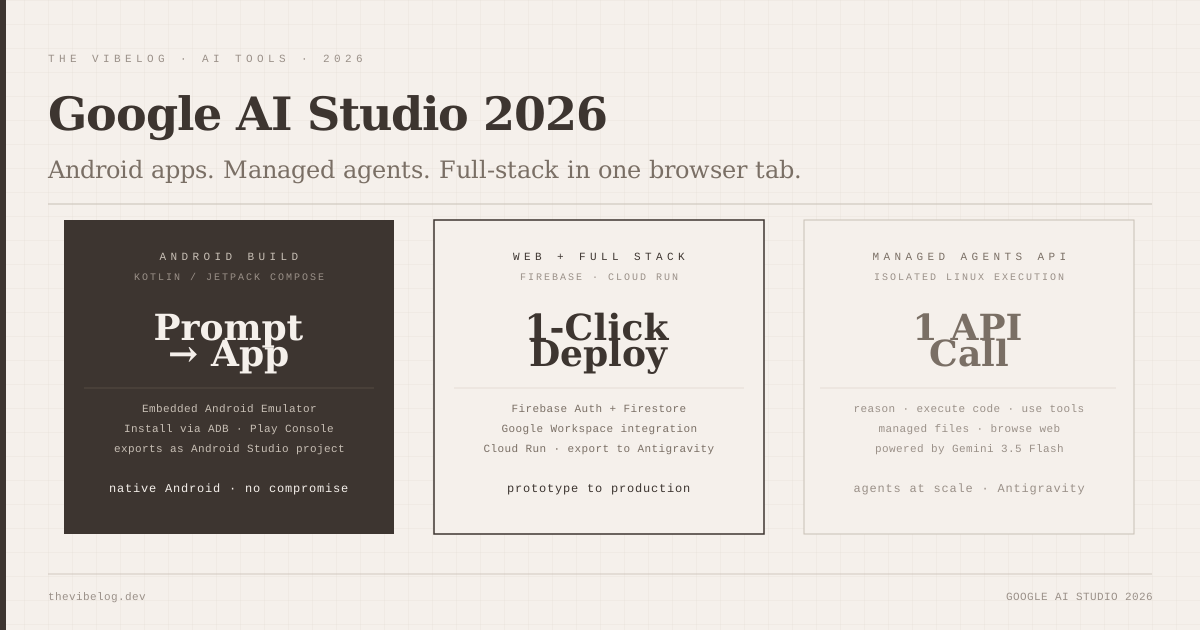
Google bet its new developer-facing agentic infrastructure on this model. The Managed Agents API — a single API call that spins up an isolated Linux environment where an agent can execute code, manage files, browse the web, and use tools — runs on Gemini 3.5 Flash. Google AI Studio’s new Android app generation runs on it. Antigravity 2.0’s CLI and SDK are built around it.
For developers building within the Google ecosystem, this is not optional — it is what they get. For developers choosing between ecosystems, it is a meaningful factor. Google has not historically been the first choice for production agentic infrastructure; Anthropic and OpenAI have had more developer tooling for longer. The Managed Agents API and the speed/cost profile of Gemini 3.5 Flash are Google’s argument for changing that.
When to Use Gemini 3.5 Flash vs. Competitors
Use Gemini 3.5 Flash when:
- You are building agentic systems with multi-step tool use — the 83.6% MCP Atlas lead is the current benchmark best
- You need the lowest latency in a real-time or streaming application — 289 tok/s versus ~70 tok/s affects user experience directly
- You are processing high volumes of API calls where the 5–10× cost difference compounds across millions of requests
- You are building in the Google developer ecosystem — AI Studio, Vertex AI, Android Studio — and want native, first-day support
- You need a Flash-tier model that matches Pro-tier coding quality and Pro-tier is your current baseline
Stick with Claude Opus 4.7 when:
- Complex multi-file code reasoning is the primary objective — the 64.3% SWE-bench Pro lead is a real nine-point gap
- Hallucination rate matters — Claude’s 36% versus GPT-5.5’s 86% is documented; Gemini 3.5 Flash has not published equivalent figures
- You are building coding assistants where output quality review is the bottleneck, not generation speed
Stick with GPT-5.5 when:
- You need OpenAI ecosystem compatibility (function calling format, existing integrations)
- Terminal-based scripting automation is the primary use case — Codex CLI built around GPT-5.5 has a specific performance advantage in that context
- You want the widest third-party tool support, which still skews toward OpenAI-compatible APIs
The clearest use case for Gemini 3.5 Flash is high-volume agentic pipelines that were previously using GPT-5.5 or Claude Opus 4.7 for tasks where speed and cost matter more than peak single-pass code quality — automated data processing, multi-tool orchestration agents, real-time streaming interfaces, and content-generation pipelines.
The BenchLM Position — Flash Tier Is No Longer the Compromise
BenchLM.ai’s provisional leaderboard puts Gemini 3.5 Flash at #10 out of 117 models, with an overall score of 88/100. For a model that costs 5–10× less than most of the models ranked above it, that position is the actual headline.
The Flash versus Pro distinction was historically a quality tradeoff: you paid less and got noticeably worse output. Gemini 3.5 Flash closes that gap on the benchmarks that matter most for engineering work. SWE-bench Pro within one point of Gemini 3.1 Pro; MCP Atlas leading the category; 4× faster. The tradeoff now is not Flash versus Pro — it is Flash versus Claude Opus 4.7, where the 9-point SWE-bench gap is real but the 10× cost gap and 4× speed gap are also real.
Google I/O 2026 positioned Gemini 3.5 Flash as the default model for developers building on Google infrastructure. The benchmark data backs that positioning for most agentic and high-volume use cases. For the workloads where it does not — complex code generation where quality per call matters more than volume — that nine-point SWE-bench gap is the reason the other frontier models still exist.
Speed measurements from Artificial Analysis independent benchmark, May 2026, and Google I/O 2026 keynote. SWE-bench Pro, MCP Atlas, Terminal-Bench 2.1, and CharXiv Reasoning scores from BenchLM.ai model card and llm-stats.com. Pricing from Gemini API pricing page, May 2026. Google I/O 2026 announcements from Google Developers Blog and buildfastwithai.com summary, May 19, 2026.