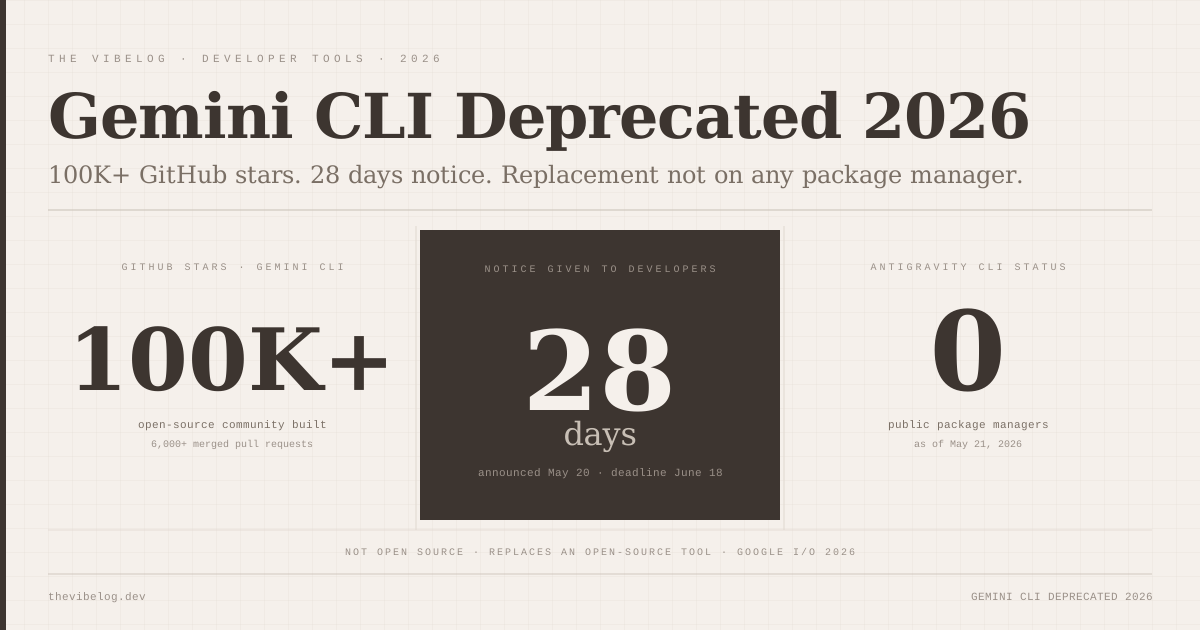
Google announced on May 20, 2026 — the day of Google I/O — that Gemini CLI would stop working for most users on June 18. That is a 28-day notice for a tool with 100,000 GitHub stars and over 6,000 merged pull requests from hundreds of community contributors.
The replacement, Antigravity CLI, was not on any public package manager as of May 21. Developers received a deadline to migrate to a tool they could not yet install.
This is the situation. Here is what you actually need to know.
What Gemini CLI was, and why it had 100,000 stars
Gemini CLI launched in 2025 as an open-source terminal agent that brought Gemini directly into your development workflow. It used a ReAct (reason and act) loop with built-in tools — Google Search grounding, file operations, shell commands, web fetching — and supported both local MCP servers and remote ones.
The free tier was genuinely generous: 60 model requests per minute and 1,000 model requests per day at no charge. For individual developers building tools, experimenting with agentic workflows, or using AI in CI/CD pipelines, the combination of open source + free tier + direct Gemini model access was compelling. The tool accumulated contributors at a rate that most developer tools never see.
Those contributors wrote hooks, extensions, integrations. They filed and fixed bugs. Some of them built their production tooling around Gemini CLI. They did this because Google presented it as an open platform.
The I/O 2026 announcement and what it actually said
At Google I/O on May 19–20, Google announced Antigravity 2.0 — a standalone agent-first development platform including a desktop application, an SDK, and the new Antigravity CLI. The Antigravity platform is positioned as Google’s answer to Claude Code, Windsurf, and Cursor in the agentic coding space.
The Gemini CLI deprecation announcement came the same day: effective June 18, the old CLI would stop serving most users. Enterprise customers on Gemini Code Assist Standard or Enterprise licenses are exempt — their access continues. Everyone else — free tier, Google AI Pro, Google AI Ultra — gets 28 days.
Dmitry Lyalin, Gemini CLI’s Lead Product Manager, posted to GitHub Discussions with additional details. The comments were not warm. Multiple users reported hitting weekly quotas with just a couple of interactions in the new system. Others pointed out directly that Antigravity CLI was not yet installable and asked how the migration was supposed to work.
Antigravity CLI: what it is and what it is not
Antigravity CLI is built in Go (faster, more responsive than the Node-based Gemini CLI). It orchestrates multiple agents for complex background tasks and shares the same agent harness as the Antigravity 2.0 desktop application. Features carried over from Gemini CLI include Agent Skills, Hooks, Subagents, and Extensions — reimplemented as Antigravity plugins.
On paper, this is a more capable product than what it is replacing. Antigravity 2.0 itself — as detailed in the Inside Antigravity DeepMind post on this blog — is a serious engineering effort with parallel agent orchestration and a purpose-built agent harness.
What Antigravity CLI is not: open source. The GitHub repository for Gemini CLI has an issue thread titled “Antigravity CLI — is it open source?” with no definitive answer from Google as of May 21. The practical answer from available evidence is no — Antigravity CLI is a proprietary product.
And as of May 21, it was not on npm, Homebrew, apt, or any other standard package manager. The migration path from an installed, working Gemini CLI to a functional Antigravity CLI was not yet navigable by normal means.
The open-source grievance — stated plainly
The developer reaction on GitHub Discussions has three layers, and they are worth separating because they are different complaints:
The notice timeline: 28 days is not much time for developers who have built tooling around Gemini CLI, especially those whose CI/CD pipelines call it programmatically. Enterprise users have no deadline; individual developers and small teams do.
The availability gap: Announcing the deprecation of a working tool before its replacement is installable is a sequencing problem. The message to developers was effectively “your current tool stops working in 28 days, and the replacement does not exist yet in a form you can install.”
The open-source bait-and-switch: This is the loudest complaint and the hardest for Google to answer. The community contributed 6,000+ pull requests to build and improve Gemini CLI under the expectation of an open platform. Google is now taking the tool they helped build and replacing it with a closed product that captures the same use case. The framing in multiple GitHub comments is consistent: Google used the open-source community to do product development, then closed the product.
Whether that framing is fair depends on how you read the original license terms. What is not debatable is how the developer community feels about it.
Who is actually affected — the non-obvious answer
Not every Gemini CLI user is in the same position.
You are not affected if: you are on a Gemini Code Assist Standard or Enterprise license. Google has been explicit that enterprise access continues unchanged. For organisations that made the decision to pay for Google’s enterprise tier, the deprecation is irrelevant.
You are directly affected if: you use Gemini CLI on the free tier, Google AI Pro, or Google AI Ultra. Your CLI stops responding on June 18. If you have scripts, aliases, or CI pipelines that call Gemini CLI, those break on June 18.
Your GitHub integration is affected if: you use Gemini Code Assist for GitHub. New installations stop on June 18; existing serving stops shortly after.
Your migration options, honestly assessed
Given that Antigravity CLI is not yet installable through standard package managers as of May 21, the practical options before June 18 are:
Wait for Antigravity CLI to ship properly — if Google executes on its timeline, Antigravity CLI will be available through standard channels before June 18. Watch the official Antigravity CLI releases page and the Google Developers Blog for the announcement. Given that the migration pressure is real, there is strong incentive for Google to ship this fast.
Switch to Claude Code — the closest functional equivalent in terms of terminal-first, agentic, production-grade tooling. Claude Code’s 1 million token context window and 87.6% SWE-bench Verified score on Opus 4.7 make it the leading terminal agent on benchmark measures. It costs $20/month plus Anthropic API usage. As covered in the Claude Code vs Cursor comparison, the terminal-first workflow is genuinely different from IDE-based tools — if you built your workflow around Gemini CLI’s agentic approach, Claude Code is the most direct replacement.
Switch to Aider — open source, actively maintained, works with any model API including the Gemini API directly. If you specifically want to keep using Gemini models but do not want to depend on Google’s CLI tooling, Aider is a legitimate path. You keep the model, you replace the client, and you stay on open-source infrastructure that you can inspect and contribute to.
Use the Gemini API directly — for CI/CD scripts that called Gemini CLI for automation, calling the Gemini REST API directly removes the dependency on the CLI product entirely. The API is not being deprecated; the packaged terminal client is.
The pattern, and what to do with it
Google’s track record with developer tools includes Reader, Plus, Inbox, Stadia, and a long list of products that were working, had established user bases, and were discontinued. Gemini CLI is a different category — it was positioned as infrastructure, not a consumer product — but the pattern of announcement-to-shutdown timelines shorter than many engineering teams’ planning cycles is consistent.
This is not an argument against using Google AI products. Gemini 3.1 Pro is a serious model with competitive coding benchmarks and the longest context window of any frontier model. The Antigravity platform, if it executes on its roadmap, could be genuinely competitive.
It is an argument for understanding what you are depending on. Open-source tools with active communities can be forked. APIs have deprecation policies and SLAs. Proprietary CLIs from companies with a history of tool discontinuation are the highest-risk dependency in your stack.
If you are building something that needs to keep running in twelve months regardless of vendor decisions, that is worth accounting for in your tool choices — before the 28-day notice arrives.
Deprecation timeline from Google Developers Blog, May 20, 2026. GitHub star count and contribution figures from google-gemini/gemini-cli repository as of May 2026. Developer community reaction from GitHub Discussions thread #27274. Antigravity 2.0 feature details from TechCrunch Google I/O 2026 coverage and Google official blog.