OpenAI shipped GPT-5.5 on April 23, 2026 — seven days after Anthropic shipped Claude Opus 4.7. Both arrived claiming coding leadership. OpenAI doubled the output token price from the previous line ($15 to $30 per million tokens). Anthropic held pricing flat at $25.
The SWE-bench Pro gap between them is 5.7 points in Claude’s favour. The hallucination gap is 50 points — also in Claude’s favour. The token efficiency gap is 72% in GPT-5.5’s favour. The speed gap is 24 tokens per second in GPT-5.5’s favour.
Both models are at the frontier. Neither is universally better. The choice is a workload decision.
The benchmarks that actually matter for developers
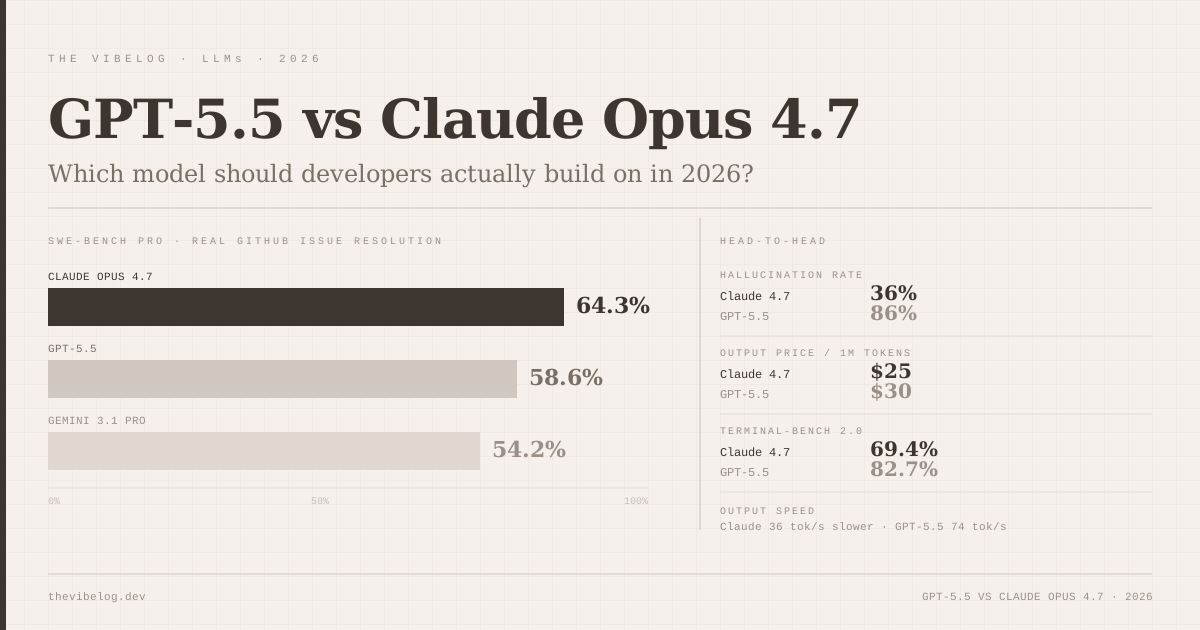
SWE-bench Pro is the benchmark that deserves the most weight for coding work. It evaluates models on their ability to resolve real GitHub issues in real codebases — not contrived problems, not synthetic code generation prompts, but the kind of tasks a developer would actually hand off to an AI agent. The results from the April 2026 evaluation:
SWE-bench Pro:
Claude Opus 4.7: 64.3%
GPT-5.5: 58.6%
Gemini 3.1 Pro: 54.2%
A 5.7-point gap on this benchmark is meaningful. It means Claude Opus 4.7 resolves roughly one additional real GitHub issue for every 17–18 that GPT-5.5 handles. Across a month of agentic coding sessions, that difference compounds.
SWE-bench Verified (the 500-problem verified subset):
Claude Opus 4.7: 87.6% (up from 80.8% on Opus 4.6)
GPT-5.5: leads on some sub-categories, notably terminal-heavy tasks
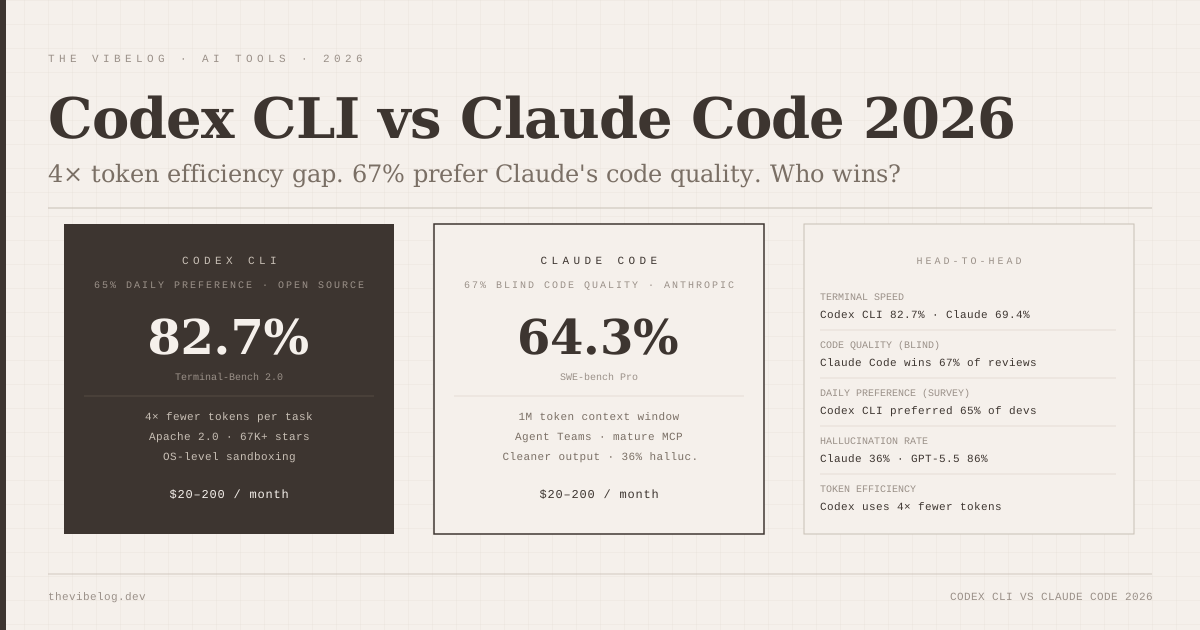
GPT-5.5 holds an edge on Terminal-Bench 2.0: 82.7% versus Claude’s 69.4%
Terminal-Bench tests complex command-line workflows requiring planning, iteration, and tool coordination. For developers building terminal-native tools, CLI utilities, or DevOps automation, GPT-5.5’s 13-point edge here is not a footnote.
The cost calculation — and why the 20% output premium is not the whole story
Both models are $5 per million input tokens. The pricing diverges on output: Claude Opus 4.7 at $25 versus GPT-5.5 at $30 — a 20% premium for GPT-5.5.
GPT-5.5 was explicitly built to be more token-efficient. OpenAI’s claim of roughly 72% fewer output tokens on equivalent tasks is the number that changes the cost picture. If GPT-5.5 genuinely produces 72% fewer output tokens to accomplish the same task, then despite its higher per-token price, the per-task cost could be lower.
The honest caveat: token efficiency claims from model providers should be verified against your specific workloads. OpenAI’s figures come from their internal evaluations, which may not reflect the distribution of tasks in your codebase. Claude Opus 4.7 is verbose — it explains, documents, and narrates as it works, which is useful in review contexts and expensive in agentic loops. If you are building an agentic system where the model’s output goes directly to execution rather than to a developer for review, verbose output is pure cost with no benefit.
The practical cost estimate for a mid-volume agentic coding use case:
Assume 500 API calls per day, 2,000 input tokens and 1,000 output tokens per call on Claude Opus 4.7. Monthly:
- Input: 30M tokens × $5/1M = $150
- Output: 15M tokens × $25/1M = $375
- Total: $525/month
If GPT-5.5 produces the same work with 72% fewer output tokens (280 output tokens per call):
- Input: 30M tokens × $5/1M = $150
- Output: 4.2M tokens × $30/1M = $126
- Total: $276/month
That is roughly half the cost — if the 72% efficiency claim holds for your task distribution. The efficiency is real on well-scoped tasks with clear outputs. It is less pronounced on complex architectural reasoning where the model needs to think through tradeoffs before responding.
The reducing Claude API costs post covers prompt caching and context management approaches that apply regardless of which model you choose — those optimisations reduce the input token cost, which is identical for both models.
Where Claude Opus 4.7 is the clear choice
Long-horizon autonomous work. Complex refactors spanning multiple files, agentic sessions that run for extended periods, tasks where the model needs to track state across many tool calls — Claude Opus 4.7 is more reliable in these contexts. Anthropic built the model for exactly this: per their benchmarks, Opus 4.7 resolves roughly 3x more production tasks than Opus 4.6. The effort setting (a new level between “high” and “max” in Opus 4.7) gives developers granular control over reasoning depth versus latency.
Code review with a reliability requirement. The hallucination rate gap — 36% for Claude, 86% for GPT-5.5 — is the number that should stop developers cold when considering which model to use for production code review. Incorrect information in a code review that gets missed costs more than the $5/million token savings. For any use case where false positives or fabricated findings cause real problems, Claude Opus 4.7’s accuracy is worth the cost difference.
Large codebase comprehension. Claude’s 1 million token context window, combined with its architectural reasoning benchmarks, makes it the stronger choice when you are asking the model to understand a large system before modifying it. The agentic coding guide covers why context coherence matters in these workflows — and it does, especially when the model needs to track how a change in one module affects five others.
Where GPT-5.5 is the clear choice
High-volume API pipelines. If you are running thousands of calls per day on well-defined tasks — code explanation, docstring generation, type annotation, test scaffolding — GPT-5.5’s token efficiency advantage translates directly to operating cost reduction. At scale, 72% fewer output tokens is a meaningful budget difference.
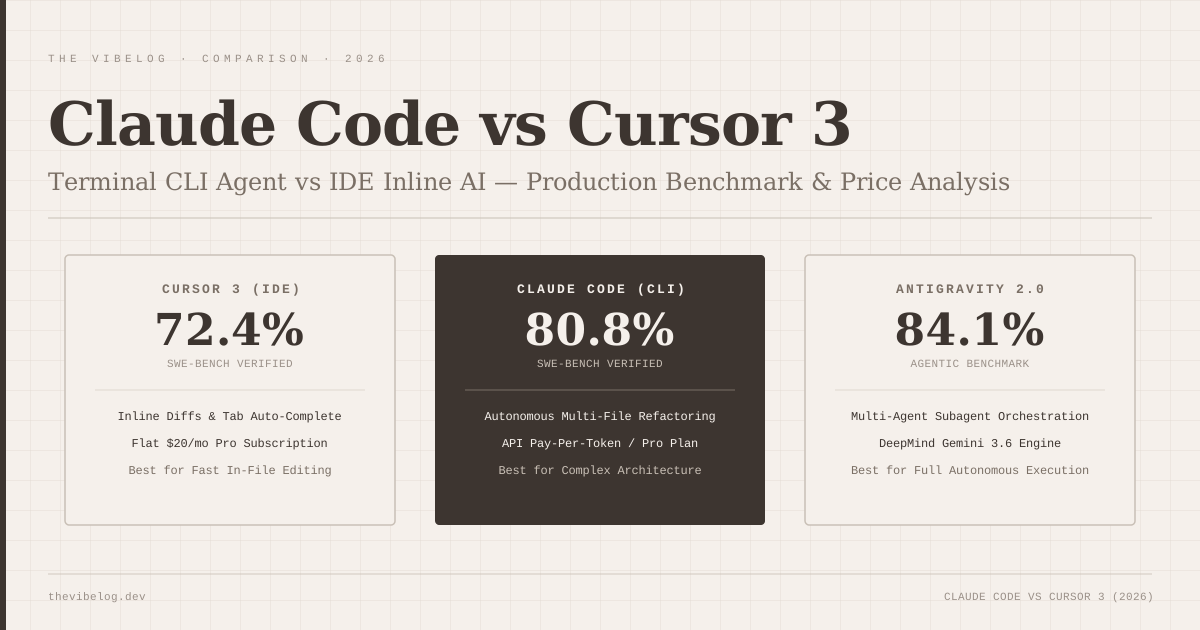
Terminal-heavy and DevOps automation. The 82.7% Terminal-Bench 2.0 score versus Claude’s 69.4% is a 13-point gap that shows up in practice: GPT-5.5 is better at planning and executing complex shell workflows, debugging build pipelines, and navigating file systems in terminal contexts. If your agentic use case involves a lot of shell interaction, GPT-5.5’s training shows.
Speed-sensitive interactive tools. GPT-5.5 outputs at approximately 74 tokens per second versus Claude Opus 4.7’s 50 tokens per second. For tools where developer response latency matters — interactive pair programming, real-time code suggestion, anything where you are waiting for the model — GPT-5.5’s speed advantage is perceptible.
OpenAI ecosystem integration. If you are already deeply integrated with OpenAI’s ecosystem — using Codex CLI, Responses API, or building on their tooling — switching to Claude for frontier model access adds API management complexity. GPT-5.5 is the straightforward choice when ecosystem consistency has value.
The pricing precedent worth noting
GPT-5.5 doubled the output token price from the previous GPT-5.4 line — from $15 to $30 per million output tokens. This happened 23 days after GPT-5.4 launched. The precedent for rapid repricing is now established at OpenAI: a new model version means a new pricing tier, and the transition can happen faster than many engineering teams’ planning cycles.
Claude Opus 4.7 launched at the same price as Opus 4.6 ($5 input / $25 output), continuing Anthropic’s practice of pricing model upgrades at equivalent or lower rates than the versions they replace. Whether this pricing discipline continues is worth monitoring — but the current data point favours predictability on the Claude side.
The practical decision
If you are building an autonomous coding agent and reliability is the top priority: Claude Opus 4.7. SWE-bench Pro leadership and a 36% hallucination rate are the numbers that matter most for agents that operate with limited human review.
If you are running high-volume pipelines and operating cost is the constraint: GPT-5.5 — but verify the token efficiency claim on your actual workloads before committing.
If you are doing terminal automation and DevOps tooling: GPT-5.5. The 13-point Terminal-Bench gap is real.
If you need to make a decision without running your own evaluation: Claude Opus 4.7’s benchmark profile is more consistently suited to the tasks that developers actually run in production. GPT-5.5 wins in specific niches that are genuinely important — but those niches require you to know which one you are in.
SWE-bench Pro benchmarks from April 2026 evaluation leaderboard. GPT-5.5 pricing from OpenAI pricing page, April 23 2026. Claude Opus 4.7 pricing from Anthropic pricing page. Token efficiency figures from OpenAI GPT-5.5 release post. Hallucination rates from MindStudio model comparison, April 2026. Terminal-Bench 2.0 figures from the GPT-5.5 complete guide, Codersera, April 2026.