OpenAI launched three new voice models on May 7, 2026, and the framing on stage was straightforward: voice AI now has access to GPT-5-class reasoning. Not a cut-down model trained on audio. GPT-Realtime-2 runs actual multi-step reasoning while handling spoken conversation — the same reasoning class as the text models that currently lead SWE-bench, applied to voice input and output in real time.
That is new. The previous generation of voice APIs used smaller, faster models specifically because reasoning-class models were too slow for conversation. GPT-Realtime-2 closes that gap. Whether the trade-off between reasoning quality and conversation latency is now practical enough for production applications is the question developers building voice-first products need to answer — and the answer depends heavily on which reasoning effort setting you use.
The Three Models — What Each One Does
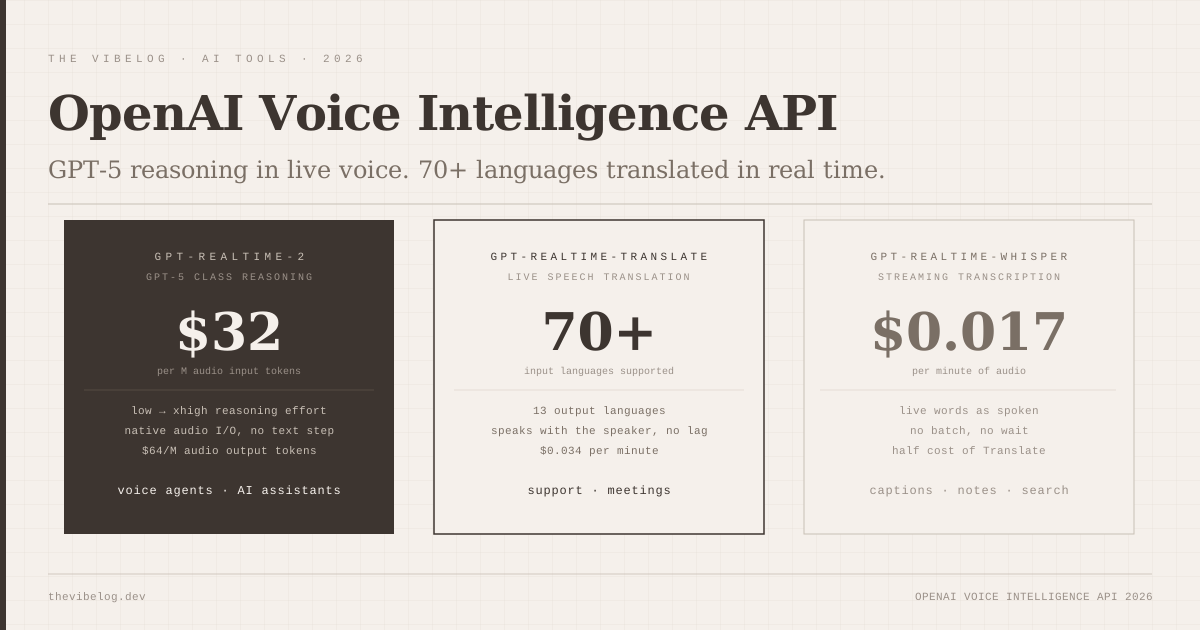
The Voice Intelligence API launch included three distinct models, each targeting a different use case. They share the real-time audio infrastructure but optimise for different developer needs.
GPT-Realtime-2 is the reasoning model. It takes audio input, processes it with GPT-5-class reasoning, and returns audio output. The voice is handled natively — no text transcription step in between, which eliminates the latency bucket that text-to-voice pipelines carry. Developers control reasoning depth through a parameter ranging from low (default, fastest) to xhigh (maximum reasoning depth, higher latency). The xhigh setting is described as intended for intricate voice tasks where thinking depth is more important than turnaround time — something like a complex technical support query that requires walking through a multi-step diagnosis.
Pricing: $32 per million audio input tokens, $64 per million audio output tokens, $0.40 per million cached audio input tokens.
GPT-Realtime-Translate handles live speech-to-speech translation across 70+ input languages into 13 output languages. The model translates at speaking pace — it does not wait for a sentence to complete before beginning translation. For developers building cross-language customer support, international meeting tools, or real-time captioning with translation, this is the model the category has needed. Previous real-time translation approaches required transcription → translation → synthesis pipelines with three latency buckets stacked. A single model that handles all three simultaneously changes the architecture.
Pricing: $0.034 per minute of translated audio.
GPT-Realtime-Whisper is the streaming transcription model. It transcribes speech live as words are spoken rather than waiting for phrases, sentences, or audio chunks. At $0.017 per minute, it is the cheapest of the three models and the right choice for any application where the output is text rather than audio — meeting records, live captions, voice note transcription, and search indexing of spoken content.
The Pricing Math — What a Real Application Costs
The per-token pricing on GPT-Realtime-2 needs translation into real numbers before it is useful for planning. The $32/M input and $64/M output figures are for audio tokens, which pack differently from text tokens.
For a typical voice conversation at average speaking pace, a 10-minute session involves roughly 15,000 audio input tokens and 10,000 audio output tokens. At standard pricing, that conversation costs approximately $0.48 for input and $0.64 for output — $1.12 total for a 10-minute call with reasoning-class responses.
For GPT-Realtime-Translate, $0.034 per minute works out to $2.04 per hour of translated conversation. For a multilingual customer support operation handling 100 hours of translated calls per month, that is $204 per month in API costs — cheaper than a single human interpreter per hour.
For GPT-Realtime-Whisper at $0.017 per minute, transcribing 8 hours of meeting audio per day across a 20-person team would cost approximately $163 per month. For comparison, a Zoom Workplace Pro subscription that includes transcription is $14.99 per user per month — $300 for the same team. The API route is already cost-competitive at moderate scale, and it integrates directly into your existing workflow rather than requiring a separate product.
OpenAI also added fine-grained conversation context controls to manage cost on long sessions: configurable token limits and multi-turn truncation that can remove completed conversation turns once they are no longer needed for context. For support agents or interactive tools with long conversations, managing the active context window directly reduces the cost of extended sessions.
What You Can Build With This
The combination of these three models covers the three distinct voice AI application categories that have had the highest development friction.
Real-time voice agents: GPT-Realtime-2 with low reasoning effort is the right model for interactive customer service agents, voice-first interfaces, and conversational apps where response latency needs to feel natural. The xhigh setting is for applications like a voice-based technical support agent that needs to reason through a complex configuration problem, where a user expects to wait a few seconds for a thorough answer rather than an instant but shallow one. That distinction — letting the application choose reasoning depth per request — is something none of the previous voice APIs supported.
Live translation pipelines: GPT-Realtime-Translate at $0.034/minute makes real-time international customer support practical without a human interpreter. A support operation serving 10 languages previously had two options: hire interpreters or lose customers. The 70+ input language coverage means essentially any spoken language a customer might use routes into the same pipeline. The 13 output language constraint is more limiting — the asymmetry between input breadth and output depth reflects where the model’s translation quality is currently reliable enough for production.
High-volume transcription: GPT-Realtime-Whisper at $0.017/minute is competitive with every existing transcription API and adds live streaming output rather than batch processing. The streaming output matters for real-time captions, live meeting dashboards, and voice-to-text interfaces where the delay of waiting for a complete phrase or sentence would break the experience. For compliance recording and meeting notes where latency matters less than accuracy, the economics are straightforward.
The Context Controls — Why They Matter for Agentic Voice
The new conversation context management feature deserves more attention than it has received in most coverage of the launch.
For voice applications running as agents in the agentic coding guide patterns — taking real actions based on spoken instructions, not just answering questions — long conversation histories accumulate quickly. A support agent on a 30-minute call has processed significant context before the customer gets to their actual problem. Without context management, the full conversation history feeds into every subsequent API call at full price.
The new controls let developers set maximum token limits for the active context and truncate completed conversation turns. For an agent that resolves a customer issue in the first half of a call and then handles follow-up questions in the second half, the resolution exchange can be truncated out of the active context once it is complete, reducing the cost of the follow-up portion.
For voice agents that run for hours across multiple sessions — an AI customer service agent at a 24/7 support operation — the cost of naive context accumulation without these controls would make economics difficult. The controls are a production requirement, not an optimisation.
Where the Limits Are
GPT-Realtime-2 with high reasoning effort adds latency. How much latency depends on the complexity of the query, but the setting is intentionally described as for “intricate voice tasks where reasoning depth is prioritized over latency.” For a product where users expect near-instant responses — a voice assistant on a mobile app, a real-time call assistant — low is the appropriate setting. For a product where users expect thoughtful, accurate answers and are willing to wait a few seconds — a complex technical support agent, a medical symptom checker — xhigh becomes viable.
The 13-language output constraint on GPT-Realtime-Translate is a meaningful limitation for global applications. A company operating in Southeast Asia where customers might speak Filipino, Burmese, or Khmer needs to check whether those languages land in the 13 supported outputs or only in the 70+ supported inputs. The asymmetry is real and the workaround — transcription then text translation then synthesis — reintroduces the latency that GPT-Realtime-Translate eliminates for supported language pairs.
GPT-Realtime-2 pricing ($32/M input, $64/M output) is significantly higher than the equivalent text model pricing. For applications that can work with text input and output — where converting voice to text before the API call and text back to voice after is acceptable — the economics of using a text model may be better by an order of magnitude. The real-time models are priced for applications where native audio handling is a requirement, not just a convenience.
What Changed From the Previous API
As documented in the GPT-5.5 vs Claude Opus 4.7 comparison, the previous Realtime API used models that were optimised for speed rather than reasoning depth. The fundamental change with GPT-Realtime-2 is not the audio handling — it is that the reasoning engine underneath is GPT-5 class. A voice model that can walk through multi-step reasoning while speaking, rather than giving fast-but-shallow responses, opens a category of voice applications that were not practical before.
Customer service agents that reason through complex cases. Technical support that can diagnose a multi-step problem in conversation. Voice interfaces to applications where users ask complicated questions that require connecting multiple pieces of information before answering.
Those are the use cases GPT-Realtime-2 is optimised for. For the simpler use cases — transcription, translation, basic Q&A — GPT-Realtime-Whisper and GPT-Realtime-Translate at lower price points are the appropriate tools.
Models and features from OpenAI blog post “Introducing gpt-realtime and Realtime API updates for production voice agents,” May 7, 2026. Pricing from OpenAI API pricing page, May 2026. Language coverage from 9to5Mac and TechCrunch coverage of the May 7 announcement. Real-time API cost analysis from CallSphere AI blog, May 2026.