Two years ago, “vibe coder” was a term used to dismiss developers who let AI write their code without understanding it. In May 2026, ServiceNow has a posted role that reaches $465,000 per year with vibe coding in the job requirements. Contract specialists in MCP integration are billing $400 per hour. Freelance AI-fluent developers are charging $100–$300 per hour on the basis that they deliver in two days what used to take two weeks.
The job category moved from experimental to mainstream faster than the industry expected. The salary data that exists now reflects a market that is still figuring out how to price this skill — which means the gap between what informed developers can negotiate and what uninformed ones accept is unusually large.
Vibe Coding Salary Ranges in 2026
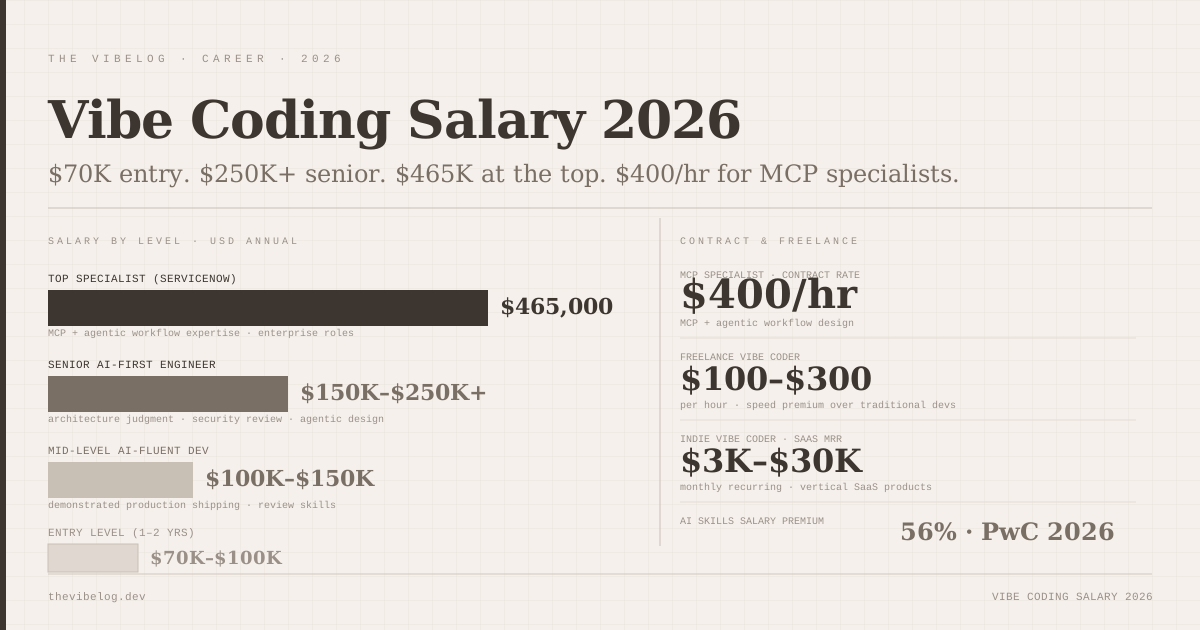
The salary bands for AI-fluent developer roles in 2026, based on GoodVibeCode’s salary guide and VibeHackers compensation data:
Entry level (1–2 years, AI tool proficiency): $70,000–$100,000. These roles are for developers who can use AI tools productively but have limited experience reviewing AI output for correctness and security. Titles include AI-assisted developer, junior full-stack engineer (AI-first), and prompt engineer — though that last title is falling out of favour at companies that understand the role involves more than prompting.
Mid-level (AI proficiency as a core demonstrated skill): $100,000–$150,000. The jump from entry to mid requires demonstrable ability to ship production code with AI tools, not just generate it. Employers at this level are testing review skills — can you catch what the AI gets wrong — and architecture judgment — can you make decisions the AI cannot.
Senior level (AI-first engineers): $150,000–$250,000+. At senior level, the expectation is that AI tools are default and the premium is for everything that AI tools cannot do: system design, security architecture, cross-team technical leadership, and the ability to identify when the AI is producing plausible-but-wrong output on complex problems.
Specialist roles: Up to $465,000 at enterprise companies like ServiceNow. These roles typically combine AI tool fluency with specific technical expertise — cloud infrastructure, security engineering, or platform engineering — where the AI productivity multiplier is applied to high-value technical work.
The salary data from AI developer career sites as of May 2026 also shows contract rates for AI-fluent developers running $200–$400 per hour for specialised work, versus $100–$200 per hour for traditionally-skilled developers at the same experience level.
What Skills Actually Command the Premium
The salary premium for vibe coding does not come from knowing how to write prompts. Every developer who uses a keyboard is learning to write prompts. The premium comes from four specific capabilities that are harder to acquire.
Architecture judgment. The ability to design a system before you vibe-code it. Knowing what the data model should look like, how services should be separated, where authentication boundaries belong, what the performance characteristics of different approaches are. AI tools generate code within an architecture; they do not generate good architecture from vague requirements. The developers who command the highest salaries are the ones who set up the architecture that lets AI tools do the implementation work correctly.
Security review. 45% of AI-generated code contains OWASP Top-10 vulnerabilities per independent security testing in 2026. An AI-fluent developer who can also catch those vulnerabilities in code review is combining two skills that rarely coexist at the entry level. Security-capable AI-fluent developers are specifically sought for roles that involve AI code at scale — internal tools, SaaS platforms, anything with user data.
Agentic workflow design. Setting up multi-agent systems — Claude Code handling complex reasoning, Cursor handling daily editing, automated pipelines running tests and reviews — and configuring them to work together effectively. As covered in the agentic coding guide, agentic workflows are where the productivity multiplier from AI tools goes from 2× to 10×. The developers who can design and implement those workflows command corresponding compensation.
Tool fluency across the stack. Not just using one AI tool, but knowing which tool to use for which task. Cursor for daily editing. Claude Code for multi-file refactoring. Greptile for architectural reviews on complex codebases. CodeRabbit for PR review automation. Devin for unsupervised backlog clearing. Knowing the performance profile of each tool and orchestrating them appropriately is a real skill that takes time to develop.
The MCP and Agent Expertise Gap — Where $400/Hour Comes From
The highest contract rates in the current market — $400/hour for MCP integration and agentic workflow expertise — reflect a specific skill gap that has emerged from the Model Context Protocol ecosystem.
MCP (Model Context Protocol) is the protocol that allows AI models to connect to external tools, databases, APIs, and services. As covered in the MCP servers guide, the shift from local stdio servers to HTTP-based team infrastructure represents a significant engineering challenge that most organisations are still figuring out.
Developers who can design, implement, and secure MCP server infrastructure — managing tool access controls, building team-shared servers, integrating with existing authentication systems — are working on a problem that most engineering teams do not yet have internal expertise for. The $400/hour contract rate exists because the demand is real, the expertise is rare, and the organisations willing to pay it are enterprises where the productivity impact of getting MCP infrastructure right is measured in millions of dollars of developer time.
This is the pattern that produces outsized compensation in any technology cycle: a new technical layer that matters a lot, where most organisations lack internal expertise, and where the people with that expertise can demonstrate clear ROI. MCP and agentic workflow design is in that window right now in mid-2026.
Freelance Vibe Coding: $100–$300 Per Hour
Freelance AI-fluent developers are pricing at $100–$300 per hour based on a straightforward value proposition: they deliver in two days what a traditional freelancer delivers in two weeks, and clients will pay a premium to compress that timeline.
The clients for freelance vibe coding work are primarily:
- Startups building MVPs who cannot afford a full-time developer or a three-month agency engagement
- Companies with well-defined development tasks that are not complex enough to justify a full-time hire
- Non-technical founders who have reached the limits of what they can build without review assistance
- Enterprise teams with backlog items that are too straightforward to assign to senior engineers but too technical for traditional vibe coding tools alone
The freelance market for vibe coding is large enough that dedicated job boards (VibeHackers Jobs, GoodVibeCode, RemoteVibeCodingJobs) now list positions specifically for AI-fluent developers. ZipRecruiter’s May 2026 data shows “vibe coding jobs” at $15–$43/hour for entry-level contract work, with specialised roles considerably higher.
The freelancers at the $200–$300/hour end are not competing on prompt writing speed. They are competing on review quality, architecture judgment, and the ability to take a vague requirement from a non-technical client and produce production-ready code with minimal back-and-forth.
Non-Developer Vibe Coder Income: The Indie Hacker Route
For non-developers who learned vibe coding, the salary data is irrelevant — they are not looking for employment. The income picture looks different.
The most successful non-developer vibe coders have built subscription SaaS products for specific industries where they have domain expertise. A physical therapist building a patient exercise tracking tool. A real estate agent building a CMA (comparative market analysis) generation tool for other agents. A restaurant owner building a reservation management system for independent restaurants.
The pattern is consistent: deep domain knowledge that produces a specific insight about what a niche needs, combined with vibe coding tools that let that domain expert build the tool themselves, combined with a subscription revenue model that generates recurring income.
Successful indie vibe coders report $3,000–$30,000 monthly recurring revenue at the median for products that found market fit. The distribution is wide — most products do not find market fit — but the tools required to test whether a product finds market fit cost under $100/month. The expected value of a vibe coding experiment is positive in a way that the expected value of paying an agency $75,000 to build a product before you have validated it is not.
What Employers Test in Vibe Coding Interviews
The interview process for AI-fluent developer roles has not yet standardised, but patterns are emerging from the companies that have been hiring into these roles for 12+ months.
Live code review. Given a chunk of AI-generated code — often deliberately including a few bugs and a security issue — can the candidate identify what is wrong? This tests whether the candidate can review AI output or whether they are dependent on the AI to self-diagnose.
Prompt design. Given a feature requirement, write a prompt. The interviewer watches how the candidate approaches the specification — how specific they are, what context they include, whether they think about edge cases upfront. This tests whether the candidate produces good output from AI tools or average output.
Tool selection. Given a multi-step engineering task, what tools would you use and in what order? This tests tool fluency — the candidate who answers “I would use Cursor for everything” is less competitive than one who describes using Claude Code for the architecture review, Cursor for daily implementation, and CodeRabbit for PR review.
Architecture discussion. Design a system for a described product. This is not AI-specific — it is a standard software engineering interview — but its presence in vibe coding interviews indicates that employers understand the premium is for architectural judgment, not prompting speed.
The Job Titles That Have Already Changed
The vibe coding wave has produced a new layer of job titles that either did not exist or meant something different before 2025.
AI-first engineer: A full-stack developer who treats AI tools as primary implementation tools rather than optional aids. The expectation is faster output with the same quality bar — the difference being that the human is responsible for architecture and review, the AI for implementation.
Prompt engineer (revised): The original prompt engineer was a narrow role writing prompts for specific applications. In 2026 the title is being applied to people who design the AI-assisted workflows for development teams — configuring tools, setting up agent pipelines, writing the system prompts and tool definitions that determine how AI tools behave in a specific codebase.
Product engineer (AI-fluent): Product engineers who can spec, build, and ship features autonomously using AI tools. The reduction in implementation time means one product engineer can now ship the output that previously required a product manager and two developers.
AI technical co-founder: A role that did not exist two years ago — a technical co-founder whose primary value is the ability to use vibe coding tools to build an MVP without a traditional development team, combined with the judgment to know when the MVP needs traditional engineering investment.
The common thread is that AI fluency is becoming a requirement rather than a differentiator at every level of software development. The salary premium for AI-fluent developers exists today because the skill is not yet universal. As that changes, the premium will compress — which is why developing the deeper skills (architecture, security, agentic workflows) matters more than the basic prompting ability that will be table stakes in 12 months.
Salary data from GoodVibeCode salary guide, VibeHackers compensation report, and RemoteVibeCodingJobs salary guide, May 2026. ServiceNow compensation figure from ZipRecruiter vibe coding jobs listings, May 2026. Contract rate data from VibeCodeCareers MCP specialist listings. Indie hacker revenue figures from HypergrowthAI vibe coding monetisation analysis, March 2026. PwC AI skills premium from PwC 2026 workforce report.