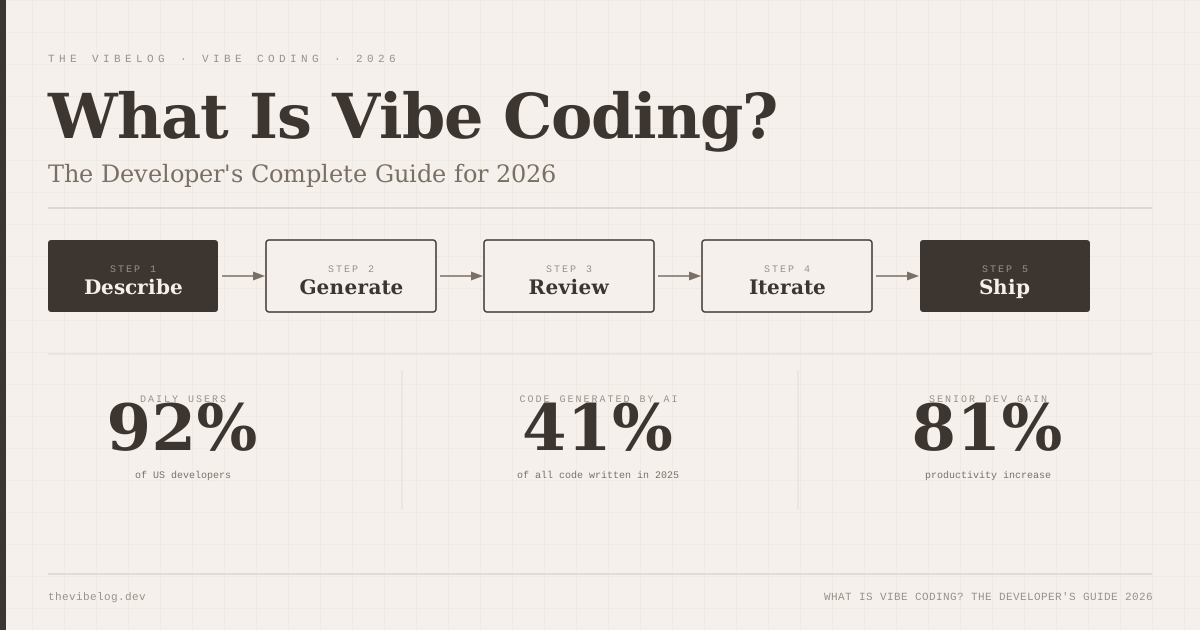
Vibe coding is now the default way software gets built. According to the 2026 Stack Overflow Developer Survey, 92% of US developers use AI coding tools daily — and 41% of all code written in the US is now AI-generated. The term has a specific origin, a specific meaning, and a specific set of tradeoffs that the enthusiasts and the skeptics both tend to flatten into something simpler than the reality.
This guide covers what vibe coding actually is, how the workflow differs from traditional development, who it works for, which tools belong in which category, and where the real performance data lands — including the parts you do not see in the LinkedIn posts about it.
What Vibe Coding Actually Is
Vibe coding is a development workflow where you describe what you want in natural language and let an AI tool generate the code. The loop is: describe the feature or behaviour you want, generate an implementation with an AI tool, review the output, iterate with follow-up prompts. You author the specification; the AI authors the code.
Andrej Karpathy — co-founder of OpenAI and former director of AI at Tesla — coined the term in a post on X in February 2025. His description was deliberately irreverent: he described “fully giving in to the vibes,” forgetting that code exists, letting the AI handle everything, and just accepting the output. That was a provocation as much as a workflow prescription. The name stuck, but most professional practice is more measured than the original framing.
Collins Dictionary named “vibe coding” Word of the Year for 2025. Merriam-Webster added it as slang in March 2025. That is an unusually fast path from a single post to a dictionary entry. It tells you how much of the developer conversation this concept has displaced in a short time.
What the term does not mean: pressing a button and getting production-ready software. The reason vibe coding works is that it removes the translation bottleneck — converting intent into syntactically correct, structured code — which is where a large fraction of a developer’s time historically went. What it does not remove is the judgment required to evaluate whether the output is correct, secure, and maintainable. That judgment is still the job; it just happens at the review stage instead of the writing stage.
Vibe Coding vs Traditional Coding: What Actually Changes
In traditional development, the developer holds every step: design the solution, write the implementation, reason about edge cases, handle errors, write the tests. The bottleneck is the translation — from the mental model of what should happen to the precise, unambiguous instructions a computer will execute. That translation requires deep knowledge of APIs, patterns, error modes, and language specifics, and it takes years to do efficiently.
In vibe coding, the developer moves upstream. You spend more time writing precise specifications and less time implementing them. You are composing prompts, reviewing generated diffs, catching the error the AI made in a 200-line authentication flow, and deciding when the output is ready to ship.
The analogy that comes closest is the shift from writing assembly to writing high-level languages. Moving away from manual register management did not make developers less capable — it freed them to operate at a higher level of abstraction. Vibe coding is another layer of abstraction. The question is whether the abstraction leaks in ways that matter. And in 2026, the answer is: yes, in specific and predictable ways.
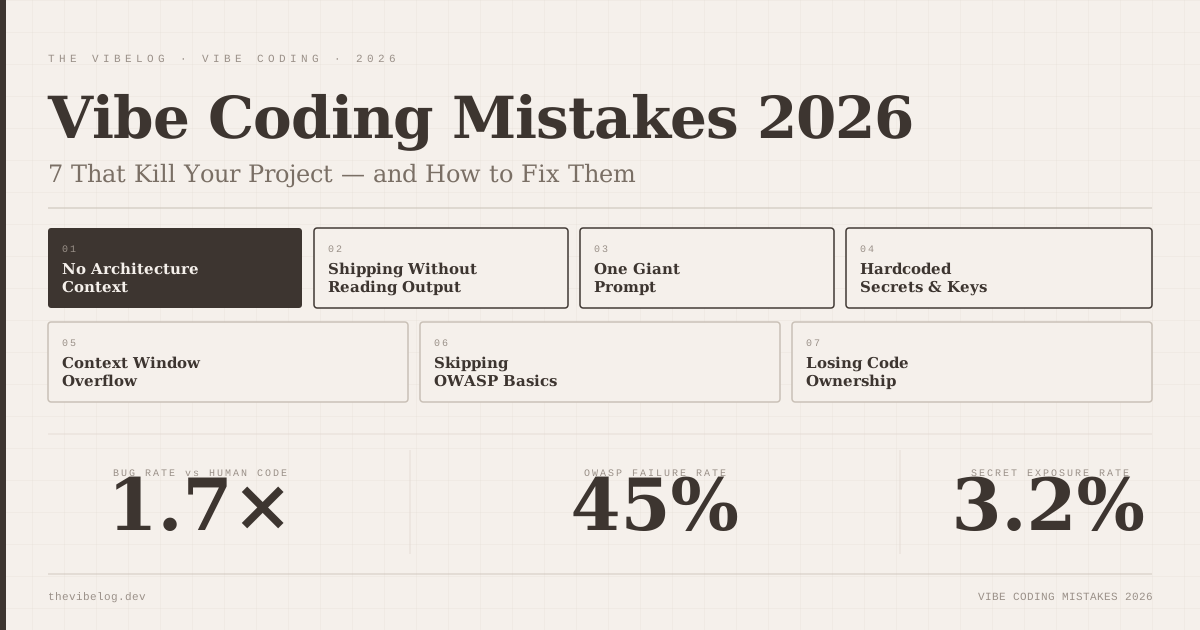
Independent testing found that AI-generated code carries a 1.7 times higher bug rate than human-written code. 45% of AI-generated code fails OWASP Top-10 security checks. Those are not arguments for avoiding AI tools. They are arguments for understanding that the review step in the vibe coding loop is not a formality — it is where the quality lives or dies.
Traditional coding puts the full cognitive load on the developer from the first keystroke. Vibe coding shifts the load to the review stage, and the review stage requires just as much technical knowledge to do well. The time distribution changes; the total expertise required does not.
The Three Types of Vibe Coders in 2026
The vibe coding population splits into three groups with meaningfully different outcomes — and the numbers are specific enough that anyone thinking seriously about this should know them.
Experienced developers are the ones getting the headline productivity numbers. The McKinsey 2026 Developer Productivity Report found that senior developers — ten or more years of experience — reported 81% faster task completion when using AI tools. That result makes sense once you understand the mechanics. AI tools accelerate the translation step, and experienced developers come to that step with precise intent already fully formed. They know exactly what they want the code to do, they can evaluate whether the output matches it, and they catch the subtle errors immediately.
I can confirm this from my own workflow. Tasks that previously took ninety minutes to two hours — writing a webhook handler with proper retry logic, building a data table with server-side sorting and filtering, implementing background job scheduling — now take twenty to forty minutes. The knowledge requirement did not change. The typing did.
Junior developers are the part of the story that productivity advocates skip over. The same McKinsey report found no statistically significant productivity gain for junior developers using AI tools. The structural reason: AI tools make you faster at tasks you could already evaluate and verify. A junior developer reading AI-generated session management code has no reliable basis for judging whether the token rotation is correct, whether there is a timing attack in the verification flow, or whether the logout function actually invalidates the session server-side. The code looks plausible. The happy-path tests pass. The problem surfaces later.
This is a structural property of the tool, not a criticism of junior developers. The expertise required for good review does not materialise faster just because a machine wrote the code.
Non-developers are genuinely new to the picture. In Q1 2026, 235,800 new apps were submitted to app stores — an 84% increase over Q1 2025. A substantial portion of those were built by people who had never written a line of code before, using AI app builders that handle the full stack. The tools made the initial build accessible. What became clear quickly is that maintenance — debugging, scaling, changing something six months later — requires understanding the code, which these builders do not automatically provide. The vibe coding in production analysis covers where that gap shows up and what the failure modes look like.
The Two Vibe Coding Tool Categories
Vibe coding tools split into two distinct categories that serve fundamentally different workflows. The wrong category choice adds friction without improving output.
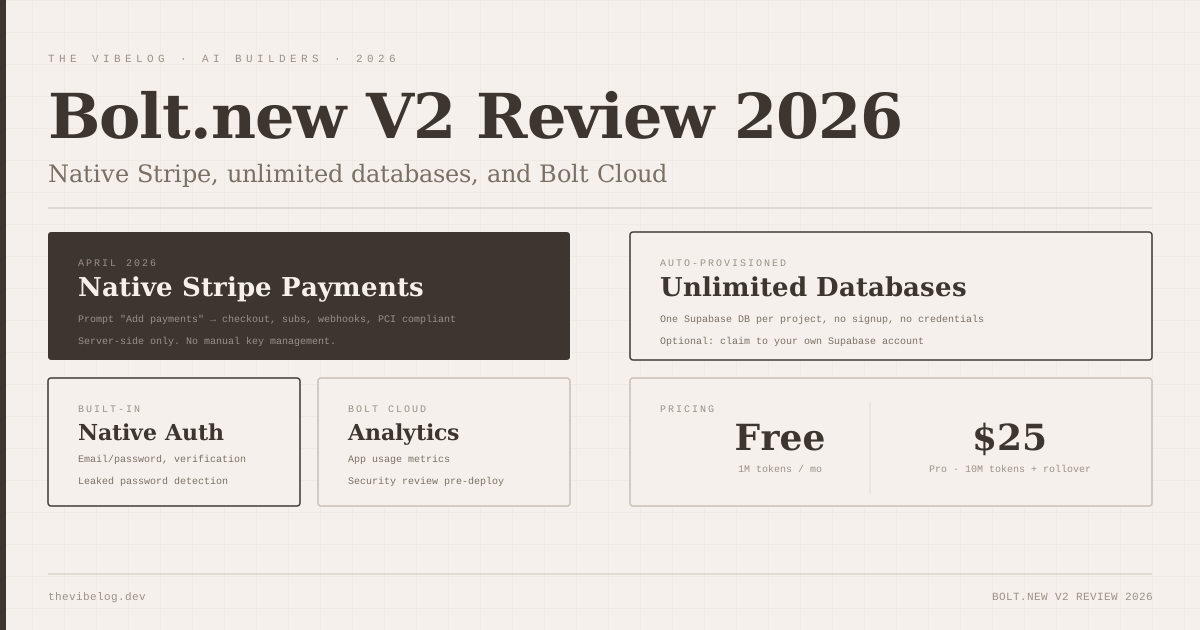
AI app builders — Lovable, Bolt.new, and v0 by Vercel — are designed for producing complete, running applications from natural language descriptions, often without the user needing to read the generated code. Lovable generates a full-stack React application with Supabase auth, database schema, and Stripe payments from a plain-English prompt, with zero configuration required. Bolt.new, built on StackBlitz WebContainers, provides a cloud IDE with a file tree, terminal, live preview, and automatically provisioned databases and authentication. Both ship working apps without requiring a local development environment or external service accounts.
These tools optimise for the fastest path to a first working app. The tradeoff is that the higher the abstraction, the harder it becomes to intervene precisely when something behaves incorrectly. v0 by Vercel sits between the categories — it focuses on UI-first React and Next.js output with one-click Vercel deployment, but requires more manual configuration for auth and payments than Lovable or Bolt.
AI coding assistants — Cursor, Claude Code, GitHub Copilot — are designed for developers who want AI acceleration inside a real development environment while retaining full visibility into every file. Cursor is VS Code with AI built throughout: inline completions, a codebase-aware chat panel, and a multi-file composer mode that can touch twenty files at once. Claude Code operates in the terminal and handles complex refactoring and architectural changes across entire codebases. These tools assume you will read and understand the code they generate.
The detailed mechanics of how Lovable, Bolt.new, and v0 compare on actual full-stack builds — auth, database, Stripe, deployment — are in the Lovable vs Bolt.new vs v0 comparison, which tests all three against the same MVP spec.
The right category comes down to one question: how much do you need to understand the generated code? For a prototype you might throw away, full visibility is optional. For something you will maintain for two years, you need to be able to read and reason about every part of it.
The Real Vibe Coding Productivity Numbers
The market figures for this category are not subtle. The AI coding tools market is valued at $4.7 billion in 2026, growing at 38% annually, with projections reaching $12.3 billion by 2027, according to Second Talent’s market analysis. Vibe coding is now searched more often than “React tutorial” or “Python for beginners.” At 92% daily adoption among US developers, this is not a niche workflow.
The senior developer productivity gains are real and substantial: 81% faster task completion in the McKinsey 2026 data. These are not marginal improvements — they represent a genuine change in how much a skilled developer can deliver in a day.
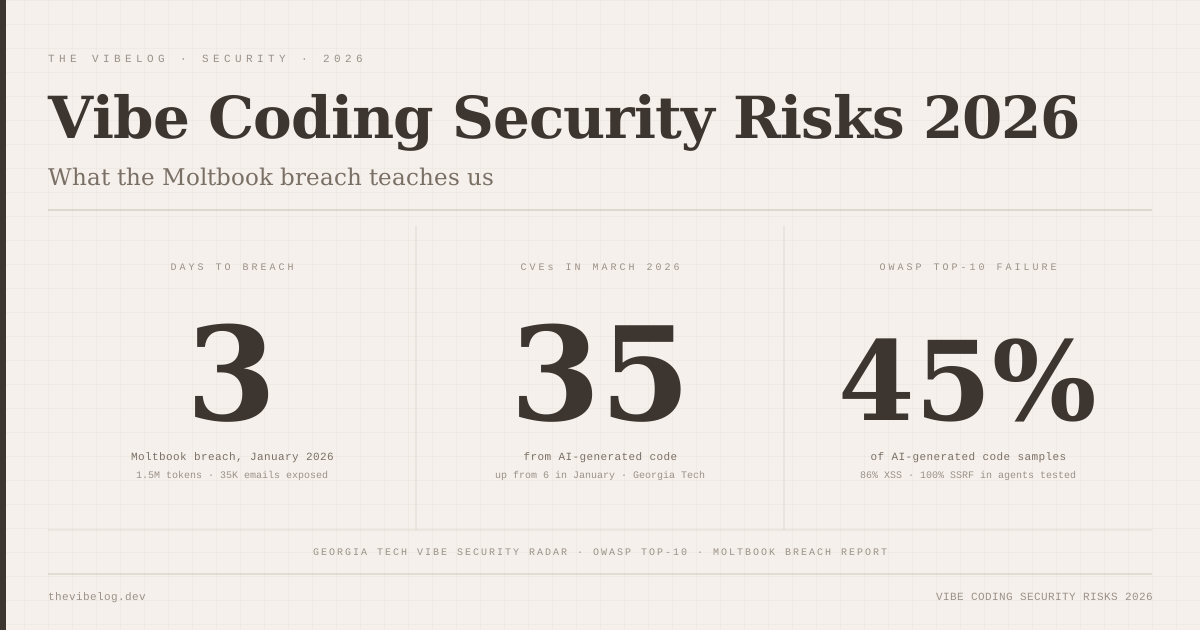
The quality data is equally specific, and it belongs in the same sentence. AI-generated code has a 1.7 times higher bug rate than human-written code. 45% of AI-generated code fails OWASP Top-10 security checks. Junior developers see no measurable productivity gain. And there is the Moltbook case: a vibe-coded social network that launched January 28, 2026 and had its entire production database exposed within three days. The breach leaked 1.5 million API authentication tokens and 35,000 email addresses. The attack was not sophisticated. The authentication implementation was wrong in ways that any security review of the generated code would have surfaced.
The honest framing is that vibe coding creates a specific tradeoff: more output per developer-hour, but output with a higher defect rate that requires active mitigation. Senior developers who review carefully get most of the speed benefit with controlled risk. Developers who treat the AI as infallible get the speed and the defects.
Vibe Coding vs Agentic Coding: Why the Distinction Matters
These terms are frequently used as synonyms. They mean different things, and the difference has practical consequences for how you review output.
Vibe coding is task-level delegation with the developer in the loop at each step. You describe a feature, the AI generates an implementation, you review it, you approve or iterate. The human makes an explicit decision at every delegation point.
Agentic coding is outcome-level delegation. You give an AI agent a goal — “migrate the authentication system to the new library and make sure all tests pass” — and it plans the execution, decides what to read and change and in what order, runs the test suite, interprets failures, and corrects itself. The developer is not consulted between steps. You review the result when the agent reports completion.
The difference is not just conceptual. In vibe coding, you see every generated block before it runs. In agentic coding, the agent made a sequence of intermediate decisions that you did not explicitly approve, and the final diff may not reveal why each decision was made. The review burden is different in character, not just in size.
Claude Code and GitHub Copilot agent mode are the primary agentic tools in 2026. Most developers who describe their workflow as “agentic” are doing vibe coding with longer prompts. True agentic execution — give the AI a ticket, review a completed pull request — requires meaningful trust in your test coverage and review process. The cases where that goes wrong are rarely spectacular; they are subtle architectural decisions made by an agent that seemed reasonable and were not.
How to Start Vibe Coding in 2026
The entry point depends on your background and what you are building.
If you have no programming experience and want to ship a web application: start with Lovable or Bolt.new. Both handle authentication, database, and deployment without requiring any local configuration. Describe the app clearly — be specific about what each page does, what data needs to persist, and what actions users can take. Scope the first project tightly. One feature works better than one sentence that describes an entire product.
If you are a developer wanting AI in an existing workflow: Cursor is the lowest-friction starting point for most people. It is VS Code with AI built throughout. Your existing codebase knowledge carries over immediately, and the transition from autocomplete to chat to multi-file composer happens gradually at your pace.
For either path, the review habit is more important than the tool selection. Before committing any AI-generated code, read it — not for syntax but for logic. Does the authentication flow handle the failure cases? Does the database query do what you think it does at the edges? Does this code give a user more access than it should? These checks take minutes. The complete vibe coding workflow guide for 2026 has a practical checklist for exactly this, including OWASP Top-10 categories to check before any AI-generated feature goes anywhere near production.
The 92% daily adoption figure is the current baseline, not a trend to watch. The question is not whether to use AI coding tools. It is whether the workflow you have built around them produces better output or just faster output — and whether you can tell the difference before it reaches users.