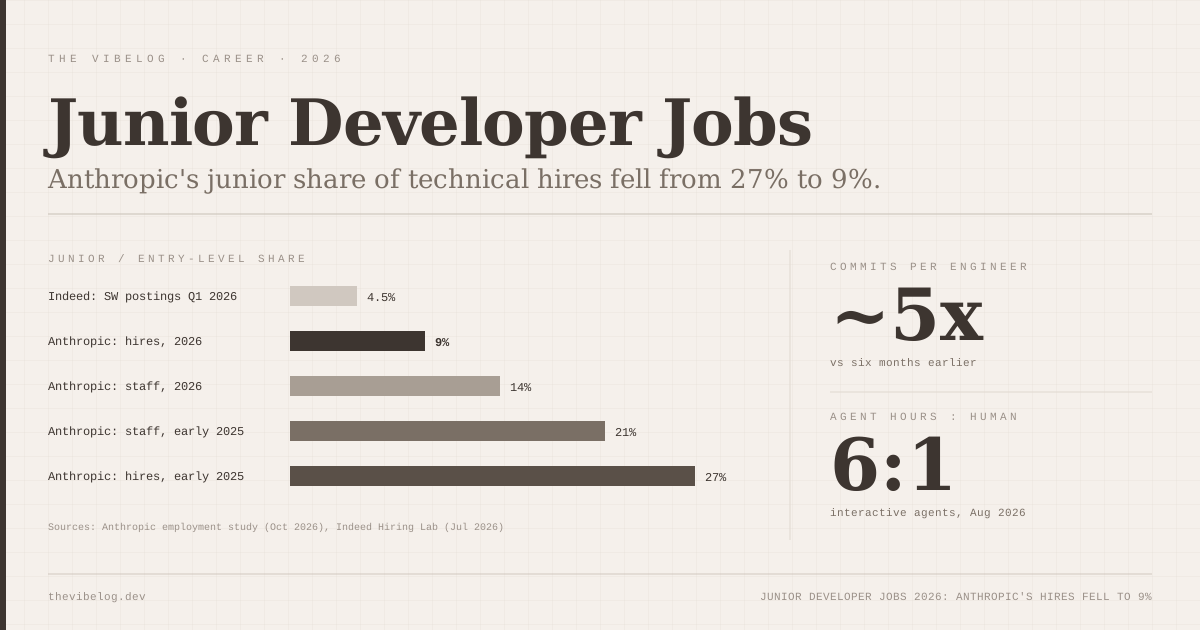
Junior developer jobs now have a data point from inside the company building the agents. Anthropic’s own employment study, published October 16, 2026, shows that junior staff went from 27% of its technical hires to 9% since early 2025, while the company roughly tripled in size.
That is not a survey of hiring managers guessing about the future. It is headcount records, hiring scorecards, calendar data and agent telemetry from the most AI-saturated engineering org on the planet.
I read the full report, the TechCrunch coverage, and the three public datasets that matter most for anyone trying to land a first developer job. The 9% figure is the headline. The more useful findings for a junior developer are further down, in what Anthropic’s interviewers now write on their scorecards.
What Anthropic’s Junior Developer Hiring Data Shows
Anthropic’s report, “How employment is changing at Anthropic,” is written by four economists at the Anthropic Institute: Nathan Wilmers, Regina Catipon, Maxim Massenkoff and Peter McCrory. It combines internal employment records, agent telemetry, Slack and calendar data, hiring scorecards, employee surveys and 17 interviews.
Here are the workforce numbers that matter for junior developers.
| Metric (Anthropic, technical departments) | Early 2025 | Latest |
|---|---|---|
| Junior share of technical employees | 21% | 14% |
| Junior share of technical hires | 27% | 9% |
| Technical departments’ share of all staff | 61% | 56% |
| Engineer-to-product-manager ratio | rising | ~17:1 |
(Source: Anthropic, How employment is changing at Anthropic, Oct 16, 2026)
- Junior share of hires, early 2025 27%
- Junior share of staff, early 2025 21%
- Junior share of staff, 2026 14%
- Junior share of hires, 2026 9%
Source: Anthropic, How employment is changing at Anthropic (Oct 2026)
Two things are true at once here, and the Reddit threads extrapolating to “zero junior hires by 2027” skip the second one.
Technical headcount at Anthropic still grew in absolute terms. Sales, finance and recruiting simply grew faster, which is why the technical share fell from 61% to 56%. Anthropic did not stop hiring engineers. It stopped hiring junior engineers at the old rate. Anthropic itself makes no forecast about future junior hiring.
The report also says junior job postings “fell sharply after December 2025.” That date lines up with the period when coding agents went from a tool engineers tried to the default way work got done inside the company.
Why Anthropic Hires Fewer Juniors: Agents Took the Starter Work
The study does not say “we replaced juniors with Claude.” It shows the conditions that make junior hiring harder to justify, and a few of the numbers are startling.
Commits per engineer are about 5x what they were six months earlier. In March 2026, combined agent work hours exceeded human work hours for the first time. By August 2026, for employee-directed interactive agents alone, agent hours ran about six times human hours.
The work agents absorbed is exactly the work that used to train juniors: well-scoped tickets, test fixes, small features, migrations. When a senior engineer can run several Claude sessions in parallel, the case for a new hire who needs months of ramp-up gets weaker.
This is the part that I think matters most. Figure 5 in the report plots job-level junior headcount growth from January to July 2026 against how complex each job’s Claude usage is. Junior growth slows in the jobs with the most complex Claude usage. The authors flag this as descriptive, not causal, and I agree with them. It still points in one direction.
There is a quality question too. Anthropic says it found no detectable difference in how often agent-written code was later deleted or reverted compared with the same engineer’s hand-written code. That removes the most common argument for keeping juniors around as a hedge against bad AI output, at least inside Anthropic.
The conclusion for this section is uncomfortable: inside a company that fully adopted coding agents, the junior pipeline shrank faster than any other part of engineering.
The Wider Entry-Level Software Developer Job Market in 2026
Anthropic is one unusual company. The authors say so repeatedly, and they warn against generalising from a fast-growing AI lab with heavy stock ownership. So I checked the numbers against three independent datasets.
| Dataset | Finding | Date |
|---|---|---|
| Indeed Hiring Lab | Entry-level roles = 4.5% of US software development postings; senior = 69.3% | Q1 2026 |
| Indeed Hiring Lab | All US entry-level postings −7.5% YoY; senior postings +14.7% | May 2026 |
| Stanford Digital Economy Lab | Ages 22–25 in AI-exposed jobs 19% below trend | Aug 2026 revision |
| US Bureau of Labor Statistics | Software devs, QA, testers +10% projected 2025–35 | 2025–35 |
(Sources: Indeed Hiring Lab, Stanford Digital Economy Lab, BLS Occupational Outlook Handbook)
Indeed’s number is the bleakest. Indeed Hiring Lab’s July 2026 analysis found software development had the lowest entry-level share of any category it tracks, at 4.5%. For comparison, personal care and home health sits at 91.3%. In tech, the senior share of postings grew about 9 points from 2019 to 2025, mostly at the expense of mid-level roles.
Anthropic’s 9% junior hire share is, oddly, double the market’s entry-level posting share. Postings and hires are not the same measure, but the comparison is a useful reality check on the panic.
Stanford’s “Canaries in the Coal Mine” paper explains the mechanism. Erik Brynjolfsson, Bharat Chandar and Ruyu Chen found that employment for 22 to 25 year olds in AI-exposed occupations is 19% below where it would be if it had kept pace with less-exposed peers. Experienced workers show no comparable gap. The gap comes mainly from reduced hiring of young workers, not layoffs.
That matches the Anthropic data almost exactly. Nobody is firing juniors. Companies are just not opening the door.
The BLS projection is the counterweight. The Bureau of Labor Statistics still projects 10% growth for software developers, QA analysts and testers from 2025 to 2035, about 106,100 openings a year, with a May 2025 median of $134,040. I covered the long-run version of this argument in what the 2026 data says about AI replacing developers, and the short version holds: demand for people who can build software is growing, while demand for people who need to be taught to build software is not.
What Anthropic’s Interviewers Now Look For in Junior Developers
This is the section I would print out if I were job hunting.
Anthropic ran an automated coder over interviewer scorecards for thousands of hires since 2024. The changes are specific:
- AI tooling track record: mentions were about 5% of technical scorecards in 2024. By 2026 they had roughly tripled for technical roles and quadrupled for non-technical roles.
- Autonomy and judgment: the largest increase in technical interview comments.
- Domain expertise: shrank as a share of what interviewers assessed.
One hiring manager quoted in the report put it this way: “I expect models to continue to be jagged, so for my team I want them to be fungible across domains.”
Read that carefully. Anthropic is not hiring people who know one framework deeply. It is hiring people who can direct agents across unfamiliar territory and spot when the output is wrong.
That changes what a junior portfolio should look like. A to-do app proves nothing in 2026, because an agent can build it in minutes. A project where you can explain why you rejected an agent’s approach, what broke in production and how you found it, is evidence of the judgment interviewers are now writing down.
My honest take is that this is harder for juniors, not easier. Judgment usually comes from years of making mistakes on small tasks, and agents now do most of the small tasks. The developers who break in will be the ones who deliberately build that judgment on their own projects. Building side projects with AI is fine, as long as you understand the gap between vibe coding and reviewing what the model wrote. The skills that pay once you are in are covered in the AI developer salary breakdown, and the vibe coding salary bands by seniority show where AI-fluent entry roles start.
The Hidden Cost: Meetings, Review Load and Agent Babysitting
The report has a side that the “AI makes everyone 5x faster” crowd will not quote.
Median meeting time per employee rose 20% year over year, and 16% for technical individual contributors, according to calendar data. Anthropic attributes this to trust and accountability, which still require humans talking to humans.
Roughly 80% of interactive Claude session time is idle, waiting for a human to respond. Non-technical staff receive enough Claude output to take more than half a work week to read. One engineer described managing “an army of Claudes, with every one asking for my attention.”
TechCrunch’s coverage picked up another employee’s description of an “eternal pressure at Anthropic to move as fast as possible and use Claude for everything.” In an April 2026 survey, 20% of employees said their work had shifted from doing it to managing Claude instances.
Here is why this matters for junior developers specifically. The bottleneck moved from writing code to reviewing it. The report says people are “bottlenecking the agents.” Review is senior work. A junior who cannot yet tell good code from plausible code adds review load instead of absorbing it.
If you are already in a team that runs agents heavily, this also explains why your senior colleagues seem to have less time to mentor. Their attention is going to agent output, and increasingly to containing it, which is the subject of today’s other post on OpenAI’s rogue AI agent incidents. I wrote about the same pressure from the other side in the post on agentic engineering after vibe coding.
Junior Developer Career Advice for 2026, Based on the Data
I will keep this concrete and tied to what the numbers support.
1. Build a review record, not just a build record. Anthropic’s scorecards reward judgment. Keep a log of agent pull requests you rejected or rewrote and why. That is interview material nobody else has.
2. Get fluent with agent workflows now. Mentions of AI tooling on technical scorecards roughly tripled. The 2026 rundown of Claude Code, Cursor and Codex is a reasonable place to pick one and go deep.
3. Target companies that are hiring, not companies that are famous. Indeed shows the entry-level squeeze is worst in software postings. The BLS still projects 106,100 openings a year across the occupation group. Smaller companies and non-tech industries that need software built are where those openings sit.
4. Learn to be “fungible across domains.” That hiring manager quote is the clearest signal in the report. Pick projects outside your comfort stack on purpose.
5. Do not over-read one company. Anthropic says its practices are “not replicable economy-wide.” It is a single, extremely AI-forward lab. Treat it as a leading indicator, not a forecast.
Junior developer jobs still exist in 2026. There are fewer of them per senior role than at any point in the data, and the bar has moved from “can you code” to “can you judge code you did not write.”
That is a harder entry exam. It is also one you can study for.